Rank #4 of 6 in AI Memory Layers

Install
 vs Mem0
 vs Letta
 vs Supermemory
 vs Cognee
 vs Airweave
Showcase
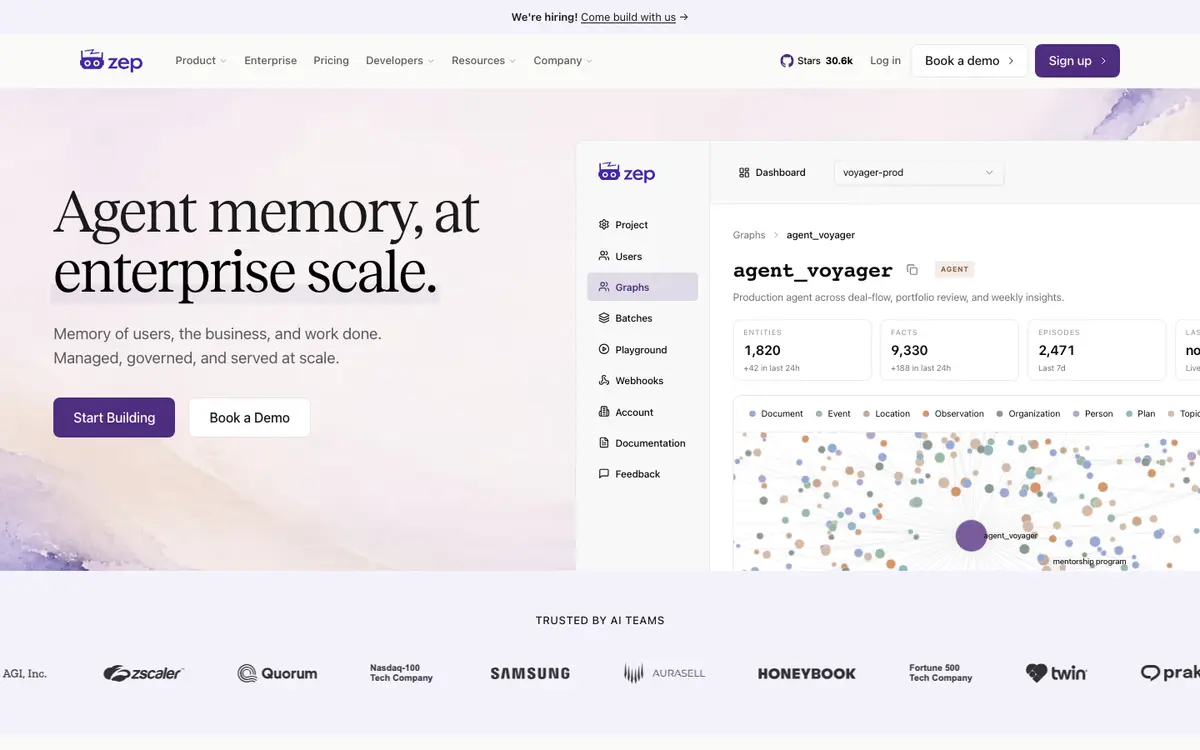
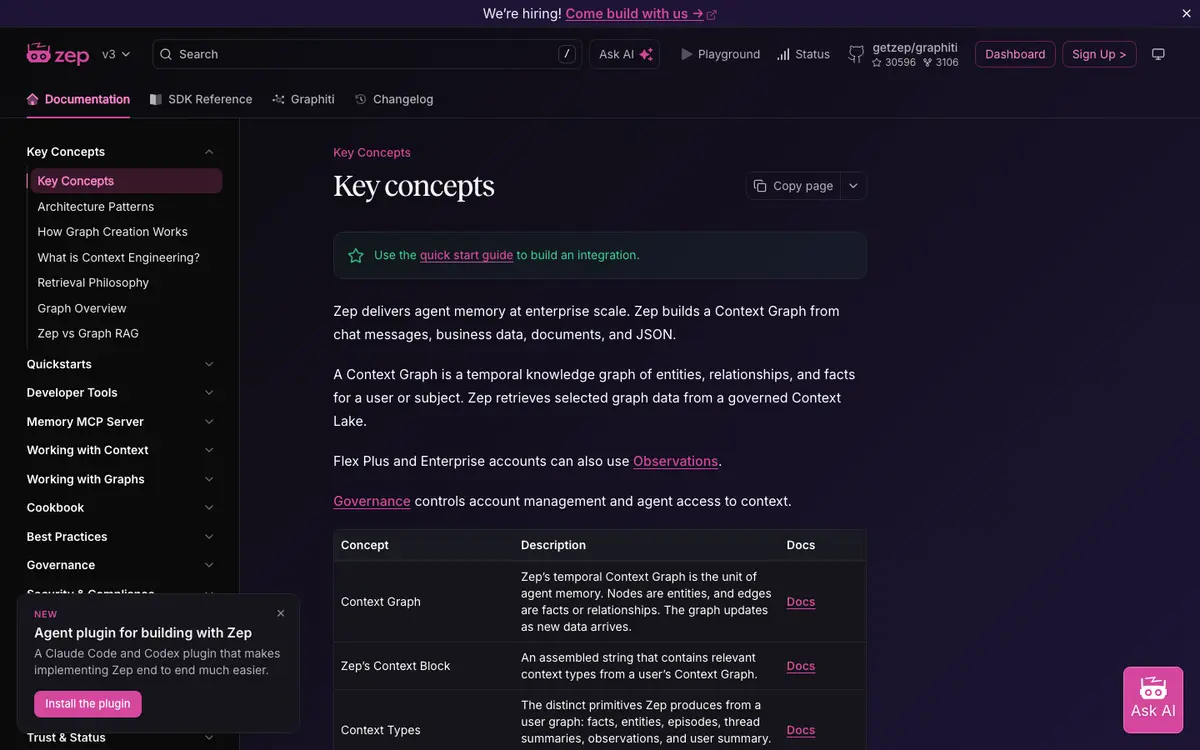
Try itExperimental
See what an agent can do with Zep before you ever sign up. Pick a story: recorded sessions replay real probe-harness transcripts; sandboxed self-drive sessions are designed and gated (docs/TRY-IT.md).
$curl -si -X POST https://help.getzep.com/_mcp/server -H 'Content-Type: application/json' -d '<jsonrpc initialize>'recorded session — replayed, not liveVerified integrations
Connections to other tracked products — hover a chip for the verbatim evidence quote behind it.




By theme — the product's score on each story themeBy theme
Agenticness — how well agents can access and operate the productAgenticnessevidence →
How well agents can access and operate the product
Automation depth — how much of the product can run unattendedAutomation depthevidence →
How much of the product can run unattended
Data lifecycle — stories about data lifecycle in this arenaData lifecycleevidence →
Stories about data lifecycle in this arena
Deployment self host — stories about deployment self host in this arenaDeployment self hostevidence →
Stories about deployment self host in this arena
Graph entity memory — stories about graph entity memory in this arenaGraph entity memoryevidence →
Stories about graph entity memory in this arena
Memory recall quality — stories about memory recall quality in this arenaMemory recall qualityevidence →
Stories about memory recall quality in this arena
Openness — open source, data portability, and self-hosting storiesOpennessevidence →
Open source, data portability, and self-hosting stories
Pricing plans — plan structure and value — what each tier costs and what it unlocksPricing plansevidence →
Plan structure and value — what each tier costs and what it unlocks
Privacy posture — data-handling and privacy storiesPrivacy postureevidence →
Data-handling and privacy stories
Retrieval performance — stories about retrieval performance in this arenaRetrieval performanceevidence →
Stories about retrieval performance in this arena
Sdk integrations — stories about sdk integrations in this arenaSdk integrationsevidence →
Stories about sdk integrations in this arena
Session context — stories about session context in this arenaSession contextevidence →
Stories about session context in this arena
Tenancy permissions — stories about tenancy permissions in this arenaTenancy permissionsevidence →
Stories about tenancy permissions in this arena
Story verdicts — every judged story with its evidenceStory verdicts
Follow the green: where the map greys out is where Zep stops today. ✓ full · ~ partial · ! disputed · — none · n/a not applicable.
Agenticness — how well agents can access and operate the productAgenticness
How well agents can access and operate the product
API surface
Drive the product through a documented public API
✓9/10
unlocks → Webhooks · Machine-readable spec · Versioning policy · API sandbox · Wire memory into real-time voice pipelines (e.g. LiveKit, Pipecat, ElevenLabs) with documented integrations fast enough for live conversation
Subscribe to events via webhooks
—–
Build against official SDKs
~6/10
Issue scoped/least-privilege API credentials for an agent
✓8/10
unlocks → Autonomous automations
Connect an agent via an official MCP server
✓9/10
Download a machine-readable API spec (OpenAPI or equivalent)
—–
Rely on versioned APIs with a documented deprecation policy
—–
Test against a sandbox environment without touching production data
—–
Explore an interactive API reference with runnable examples
—–
Docs for agents
Point an agent at llms.txt or agent-oriented docs
✓9/10
Agentic features
Delegate tasks to a built-in AI assistant inside the product
—–
Operate the product with natural-language commands
~5/10
unlocks → Autonomous automations
Plug MCP servers into this product so it can use their tools
n/an/a
Get AI-generated insights and suggestions from my data inside the product
~5/10
Set up automations that run autonomously in the background
—–
Automation depth — how much of the product can run unattendedAutomation depth
How much of the product can run unattended
Data lifecycle — stories about data lifecycle in this arenaData lifecycle
Stories about data lifecycle in this arena
Deployment self host — stories about deployment self host in this arenaDeployment self host
Stories about deployment self host in this arena
Graph entity memory — stories about graph entity memory in this arenaGraph entity memory
Stories about graph entity memory in this arena
Memory recall quality — stories about memory recall quality in this arenaMemory recall quality
Stories about memory recall quality in this arena
Openness — open source, data portability, and self-hosting storiesOpenness
Open source, data portability, and self-hosting stories
Pricing plans — plan structure and value — what each tier costs and what it unlocksPricing plans
Plan structure and value — what each tier costs and what it unlocks
Privacy posture — data-handling and privacy storiesPrivacy posture
Data-handling and privacy stories
Retrieval performance — stories about retrieval performance in this arenaRetrieval performance
Stories about retrieval performance in this arena
Sdk integrations — stories about sdk integrations in this arenaSdk integrations
Stories about sdk integrations in this arena
Session context — stories about session context in this arenaSession context
Stories about session context in this arena
Context assembly
Tenancy permissions — stories about tenancy permissions in this arenaTenancy permissions
Stories about tenancy permissions in this arena
Govern who and what can read or write memory with roles, policies, or access-control lists, and audit that access
~6/10
Scope memories per user, agent, or application so one tenant's memories never leak into another's retrieval
✓7/10
Share selected memory across multiple agents or users (team or group memory) while keeping private memory private
~5/10
Sorted by importance (agentic first) (high → low) · 57/57 stories · click a row’s chevron for the rationale and evidence
Connect an agent via an official MCP server G Agent access | ai-native user | Agenticness — how well agents can access and operate the productAgenticness | 3 | full | 9/10 | Tprobed⚿ | |
Drive the product through a documented public API G Agent access | ai-native user | Agenticness — how well agents can access and operate the productAgenticness | 3 | full | 9/10 | Tprobed⚿ | |
Plug MCP servers into this product so it can use their tools G Agent access | ai-native user | Agenticness — how well agents can access and operate the productAgenticness | 3 | n/a | 0/10 | ⚿ | |
Delegate tasks to a built-in AI assistant inside the product G Agentic features | ai-native user | Agenticness — how well agents can access and operate the productAgenticness | 3 | none | untested | none yet | |
Point an agent at llms.txt or agent-oriented docs G Agent access | ai-native user | Agenticness — how well agents can access and operate the productAgenticness | 2 | full | 9/10 | Tprobed | |
Issue scoped/least-privilege API credentials for an agent G Agent access | ai-native user | Agenticness — how well agents can access and operate the productAgenticness | 2 | full | 8/10 | Tprobed⚿ | |
Use an official CLI G Agent access | ai-native user | Agenticness — how well agents can access and operate the productAgenticness | 2 | full | 8/10 | Tprobed | |
Build against official SDKs G Agent access | ai-native user | Agenticness — how well agents can access and operate the productAgenticness | 2 | partial | 6/10 | Tprobed | |
Run the product headlessly / in CI for automation G Agent access | ai-native user | Agenticness — how well agents can access and operate the productAgenticness | 2 | partial | 6/10 | Tprobed | |
Get AI-generated insights and suggestions from my data inside the product G Agentic features | ai-native user | Agenticness — how well agents can access and operate the productAgenticness | 2 | partial | 5/10 | Cclaimed | |
Operate the product with natural-language commands G Agentic features | ai-native user | Agenticness — how well agents can access and operate the productAgenticness | 2 | partial | 5/10 | Tprobed⚿ | |
Download a machine-readable API spec (OpenAPI or equivalent) G Api quality | ai-native user | Agenticness — how well agents can access and operate the productAgenticness | 2 | none | untested | none yet | |
Explore an interactive API reference with runnable examples G Api quality | ai-native user | Agenticness — how well agents can access and operate the productAgenticness | 2 | none | untested | none yet | |
Rely on versioned APIs with a documented deprecation policy G Api quality | ai-native user | Agenticness — how well agents can access and operate the productAgenticness | 2 | none | untested | none yet | |
Set up automations that run autonomously in the background G Agentic features | ai-native user | Agenticness — how well agents can access and operate the productAgenticness | 2 | none | untested | none yet | |
Subscribe to events via webhooks G Agent access | ai-native user | Agenticness — how well agents can access and operate the productAgenticness | 2 | none | untested | none yet | |
Test against a sandbox environment without touching production data G Api quality | ai-native user | Agenticness — how well agents can access and operate the productAgenticness | 1 | none | untested | none yet | |
Add memories from conversations and retrieve them later with semantic search, so context persists across sessions C Core memory | developer | Memory recall quality — stories about memory recall quality in this arenaMemory recall quality | 3 | full | 9/10 | Tprobed⚿ | |
Get summaries of past sessions or threads so an agent can pick up where the last conversation left off C Context assembly | developer | Session context — stories about session context in this arenaSession context | 3 | full | 9/10 | Cclaimed | |
Store memories as a knowledge graph of entities and relationships so multi-hop and entity-centric questions are answerable C Knowledge graph | ml-engineer | Graph entity memory — stories about graph entity memory in this arenaGraph entity memory | 3 | full | 9/10 | Tprobed | |
My agent can manage its own memory mid-conversation — adding, searching, updating, and deleting memories through tools or API calls it invokes itself C Agent memory | ai-native user | Memory recall quality — stories about memory recall quality in this arenaMemory recall quality | 3 | partial | 7/10 | Tprobed⚿ | |
Scope memories per user, agent, or application so one tenant's memories never leak into another's retrieval C Isolation | developer | Tenancy permissions — stories about tenancy permissions in this arenaTenancy permissions | 3 | full | 7/10 | Cclaimed | |
Self-host the core product G | ai-native user | Openness — open source, data portability, and self-hosting storiesOpenness | 3 | partial | 5/10 | Tprobed | |
Export all of my data in open formats and leave G | ai-native user | Openness — open source, data portability, and self-hosting storiesOpenness | 3 | partial | 4/10 | Tprobed | |
Self-host the memory layer from open-source code (e.g. via Docker) on infrastructure I control C Self host | platform-engineer | Deployment self host — stories about deployment self host in this arenaDeployment self host | 3 | partial | 4/10 | Tprobed | |
Define rules that trigger actions automatically on events G | ai-native user | Automation depth — how much of the product can run unattendedAutomation depth | 3 | none | untested | none yet | |
Prevent my data from being used to train AI models G | ai-native user | Privacy posture — data-handling and privacy storiesPrivacy posture | 3 | none | untested | none yet | |
Connect off-the-shelf assistants (Claude, ChatGPT, Cursor) to the same memory so every tool I use shares what it knows about me C Agent memory | ai-native user | Sdk integrations — stories about sdk integrations in this arenaSdk integrations | 2 | full | 9/10 | Tprobed⚿ | |
Delete a user's memories on demand — single memory, per-entity, or full erasure — to satisfy privacy requirements C Forgetting | platform-engineer | Data lifecycle — stories about data lifecycle in this arenaData lifecycle | 2 | full | 9/10 | Cclaimed | |
Control data retention and deletion G | ai-native user | Privacy posture — data-handling and privacy storiesPrivacy posture | 2 | full | 8/10 | Cclaimed | |
Ingest documents, JSON, and business data into memory — not just chat transcripts C Ingestion | developer | Session context — stories about session context in this arenaSession context | 2 | full | 8/10 | Cclaimed | |
Rely on the memory layer to update, supersede, or merge memories when new information contradicts what was stored C Core memory | developer | Memory recall quality — stories about memory recall quality in this arenaMemory recall quality | 2 | full | 8/10 | Xcommunity | |
Retrieve a token-budgeted, prompt-ready context block assembled from relevant memories in one call C Context assembly | developer | Session context — stories about session context in this arenaSession context | 2 | full | 8/10 | Xcommunity | |
The memory layer decides for itself what is worth remembering — extracting salient facts from raw conversation and consolidating them in the background C Agent memory | ai-native user | Memory recall quality — stories about memory recall quality in this arenaMemory recall quality | 2 | full | 8/10 | Xcommunity | |
Track when facts became valid or invalid (temporal reasoning) so the memory distinguishes current from outdated information C Knowledge graph | ml-engineer | Graph entity memory — stories about graph entity memory in this arenaGraph entity memory | 2 | full | 8/10 | Tprobed | |
Do everything through the API that I can do in the UI G | ai-native user | Openness — open source, data portability, and self-hosting storiesOpenness | 2 | partial | 7/10 | Cclaimed | |
Drop the memory layer into agent frameworks like LangChain, LangGraph, CrewAI, or the Vercel AI SDK via documented first-party integrations C Frameworks | developer | Sdk integrations — stories about sdk integrations in this arenaSdk integrations | 2 | partial | 6/10 | Cclaimed | |
Govern who and what can read or write memory with roles, policies, or access-control lists, and audit that access C Governance | platform-engineer | Tenancy permissions — stories about tenancy permissions in this arenaTenancy permissions | 2 | partial | 6/10 | Cclaimed | |
Steer retrieval with metadata filters, keyword/hybrid search modes, or reranking instead of accepting a single fixed similarity search C Retrieval controls | developer | Memory recall quality — stories about memory recall quality in this arenaMemory recall quality | 2 | partial | 6/10 | Cclaimed | |
Choose where my data is stored (region/residency) G | ai-native user | Privacy posture — data-handling and privacy storiesPrivacy posture | 2 | partial | 5/10 | Cclaimed | |
Read the product's source under an open license G | ai-native user | Openness — open source, data portability, and self-hosting storiesOpenness | 2 | partial | 5/10 | Tprobed | |
See documented retrieval-latency targets or measured numbers (e.g. p50/p95) backing the product's speed claims C Latency | platform-engineer | Retrieval performance — stories about retrieval performance in this arenaRetrieval performance | 2 | partial | 5/10 | Cclaimed | |
Export memories in a machine-readable format so the memory store is portable and not a lock-in trap C Portability | platform-engineer | Data lifecycle — stories about data lifecycle in this arenaData lifecycle | 2 | partial | 4/10 | Tprobed | |
Make memories expire or decay — via TTL, expiration dates, or recency weighting — so stale facts stop surfacing C Forgetting | developer | Data lifecycle — stories about data lifecycle in this arenaData lifecycle | 2 | partial | 4/10 | Cclaimed | |
Perform bulk operations across many items at once G | ai-native user | Automation depth — how much of the product can run unattendedAutomation depth | 2 | partial | 4/10 | Cclaimed | |
Build against official SDKs in at least Python and TypeScript with equivalent memory APIs C Sdks | developer | Sdk integrations — stories about sdk integrations in this arenaSdk integrations | 2 | partial | 3/10 | Cclaimed | |
See published memory-quality benchmark results (e.g. LongMemEval, LoCoMo) backing the product's recall-accuracy claims C Benchmarks | ml-engineer | Memory recall quality — stories about memory recall quality in this arenaMemory recall quality | 2 | none | 0/10 | ||
See published pricing with a free tier and per-unit rates so I can project memory costs before committing G Pricing | platform-engineer | Pricing plans — plan structure and value — what each tier costs and what it unlocksPricing plans | 2 | none | 0/10 | ||
Ingest at scale with async or batch processing and check the status of background memory operations C Scale | platform-engineer | Retrieval performance — stories about retrieval performance in this arenaRetrieval performance | 2 | none | untested | none yet | |
Opt out of telemetry and usage tracking G | ai-native user | Privacy posture — data-handling and privacy storiesPrivacy posture | 2 | none | untested | none yet | |
Schedule recurring jobs or workflows G | ai-native user | Automation depth — how much of the product can run unattendedAutomation depth | 2 | n/a | untested | none yet | |
Customize the memory schema — entity types, edge types, or ontology — to match my domain C Schema customization | ml-engineer | Graph entity memory — stories about graph entity memory in this arenaGraph entity memory | 1 | full | 8/10 | Cclaimed | |
Run the memory layer fully locally — embedded in-process or against local models — without any cloud dependency C Self host | developer | Deployment self host — stories about deployment self host in this arenaDeployment self host | 1 | partial | 5/10 | Tprobed | |
Share selected memory across multiple agents or users (team or group memory) while keeping private memory private C Sharing | developer | Tenancy permissions — stories about tenancy permissions in this arenaTenancy permissions | 1 | partial | 5/10 | Cclaimed | |
Store images, PDFs, or other files as memory inputs and recall information from them later C Ingestion | developer | Session context — stories about session context in this arenaSession context | 1 | none | 0/10 | ||
Version, review, and roll back my automations G | ai-native user | Automation depth — how much of the product can run unattendedAutomation depth | 1 | n/a | untested | none yet | |
Wire memory into real-time voice pipelines (e.g. LiveKit, Pipecat, ElevenLabs) with documented integrations fast enough for live conversation C Frameworks | developer | Sdk integrations — stories about sdk integrations in this arenaSdk integrations | 1 | none | untested | none yet |
Opportunities — the stories that would move this product's scores, from its own judged verdictsOpportunitiestop 8 of 36 stories with headroom
What would move Zep’s scores — derived from its own judged verdicts, biggest headroom first. Each line quotes what the judge found missing; shipping it (or evidencing it publicly) is the fix.
Agenticness — how well agents can access and operate the productDelegate tasks to a built-in AI assistant inside the product
nonemoves Built-in AIimpact 45
The axis applies to this product kind (peer products hold positive or none verdicts on this story), so lack of evidence for an applicable capability is "none", never "na".
Automation depth — how much of the product can run unattendedDefine rules that trigger actions automatically on events
nonemoves PA Scoreimpact 30
Zep is a memory/context-graph layer with search, retrieval, MCP access, and governance policies, but no evidence describes a rules engine or event-trigger mechanism that automatically fires actions on defined conditions/events.
Privacy posture — data-handling and privacy storiesPrevent my data from being used to train AI models
nonemoves PA Scoreimpact 30
The evidence pack covers RTBF/deletion, access control, and MCP/CLI tooling, but contains no statement about Zep's or its LLM providers' use of customer data for model training, nor any opt-out/no-training guarantee.
Agenticness — how well agents can access and operate the productSet up automations that run autonomously in the background
nonemoves Built-in AIimpact 30
The axis applies to this product kind (peer products hold positive or none verdicts on this story), so lack of evidence for an applicable capability is "none", never "na".
Agenticness — how well agents can access and operate the productSubscribe to events via webhooks
nonemoves agent-readyimpact 30
No evidence in the pack mentions webhooks or event subscription mechanisms; Zep's docs cover MCP servers, CLI, SDKs, and API access but nothing about outbound event notifications or webhook subscriptions.
Agenticness — how well agents can access and operate the productExplore an interactive API reference with runnable examples
nonemoves API qualityimpact 30
Zep's docs pages show static code snippets (e.g., zep-docs-21, zep-docs-29) but there is no evidence of an interactive, runnable API reference (e.g., embedded sandbox, 'try it' console, Postman/Swagger integration) anywhere in the evidence pack.
Agenticness — how well agents can access and operate the productDownload a machine-readable API spec (OpenAPI or equivalent)
nonemoves API qualityimpact 30
Zep is an API-first service with SDKs, a CLI (zepctl), and MCP servers, so a downloadable OpenAPI spec would be a natural artifact — but no evidence pack item mentions an OpenAPI/Swagger spec, API reference export, or machine-readable schema file being available for download.
Agenticness — how well agents can access and operate the productRely on versioned APIs with a documented deprecation policy
nonemoves API qualityimpact 30
The evidence pack covers Zep's features (memory, graph, MCP, CLI) but contains no mention of API versioning scheme or a documented deprecation policy for breaking changes.
Showing the top 8 of 36 — every none/partial verdict in the story verdicts table is headroom.
Think a verdict is wrong? Every verdicts-table row has a Flag link — see the methodology.
Coverage map — which docs area, API section, or community source covers which judged storiesCoverage map19 surfaces · 39 covered stories
Where the cited evidence behind each covered verdict came from — the same citations the verdicts table shows, no extra judging.
Deleting data from the graph docs13 stories
- Run the product headlessly / in CI for automation
- Drive the product through a documented public API
- Build against official SDKs
- Delete a user's memories on demand — single memory, per-entity, or full erasure — to satisfy privacy requirements
- Make memories expire or decay — via TTL, expiration dates, or recency weighting — so stale facts stop surfacing
- Export memories in a machine-readable format so the memory store is portable and not a lock-in trap
- Store memories as a knowledge graph of entities and relationships so multi-hop and entity-centric questions are answerable
- My agent can manage its own memory mid-conversation — adding, searching, updating, and deleting memories through tools or API calls it invokes itself
- Rely on the memory layer to update, supersede, or merge memories when new information contradicts what was stored
- Do everything through the API that I can do in the UI
- Export all of my data in open formats and leave
- Control data retention and deletion
- Build against official SDKs in at least Python and TypeScript with equivalent memory APIs
Threads docs12 stories
- Run the product headlessly / in CI for automation
- Drive the product through a documented public API
- Build against official SDKs
- My agent can manage its own memory mid-conversation — adding, searching, updating, and deleting memories through tools or API calls it invokes itself
- The memory layer decides for itself what is worth remembering — extracting salient facts from raw conversation and consolidating them in the background
- Add memories from conversations and retrieve them later with semantic search, so context persists across sessions
- Do everything through the API that I can do in the UI
- Build against official SDKs in at least Python and TypeScript with equivalent memory APIs
- Get summaries of past sessions or threads so an agent can pick up where the last conversation left off
- Ingest documents, JSON, and business data into memory — not just chat transcripts
- Scope memories per user, agent, or application so one tenant's memories never leak into another's retrieval
- Share selected memory across multiple agents or users (team or group memory) while keeping private memory private
GitHub README11 stories
- Make memories expire or decay — via TTL, expiration dates, or recency weighting — so stale facts stop surfacing
- Run the memory layer fully locally — embedded in-process or against local models — without any cloud dependency
- Self-host the memory layer from open-source code (e.g. via Docker) on infrastructure I control
- Store memories as a knowledge graph of entities and relationships so multi-hop and entity-centric questions are answerable
- Track when facts became valid or invalid (temporal reasoning) so the memory distinguishes current from outdated information
- Customize the memory schema — entity types, edge types, or ontology — to match my domain
- The memory layer decides for itself what is worth remembering — extracting salient facts from raw conversation and consolidating them in the background
- Rely on the memory layer to update, supersede, or merge memories when new information contradicts what was stored
- Read the product's source under an open license
- Self-host the core product
- Ingest documents, JSON, and business data into memory — not just chat transcripts
Graphiti docs10 stories
- Build against official SDKs
- Export memories in a machine-readable format so the memory store is portable and not a lock-in trap
- Run the memory layer fully locally — embedded in-process or against local models — without any cloud dependency
- Self-host the memory layer from open-source code (e.g. via Docker) on infrastructure I control
- Store memories as a knowledge graph of entities and relationships so multi-hop and entity-centric questions are answerable
- Track when facts became valid or invalid (temporal reasoning) so the memory distinguishes current from outdated information
- Export all of my data in open formats and leave
- Read the product's source under an open license
- Self-host the core product
- Choose where my data is stored (region/residency)
Zepctl CLI docs10 stories
- Run the product headlessly / in CI for automation
- Use an official CLI
- Drive the product through a documented public API
- Operate the product with natural-language commands
- Perform bulk operations across many items at once
- Export memories in a machine-readable format so the memory store is portable and not a lock-in trap
- Do everything through the API that I can do in the UI
- Export all of my data in open formats and leave
- Self-host the core product
- Control data retention and deletion
Searching the graph docs9 stories
- Get AI-generated insights and suggestions from my data inside the product
- Make memories expire or decay — via TTL, expiration dates, or recency weighting — so stale facts stop surfacing
- Store memories as a knowledge graph of entities and relationships so multi-hop and entity-centric questions are answerable
- My agent can manage its own memory mid-conversation — adding, searching, updating, and deleting memories through tools or API calls it invokes itself
- Add memories from conversations and retrieve them later with semantic search, so context persists across sessions
- Rely on the memory layer to update, supersede, or merge memories when new information contradicts what was stored
- Steer retrieval with metadata filters, keyword/hybrid search modes, or reranking instead of accepting a single fixed similarity search
- Retrieve a token-budgeted, prompt-ready context block assembled from relevant memories in one call
- Get summaries of past sessions or threads so an agent can pick up where the last conversation left off
Memory MCP server docs8 stories
- Point an agent at llms.txt or agent-oriented docs
- Connect an agent via an official MCP server
- Drive the product through a documented public API
- Issue scoped/least-privilege API credentials for an agent
- Operate the product with natural-language commands
- My agent can manage its own memory mid-conversation — adding, searching, updating, and deleting memories through tools or API calls it invokes itself
- Add memories from conversations and retrieve them later with semantic search, so context persists across sessions
- Connect off-the-shelf assistants (Claude, ChatGPT, Cursor) to the same memory so every tool I use shares what it knows about me
Quick start guide docs8 stories
- Drive the product through a documented public API
- Build against official SDKs
- Add memories from conversations and retrieve them later with semantic search, so context persists across sessions
- See documented retrieval-latency targets or measured numbers (e.g. p50/p95) backing the product's speed claims
- Drop the memory layer into agent frameworks like LangChain, LangGraph, CrewAI, or the Vercel AI SDK via documented first-party integrations
- Retrieve a token-budgeted, prompt-ready context block assembled from relevant memories in one call
- Scope memories per user, agent, or application so one tenant's memories never leak into another's retrieval
- Share selected memory across multiple agents or users (team or group memory) while keeping private memory private
Governance docs7 stories
- Connect an agent via an official MCP server
- Issue scoped/least-privilege API credentials for an agent
- Do everything through the API that I can do in the UI
- Connect off-the-shelf assistants (Claude, ChatGPT, Cursor) to the same memory so every tool I use shares what it knows about me
- Govern who and what can read or write memory with roles, policies, or access-control lists, and audit that access
- Scope memories per user, agent, or application so one tenant's memories never leak into another's retrieval
- Share selected memory across multiple agents or users (team or group memory) while keeping private memory private
Performance docs7 stories
- Drive the product through a documented public API
- Build against official SDKs
- Add memories from conversations and retrieve them later with semantic search, so context persists across sessions
- See documented retrieval-latency targets or measured numbers (e.g. p50/p95) backing the product's speed claims
- Build against official SDKs in at least Python and TypeScript with equivalent memory APIs
- Retrieve a token-budgeted, prompt-ready context block assembled from relevant memories in one call
- Get summaries of past sessions or threads so an agent can pick up where the last conversation left off
Hacker News5 stories
- Track when facts became valid or invalid (temporal reasoning) so the memory distinguishes current from outdated information
- The memory layer decides for itself what is worth remembering — extracting salient facts from raw conversation and consolidating them in the background
- Add memories from conversations and retrieve them later with semantic search, so context persists across sessions
- Rely on the memory layer to update, supersede, or merge memories when new information contradicts what was stored
- Retrieve a token-budgeted, prompt-ready context block assembled from relevant memories in one call
Concepts docs5 stories
- Get AI-generated insights and suggestions from my data inside the product
- Export memories in a machine-readable format so the memory store is portable and not a lock-in trap
- Store memories as a knowledge graph of entities and relationships so multi-hop and entity-centric questions are answerable
- Customize the memory schema — entity types, edge types, or ontology — to match my domain
- Ingest documents, JSON, and business data into memory — not just chat transcripts
Pricing docs5 stories
- Run the memory layer fully locally — embedded in-process or against local models — without any cloud dependency
- Self-host the memory layer from open-source code (e.g. via Docker) on infrastructure I control
- Read the product's source under an open license
- Self-host the core product
- Choose where my data is stored (region/residency)
Users and user graphs docs5 stories
- Perform bulk operations across many items at once
- Delete a user's memories on demand — single memory, per-entity, or full erasure — to satisfy privacy requirements
- Export all of my data in open formats and leave
- Control data retention and deletion
- Scope memories per user, agent, or application so one tenant's memories never leak into another's retrieval
help.getzep.com4 stories
- Get AI-generated insights and suggestions from my data inside the product
- Store memories as a knowledge graph of entities and relationships so multi-hop and entity-centric questions are answerable
- The memory layer decides for itself what is worth remembering — extracting salient facts from raw conversation and consolidating them in the background
- Ingest documents, JSON, and business data into memory — not just chat transcripts
Thread summaries docs3 stories
- Get AI-generated insights and suggestions from my data inside the product
- The memory layer decides for itself what is worth remembering — extracting salient facts from raw conversation and consolidating them in the background
- Get summaries of past sessions or threads so an agent can pick up where the last conversation left off
Probe proofs — replayable recordings from the probe harnessProbe proofs
Replayable recordings from our probe harness — see the Prove-It protocol to submit one.
$curl -si -X POST https://help.getzep.com/_mcp/server -H 'Content-Type: application/json' -d '<jsonrpc initialize>'reproduced$ curl -si -X POST https://help.getzep.com/_mcp/server -H 'Content-Type: application/json' -d '<jsonrpc initialize>'
HTTP/2 200
date: Sat, 05 Sep 2026 00:46:50 GMT
content-type: text/event-stream
cache-control: no-cache
content-security-policy: default-src 'self'; script-src 'self' 'unsafe-inline' 'unsafe-eval' https://app.buildwithfern.com https: blob:; style-src 'self' 'unsafe-inline' https://app.buildwithfern.com https:; img-src 'self' https://app.buildwithfern.com https: data: blob:; font-src 'self' https://app.buildwithfern.com https: data:; connect-src 'self' https://app.buildwithfern.com https: wss: ws: data: blob:; media-src 'self' https://app.buildwithfern.com https: data: blob:; object-src 'self' https://app.buildwithfern.com https: data: blob:; frame-src 'self' https://app.buildwithfern.com https: data: blob:; base-uri 'self'; form-action 'self' https://app.buildwithfern.com https:
permissions-policy: camera=(self), microphone=(self), geolocation=()
referrer-policy: strict-origin-when-cross-origin
server: cloudflare
strict-transport-security: max-age=2592000
x-content-type-options: nosniff
x-matched-path: /[domain]/api/fern-docs/mcp
x-vercel-cache: MISS
x-vercel-id: sfo1::iad1::fn5ww-1788569209940-58118193d5ad
cf-cache-status: DYNAMIC
cf-ray: a3613819fd87d438-SJC
event: message
data: {"result":{"protocolVersion":"2025-06-18","capabilities":{"tools":{"listChanged":true}},"serverInfo":{"name":"fern-docs-mcp-server","version":"1.0.0"}},"jsonrpc":"2.0","id":1}
$curl -si -X POST https://api.getzep.com/mcp -H 'Content-Type: application/json' -d '<jsonrpc initialize>'reproduced$ curl -si -X POST https://api.getzep.com/mcp -H 'Content-Type: application/json' -d '<jsonrpc initialize>' HTTP/2 401 date: Sat, 05 Sep 2026 00:46:50 GMT content-type: text/plain; charset=utf-8 content-length: 13 www-authenticate: Bearer resource_metadata="https://api.getzep.com/.well-known/oauth-protected-resource/mcp" x-content-type-options: nosniff strict-transport-security: max-age=2592000 cf-cache-status: DYNAMIC server: cloudflare cf-ray: a361381bfc3d4c71-SJC unauthorized
$uv run --with graphiti-core python3 -c 'from graphiti_core import Graphiti; print("PA_PROBE_OK graphiti-core imported")'reproduced$ uv run --with graphiti-core python3 -c 'from graphiti_core import Graphiti; print("PA_PROBE_OK graphiti-core imported")'
⠋ Resolving dependencies...
⠙ Resolving dependencies...
⠋ Resolving dependencies...
⠙ Resolving dependencies...
⠙ graphiti-core==0.30.1
⠙ httpx==0.28.1
⠙ neo4j==6.3.0
⠙ numpy==2.5.2
⠙ openai==3.8.0
⠙ posthog==7.47.0
⠙ pydantic==2.13.5
⠙ pydantic-core==2.46.5
⠙ python-dotenv==1.2.3
⠙ tenacity==9.1.4
⠙ anyio==4.15.0
⠙ certifi==2026.7.22
⠙ httpcore==1.0.9
⠙ idna==3.19
⠙ pytz==2026.3.post1
⠙ httpx2==2.12.0
⠙ httpcore2==2.12.0
⠙ httpcore2==2.12.0
PA_PROBE_OK graphiti-core imported
Claims vs evidence — vendor claims reconciled against independent verdictsClaims vs evidence
9 of 18 testable claims verified · 0 contradicted → integrity 50/100
26 distinct capability claims found in Zep’s own claimed-docs/GitHub materials, reconciled against our judge’s independent verdicts.
9
Verified
9
Unverified
0
Contradicted
21
Undersold
Verified (13)
“Add memory to an app in three lines of code, with a quick start covering users, threads, ingestion, and sub-200ms context retrieval”
Add memories from conversations and retrieve them later with semantic search, so context persists across sessionsfullproof ↗
“A Memory MCP Server lets MCP clients like Claude, ChatGPT, Cursor connect to a user's own agent memory”
“zepctl CLI provides full terminal access to manage users, threads, Context Graphs, and data operations”
“With scope='auto', Zep dynamically composes relevant edges, nodes, episodes, observations, and summaries into one ready-to-use context block”
Retrieve a token-budgeted, prompt-ready context block assembled from relevant memories in one callfullproof ↗
“Can request the Context Block directly in the thread.add_messages() response, avoiding a separate get_user_context call”
Retrieve a token-budgeted, prompt-ready context block assembled from relevant memories in one callfullproof ↗
“Graphiti is an open-source temporal knowledge graph framework you can run locally to build/query a Context Graph per subject”
Self-host the memory layer from open-source code (e.g. via Docker) on infrastructure I controlpartialproof ↗
“Graphiti's Context Graphs can be connected to Claude, Cursor, and other MCP clients via the Graphiti MCP server”
“Can be deployed to Zep's cloud or within your own VPC”
Self-host the memory layer from open-source code (e.g. via Docker) on infrastructure I controlpartialproof ↗
“thread.add_messages() adds messages to thread history and ingests them into the user-level knowledge graph”
Add memories from conversations and retrieve them later with semantic search, so context persists across sessionsfullproof ↗
“ABAC policies on API keys and UserGroups let you limit which actions/context each agent or Memory MCP user can access”
Issue scoped/least-privilege API credentials for an agentfullproof ↗
“Graphiti's context graphs track how facts change over time, maintain provenance to source data, and support prescribed or learned ontologies”
Track when facts became valid or invalid (temporal reasoning) so the memory distinguishes current from outdated informationfullproof ↗
“Graphiti is a framework for building and querying temporal context graphs for AI agents, unlike static knowledge graphs”
Store memories as a knowledge graph of entities and relationships so multi-hop and entity-centric questions are answerablefullproof ↗
“AI assistants like Claude Desktop, Cursor, and VS Code Copilot can interact with Graphiti's Context Graph for persistent, contextual awareness”
Connect off-the-shelf assistants (Claude, ChatGPT, Cursor) to the same memory so every tool I use shares what it knows about mefullproof ↗
Unverified (13)
“Sub-200ms context retrieval regardless of graph size or number of graphs”
See documented retrieval-latency targets or measured numbers (e.g. p50/p95) backing the product's speed claimspartialproof ↗
“Ingests chat messages, business data, documents, and JSON into a Context Graph”
Ingest documents, JSON, and business data into memory — not just chat transcriptsfullproof ↗
“Custom Entity/Edge Types let you use Pydantic-like classes to customize entity and relation creation/retrieval in the graph”
Customize the memory schema — entity types, edge types, or ontology — to match my domainfullproof ↗
“Deleting a user deletes all their threads and artifacts in one API call, supporting Right To Be Forgotten requests”
Delete a user's memories on demand — single memory, per-entity, or full erasure — to satisfy privacy requirementsfullproof ↗
“Generates and incrementally updates a natural-language summary of each thread's messages”
Get summaries of past sessions or threads so an agent can pick up where the last conversation left offfullproof ↗
“Graph search combines semantic similarity search with BM25 full-text search for conceptual and exact-term matches”
Steer retrieval with metadata filters, keyword/hybrid search modes, or reranking instead of accepting a single fixed similarity searchpartialproof ↗
“Role-based access control governs dashboard users; attribute-based access control governs API keys and UserGroups”
Govern who and what can read or write memory with roles, policies, or access-control lists, and audit that accesspartialproof ↗
“Deleting a graph node also deletes all edges connected to it”
Delete a user's memories on demand — single memory, per-entity, or full erasure — to satisfy privacy requirementsfullproof ↗
“Provides agent memory integrations for supported frameworks that persist conversation turns and retrieve from the user's Context Graph”
Drop the memory layer into agent frameworks like LangChain, LangGraph, CrewAI, or the Vercel AI SDK via documented first-party integrationspartialproof ↗
“Triggers creation of a Zep user record whenever a user is created in the host application, scoping memory per user”
Scope memories per user, agent, or application so one tenant's memories never leak into another's retrievalfullproof ↗
“Individual graph edges can be deleted via a direct API call using the edge UUID”
Delete a user's memories on demand — single memory, per-entity, or full erasure — to satisfy privacy requirementsfullproof ↗
“ABAC policies on API keys and UserGroups let you limit which actions/context each agent or Memory MCP user can access”
Govern who and what can read or write memory with roles, policies, or access-control lists, and audit that accesspartialproof ↗
“Zep ingests JSON, text, and message data types into a Context Graph”
Ingest documents, JSON, and business data into memory — not just chat transcriptsfullproof ↗
Undersold (21)
Point an agent at llms.txt or agent-oriented docsfullproof ↗
Run the product headlessly / in CI for automationpartialproof ↗
Drive the product through a documented public APIfullproof ↗
Get AI-generated insights and suggestions from my data inside the productpartialproof ↗
Operate the product with natural-language commandspartialproof ↗
Perform bulk operations across many items at oncepartialproof ↗
Make memories expire or decay — via TTL, expiration dates, or recency weighting — so stale facts stop surfacingpartialproof ↗
Export memories in a machine-readable format so the memory store is portable and not a lock-in trappartialproof ↗
Run the memory layer fully locally — embedded in-process or against local models — without any cloud dependencypartialproof ↗
My agent can manage its own memory mid-conversation — adding, searching, updating, and deleting memories through tools or API calls it invokes itselfpartialproof ↗
The memory layer decides for itself what is worth remembering — extracting salient facts from raw conversation and consolidating them in the backgroundfullproof ↗
Rely on the memory layer to update, supersede, or merge memories when new information contradicts what was storedfullproof ↗
Do everything through the API that I can do in the UIpartialproof ↗
Export all of my data in open formats and leavepartialproof ↗
Read the product's source under an open licensepartialproof ↗
Choose where my data is stored (region/residency)partialproof ↗
Build against official SDKs in at least Python and TypeScript with equivalent memory APIspartialproof ↗
Share selected memory across multiple agents or users (team or group memory) while keeping private memory privatepartialproof ↗
Claims outside our story set (1)
Real capability claims found in Zep’s own materials, but no story in this arena’s taxonomy covers them yet — that’s feedback on the taxonomy, not a mark against the product.
“Provides a guide for migrating existing memories from Mem0 to Zep”
source ↗
Business model
Managed cloud with a free tier, then usage-based plans priced per ingested message/data and retrieval; BYOC and Enterprise (custom OIDC, ABAC) are custom-quoted.
pricing ↗Score trend
How this product’s scores have moved as evidence and verdicts are re-derived — a point per change, not per day.
Try Experimental
Run it in the microterminal →Recorded agent sessions — and a live MCP handshake where the vendor ships one.
Flag
⚑ Flag a verdictThink a verdict is wrong? Opens a prefilled GitHub issue — or use the ⚑ next to any verdict above.
For agents
Agent surface uptime MCP 100% · llms.txt 100% (30d, checked every 6h since Sep 8 '26)