Rank #1 of 4 in Backend as a Service

 vs Firebase
 vs Convex
 vs Appwrite
Showcase
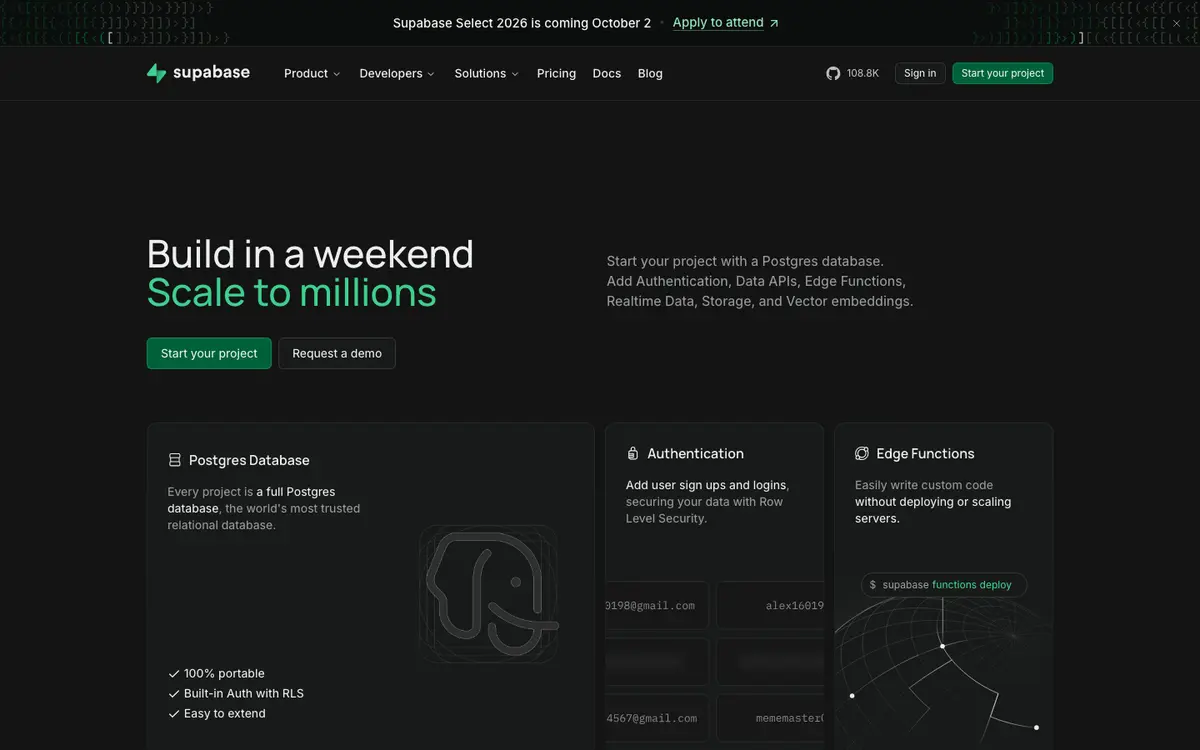
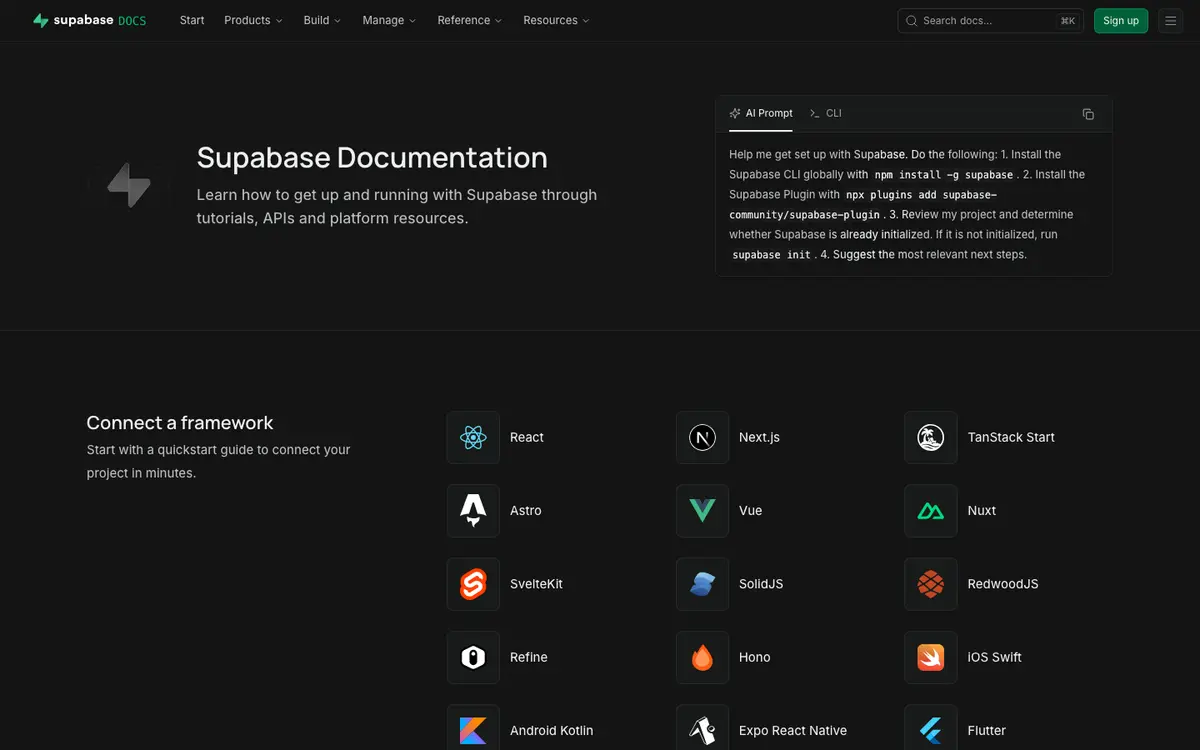
Try itExperimental
See what an agent can do with Supabase before you ever sign up. Pick a story: recorded sessions replay real probe-harness transcripts; the live MCP handshake runs real requests from our edge, right now — including, where the server allows it, one real read-only tool call (bring your own key for auth-gated servers); sandboxed self-drive sessions are designed and gated (docs/TRY-IT.md).
$mcp-probe → https://mcp.supabase.com/mcplive — run just now from our edge$ press ▶ run to send one JSON-RPC initialize from our edge
Verified integrations
Connections to other tracked products — hover a chip for the verbatim evidence quote behind it.



By theme — the product's score on each story themeBy theme
Agenticness — how well agents can access and operate the productAgenticnessevidence →
How well agents can access and operate the product
Ai vector — stories about ai vector in this arenaAi vectorevidence →
Stories about ai vector in this arena
Auth — stories about auth in this arenaAuthevidence →
Stories about auth in this arena
Automation depth — how much of the product can run unattendedAutomation depthevidence →
How much of the product can run unattended
Database realtime — database and realtime features — queries, subscriptions, live syncDatabase realtimeevidence →
Database and realtime features — queries, subscriptions, live sync
Functions — stories about functions in this arenaFunctionsevidence →
Stories about functions in this arena
Local dev — stories about local dev in this arenaLocal devevidence →
Stories about local dev in this arena
Openness — open source, data portability, and self-hosting storiesOpennessevidence →
Open source, data portability, and self-hosting stories
Privacy posture — data-handling and privacy storiesPrivacy postureevidence →
Data-handling and privacy stories
Schema migrations — stories about schema migrations in this arenaSchema migrationsevidence →
Stories about schema migrations in this arena
Security rules — stories about security rules in this arenaSecurity rulesevidence →
Stories about security rules in this arena
Storage — stories about storage in this arenaStorageevidence →
Stories about storage in this arena
Story verdicts — every judged story with its evidenceStory verdicts
Follow the green: where the map greys out is where Supabase stops today. ✓ full · ~ partial · ! disputed · — none · n/a not applicable.
Agenticness — how well agents can access and operate the productAgenticness
How well agents can access and operate the product
API surface
Drive the product through a documented public API
✓8/10
unlocks → Webhooks · Scoped API keys · Versioning policy
Subscribe to events via webhooks
—–
Build against official SDKs
~6/10
Issue scoped/least-privilege API credentials for an agent
!4/10
Connect an agent via an official MCP server
✓9/10
Download a machine-readable API spec (OpenAPI or equivalent)
✓9/10
Rely on versioned APIs with a documented deprecation policy
—–
Test against a sandbox environment without touching production data
✓8/10
Explore an interactive API reference with runnable examples
~4/10
Docs for agents
Point an agent at llms.txt or agent-oriented docs
✓9/10
Agentic features
Delegate tasks to a built-in AI assistant inside the product
—–
Operate the product with natural-language commands
✓8/10
unlocks → Autonomous automations
Plug MCP servers into this product so it can use their tools
n/an/a
Get AI-generated insights and suggestions from my data inside the product
~5/10
Set up automations that run autonomously in the background
—–
Ai vector — stories about ai vector in this arenaAi vector
Stories about ai vector in this arena
Auth — stories about auth in this arenaAuth
Stories about auth in this arena
Automation depth — how much of the product can run unattendedAutomation depth
How much of the product can run unattended
Database realtime — database and realtime features — queries, subscriptions, live syncDatabase realtime
Database and realtime features — queries, subscriptions, live sync
Functions — stories about functions in this arenaFunctions
Stories about functions in this arena
Local dev — stories about local dev in this arenaLocal dev
Stories about local dev in this arena
Openness — open source, data portability, and self-hosting storiesOpenness
Open source, data portability, and self-hosting stories
Privacy posture — data-handling and privacy storiesPrivacy posture
Data-handling and privacy stories
Schema migrations — stories about schema migrations in this arenaSchema migrations
Stories about schema migrations in this arena
Security rules — stories about security rules in this arenaSecurity rules
Stories about security rules in this arena
Storage — stories about storage in this arenaStorage
Stories about storage in this arena
Sorted by importance (agentic first) (high → low) · 51/51 stories · click a row’s chevron for the rationale and evidence
Connect an agent via an official MCP server G Agent access | ai-native user | Agenticness — how well agents can access and operate the productAgenticness | 3 | full | 9/10 | Tprobed⚿ | |
Drive the product through a documented public API G Agent access | ai-native user | Agenticness — how well agents can access and operate the productAgenticness | 3 | full | 8/10 | Tprobed | |
Delegate tasks to a built-in AI assistant inside the product G Agentic features | ai-native user | Agenticness — how well agents can access and operate the productAgenticness | 3 | none | untested | none yet | |
Plug MCP servers into this product so it can use their tools G Agent access | ai-native user | Agenticness — how well agents can access and operate the productAgenticness | 3 | n/a | untested | none yet | |
Download a machine-readable API spec (OpenAPI or equivalent) G Api quality | ai-native user | Agenticness — how well agents can access and operate the productAgenticness | 2 | full | 9/10 | Tprobed | |
Point an agent at llms.txt or agent-oriented docs G Agent access | ai-native user | Agenticness — how well agents can access and operate the productAgenticness | 2 | full | 9/10 | Tprobed | |
Run the product headlessly / in CI for automation G Agent access | ai-native user | Agenticness — how well agents can access and operate the productAgenticness | 2 | full | 9/10 | Tprobed | |
Use an official CLI G Agent access | ai-native user | Agenticness — how well agents can access and operate the productAgenticness | 2 | full | 9/10 | Tprobed | |
Operate the product with natural-language commands G Agentic features | ai-native user | Agenticness — how well agents can access and operate the productAgenticness | 2 | full | 8/10 | Tprobed⚿ | |
Build against official SDKs G Agent access | ai-native user | Agenticness — how well agents can access and operate the productAgenticness | 2 | partial | 6/10 | Tprobed | |
Get AI-generated insights and suggestions from my data inside the product G Agentic features | ai-native user | Agenticness — how well agents can access and operate the productAgenticness | 2 | partial | 5/10 | Tprobed⚿ | |
Explore an interactive API reference with runnable examples G Api quality | ai-native user | Agenticness — how well agents can access and operate the productAgenticness | 2 | partial | 4/10 | Tprobed | |
Issue scoped/least-privilege API credentials for an agent G Agent access | ai-native user | Agenticness — how well agents can access and operate the productAgenticness | 2 | disputed | 4/10 | Dcontradicted⚿ | |
Rely on versioned APIs with a documented deprecation policy G Api quality | ai-native user | Agenticness — how well agents can access and operate the productAgenticness | 2 | none | untested | none yet | |
Set up automations that run autonomously in the background G Agentic features | ai-native user | Agenticness — how well agents can access and operate the productAgenticness | 2 | none | untested | none yet | |
Subscribe to events via webhooks G Agent access | ai-native user | Agenticness — how well agents can access and operate the productAgenticness | 2 | none | untested | none yet | |
Test against a sandbox environment without touching production data G Api quality | ai-native user | Agenticness — how well agents can access and operate the productAgenticness | 1 | full | 8/10 | Tprobed | |
Provision a managed database and read/write it from client and server SDKs C Database | developer | Database realtime — database and realtime features — queries, subscriptions, live syncDatabase realtime | 3 | full | 9/10 | Tprobed | |
Self-host the core product G | ai-native user | Openness — open source, data portability, and self-hosting storiesOpenness | 3 | full | 9/10 | Tprobed | |
Subscribe to live data changes so my UI updates in real time without polling C Realtime | developer | Database realtime — database and realtime features — queries, subscriptions, live syncDatabase realtime | 3 | full | 9/10 | Xcommunity | |
Add email/password and social OAuth sign-in with the platform SDK in minutes C Authentication | developer | Auth — stories about auth in this arenaAuth | 3 | full | 8/10 | Xcommunity | |
Deploy server-side functions invoked by HTTP or SDK calls without managing servers C | developer | Functions — stories about functions in this arenaFunctions | 3 | full | 8/10 | Cclaimed | |
Store embeddings and run vector similarity search for AI features C Vector | developer | Ai vector — stories about ai vector in this arenaAi vector | 3 | full | 8/10 | Cclaimed | |
Have an agent stand up a new backend — schema, auth, and policies — headlessly from the CLI in a script C Ai provisioning | ai-native user | Local dev — stories about local dev in this arenaLocal dev | 3 | full | 7/10 | Tprobed | |
Let an agent create and test schema changes in an isolated branch or preview environment before production C Ai migrations | ai-native user | Schema migrations — stories about schema migrations in this arenaSchema migrations | 3 | partial | 7/10 | Tprobed⚿ | |
Restrict data access per user with row-level security policies or security rules C Access control | developer | Security rules — stories about security rules in this arenaSecurity rules | 3 | partial | 7/10 | Xcommunity | |
Upload and serve user files with access rules and CDN-backed delivery C Files | developer | Storage — stories about storage in this arenaStorage | 3 | full | 7/10 | Xcommunity | |
Export all of my data in open formats and leave G | ai-native user | Openness — open source, data portability, and self-hosting storiesOpenness | 3 | partial | 5/10 | Xcommunity | |
Run the whole backend stack locally with an emulator or CLI before deploying C Local | developer | Local dev — stories about local dev in this arenaLocal dev | 3 | disputed | 5/10 | Dcontradicted | |
Define rules that trigger actions automatically on events G | ai-native user | Automation depth — how much of the product can run unattendedAutomation depth | 3 | partial | 4/10 | Cclaimed | |
Manage schema changes as version-controlled migrations applied via the CLI or CI C Migrations | developer | Schema migrations — stories about schema migrations in this arenaSchema migrations | 3 | disputed | 4/10 | Dcontradicted | |
Prevent my data from being used to train AI models G | ai-native user | Privacy posture — data-handling and privacy storiesPrivacy posture | 3 | n/a | untested | none yet | |
Generate typed client code (e.g. TypeScript types) from my schema automatically C Type safety | developer | Schema migrations — stories about schema migrations in this arenaSchema migrations | 2 | full | 8/10 | Cclaimed | |
Do everything through the API that I can do in the UI G | ai-native user | Openness — open source, data portability, and self-hosting storiesOpenness | 2 | partial | 7/10 | Tprobed | |
Read the product's source under an open license G | ai-native user | Openness — open source, data portability, and self-hosting storiesOpenness | 2 | full | 7/10 | Cclaimed | |
Express relational queries with joins, constraints, and transactions C Database | developer | Database realtime — database and realtime features — queries, subscriptions, live syncDatabase realtime | 2 | partial | 6/10 | Xcommunity | |
Ask an AI assistant in the dashboard to write queries, debug errors, and explain my backend C Ai assist | ai-native user | Ai vector — stories about ai vector in this arenaAi vector | 2 | partial | 5/10 | Tprobed⚿ | |
Choose where my data is stored (region/residency) G | ai-native user | Privacy posture — data-handling and privacy storiesPrivacy posture | 2 | partial | 5/10 | Cclaimed | |
Connect to the underlying database with standard clients and ORMs via a connection string C Database | developer | Database realtime — database and realtime features — queries, subscriptions, live syncDatabase realtime | 2 | partial | 5/10 | Xcommunity | |
Require MFA and enterprise SSO (SAML/OIDC) for my application users G Authentication | platform-engineer | Auth — stories about auth in this arenaAuth | 2 | partial | 3/10 | Cclaimed | |
Run functions automatically in response to database or auth events C | developer | Functions — stories about functions in this arenaFunctions | 2 | partial | 3/10 | Cclaimed | |
Build offline-capable clients whose local writes sync automatically on reconnect C Realtime | developer | Database realtime — database and realtime features — queries, subscriptions, live syncDatabase realtime | 2 | none | 0/10 | ||
Rely on automated backups and point-in-time recovery for my data C Data protection | platform-engineer | Security rules — stories about security rules in this arenaSecurity rules | 2 | none | 0/10 | ||
Control data retention and deletion G | ai-native user | Privacy posture — data-handling and privacy storiesPrivacy posture | 2 | none | untested | none yet | |
Opt out of telemetry and usage tracking G | ai-native user | Privacy posture — data-handling and privacy storiesPrivacy posture | 2 | none | untested | none yet | |
Perform bulk operations across many items at once G | ai-native user | Automation depth — how much of the product can run unattendedAutomation depth | 2 | none | untested | none yet | |
Run full-text search over my data without wiring up an external search service C Search | developer | Database realtime — database and realtime features — queries, subscriptions, live syncDatabase realtime | 2 | none | untested | none yet | |
Schedule recurring jobs or workflows G | ai-native user | Automation depth — how much of the product can run unattendedAutomation depth | 2 | none | untested | none yet | |
Track user presence and broadcast ephemeral state between connected clients C Realtime | developer | Database realtime — database and realtime features — queries, subscriptions, live syncDatabase realtime | 1 | full | 9/10 | Xcommunity | |
Version, review, and roll back my automations G | ai-native user | Automation depth — how much of the product can run unattendedAutomation depth | 1 | partial | 3/10 | Cclaimed | |
Serve resized or transformed images from storage without running my own image pipeline C Files | developer | Storage — stories about storage in this arenaStorage | 1 | none | 0/10 |
Opportunities — the stories that would move this product's scores, from its own judged verdictsOpportunitiestop 8 of 27 stories with headroom
What would move Supabase’s scores — derived from its own judged verdicts, biggest headroom first. Each line quotes what the judge found missing; shipping it (or evidencing it publicly) is the fix.
Agenticness — how well agents can access and operate the productDelegate tasks to a built-in AI assistant inside the product
nonemoves Built-in AIimpact 45
All evidence describes Supabase's MCP server, which lets *external* AI assistants (Cursor, Claude, etc.) connect to and query a Supabase project — this is the client-connectivity story, not a built-in assistant living inside Supabase's own product/dashboard.
Agenticness — how well agents can access and operate the productSet up automations that run autonomously in the background
nonemoves Built-in AIimpact 30
The evidence pack covers Edge Functions, Realtime, RLS, and MCP/CLI tooling, but contains no mention of scheduled jobs, cron triggers, database webhooks, or any mechanism for autonomous background automations that an AI-native user could set up and let run unattended.
Agenticness — how well agents can access and operate the productSubscribe to events via webhooks
nonemoves agent-readyimpact 30
Missing: any documentation of Database Webhooks or HTTP callback subscription mechanism.
Agenticness — how well agents can access and operate the productRely on versioned APIs with a documented deprecation policy
nonemoves API qualityimpact 30
The evidence pack has no mention of API versioning schemes or a documented deprecation policy for Supabase's REST/GraphQL/Auth/Storage APIs; there's an OpenAPI spec probe but nothing about version lifecycle or deprecation commitments.
Security rules — stories about security rules in this arenaRely on automated backups and point-in-time recovery for my data
nonemoves PA Scoreimpact 20
The evidence pack contains no vendor-tier documentation describing automated backups or point-in-time recovery (PITR) features; the only related evidence is a community report (supabase-comm-9) describing nightly pg_dump backups causing write-contention problems and the team merely 'investigating' moving customers to PITR.
Automation depth — how much of the product can run unattendedPerform bulk operations across many items at once
nonemoves PA Scoreimpact 20
The evidence pack documents Supabase's REST API generation, RLS, realtime, storage, and CLI/MCP tooling, but nothing explicitly addresses bulk/batch operations (e.g., batch insert/update/delete across many rows or items) via the API, CLI, or MCP server.
Automation depth — how much of the product can run unattendedSchedule recurring jobs or workflows
nonemoves PA Scoreimpact 20
The evidence pack covers Supabase's database, auth, storage, realtime, edge functions, CLI, and MCP integration, but contains no mention of a scheduling feature (e.g., pg_cron, scheduled Edge Functions, or workflow orchestration) for recurring jobs.
Database realtime — database and realtime features — queries, subscriptions, live syncRun full-text search over my data without wiring up an external search service
nonemoves PA Scoreimpact 20
The evidence pack covers Supabase's database, realtime, auth, storage, vector/AI, and CLI/MCP capabilities extensively, but nowhere mentions Postgres full-text search (tsvector, GIN indexes, or a dedicated search feature).
Showing the top 8 of 27 — every none/partial verdict in the story verdicts table is headroom.
Think a verdict is wrong? Every verdicts-table row has a Flag link — see the methodology.
Coverage map — which docs area, API section, or community source covers which judged storiesCoverage map7 surfaces · 37 covered stories
Where the cited evidence behind each covered verdict came from — the same citations the verdicts table shows, no extra judging.
docs36 stories
- Point an agent at llms.txt or agent-oriented docs
- Run the product headlessly / in CI for automation
- Connect an agent via an official MCP server
- Use an official CLI
- Drive the product through a documented public API
- Issue scoped/least-privilege API credentials for an agent
- Build against official SDKs
- Get AI-generated insights and suggestions from my data inside the product
- Operate the product with natural-language commands
- Download a machine-readable API spec (OpenAPI or equivalent)
- Test against a sandbox environment without touching production data
- Ask an AI assistant in the dashboard to write queries, debug errors, and explain my backend
- Store embeddings and run vector similarity search for AI features
- Add email/password and social OAuth sign-in with the platform SDK in minutes
- Require MFA and enterprise SSO (SAML/OIDC) for my application users
- Define rules that trigger actions automatically on events
- Version, review, and roll back my automations
- Connect to the underlying database with standard clients and ORMs via a connection string
- Provision a managed database and read/write it from client and server SDKs
- Express relational queries with joins, constraints, and transactions
- Track user presence and broadcast ephemeral state between connected clients
- Subscribe to live data changes so my UI updates in real time without polling
- Run functions automatically in response to database or auth events
- Deploy server-side functions invoked by HTTP or SDK calls without managing servers
- Have an agent stand up a new backend — schema, auth, and policies — headlessly from the CLI in a script
- Run the whole backend stack locally with an emulator or CLI before deploying
- Do everything through the API that I can do in the UI
- Export all of my data in open formats and leave
- Read the product's source under an open license
- Self-host the core product
- Choose where my data is stored (region/residency)
- Let an agent create and test schema changes in an isolated branch or preview environment before production
- Manage schema changes as version-controlled migrations applied via the CLI or CI
- Generate typed client code (e.g. TypeScript types) from my schema automatically
- Restrict data access per user with row-level security policies or security rules
- Upload and serve user files with access rules and CDN-backed delivery
Hacker News19 stories
- Connect an agent via an official MCP server
- Issue scoped/least-privilege API credentials for an agent
- Operate the product with natural-language commands
- Test against a sandbox environment without touching production data
- Ask an AI assistant in the dashboard to write queries, debug errors, and explain my backend
- Add email/password and social OAuth sign-in with the platform SDK in minutes
- Connect to the underlying database with standard clients and ORMs via a connection string
- Provision a managed database and read/write it from client and server SDKs
- Express relational queries with joins, constraints, and transactions
- Track user presence and broadcast ephemeral state between connected clients
- Subscribe to live data changes so my UI updates in real time without polling
- Run the whole backend stack locally with an emulator or CLI before deploying
- Do everything through the API that I can do in the UI
- Export all of my data in open formats and leave
- Self-host the core product
- Let an agent create and test schema changes in an isolated branch or preview environment before production
- Manage schema changes as version-controlled migrations applied via the CLI or CI
- Restrict data access per user with row-level security policies or security rules
- Upload and serve user files with access rules and CDN-backed delivery
GitHub README10 stories
- Drive the product through a documented public API
- Build against official SDKs
- Explore an interactive API reference with runnable examples
- Download a machine-readable API spec (OpenAPI or equivalent)
- Provision a managed database and read/write it from client and server SDKs
- Subscribe to live data changes so my UI updates in real time without polling
- Deploy server-side functions invoked by HTTP or SDK calls without managing servers
- Do everything through the API that I can do in the UI
- Export all of my data in open formats and leave
- Read the product's source under an open license
supabase.com9 stories
- Drive the product through a documented public API
- Build against official SDKs
- Explore an interactive API reference with runnable examples
- Download a machine-readable API spec (OpenAPI or equivalent)
- Store embeddings and run vector similarity search for AI features
- Provision a managed database and read/write it from client and server SDKs
- Express relational queries with joins, constraints, and transactions
- Deploy server-side functions invoked by HTTP or SDK calls without managing servers
- Do everything through the API that I can do in the UI
MCP docs6 stories
- Connect an agent via an official MCP server
- Issue scoped/least-privilege API credentials for an agent
- Get AI-generated insights and suggestions from my data inside the product
- Operate the product with natural-language commands
- Ask an AI assistant in the dashboard to write queries, debug errors, and explain my backend
- Let an agent create and test schema changes in an isolated branch or preview environment before production
OpenAPI spec4 stories
Claims vs evidence — vendor claims reconciled against independent verdictsClaims vs evidence
11 of 16 testable claims verified · 1 contradicted → integrity 56/100
20 distinct capability claims found in Supabase’s own claimed-docs/GitHub materials, reconciled against our judge’s independent verdicts.
11
Verified
4
Unverified
1
Contradicted
19
Undersold
Verified (13)
“AI assistants can connect to and query your Supabase projects on your behalf”
“Two-command CLI workflow (`init`, `start`) sets up and launches a local Supabase project”
“Self-hosting supported for full data control, compliance, or isolated environments”
“Postgres Row Level Security provides granular, in-database authorization rules”
Restrict data access per user with row-level security policies or security rulespartialproof ↗
“Broadcast and Presence let clients send low-latency messages and track/synchronize online user state”
Track user presence and broadcast ephemeral state between connected clientsfullproof ↗
“Postgres Changes lets clients listen to database changes in real time”
Subscribe to live data changes so my UI updates in real time without pollingfullproof ↗
“Users can sign in via password, magic link, OTP, social login, or SSO”
Add email/password and social OAuth sign-in with the platform SDK in minutesfullproof ↗
“Storage service manages files of any size with fine-grained access controls and optimized delivery”
Upload and serve user files with access rules and CDN-backed deliveryfullproof ↗
“Branching lets you create isolated environments to test schema/config changes before production”
Let an agent create and test schema changes in an isolated branch or preview environment before productionpartialproof ↗
“Instant ready-to-use REST APIs generated for your project”
Provision a managed database and read/write it from client and server SDKsfullproof ↗
“CLI can run the entire Supabase stack locally, including in CI environments”
Run the product headlessly / in CI for automationfullproof ↗
“Storage supports fine-grained access control via row-level security and custom policies”
Upload and serve user files with access rules and CDN-backed deliveryfullproof ↗
“Storage supports fine-grained access control via row-level security and custom policies”
Restrict data access per user with row-level security policies or security rulespartialproof ↗
Unverified (5)
“Users can sign in via password, magic link, OTP, social login, or SSO”
Require MFA and enterprise SSO (SAML/OIDC) for my application userspartialproof ↗
“Edge Functions are server-side TypeScript functions distributed globally close to users”
Deploy server-side functions invoked by HTTP or SDK calls without managing serversfullproof ↗
“Open-source toolkit for building AI applications using Postgres and pgvector”
Store embeddings and run vector similarity search for AI featuresfullproof ↗
“Generate TypeScript types (`database.types.ts`) for your project schema”
Generate typed client code (e.g. TypeScript types) from my schema automaticallyfullproof ↗
“APIs are auto-generated via database introspection into type-safe definitions”
Generate typed client code (e.g. TypeScript types) from my schema automaticallyfullproof ↗
Contradicted (2)
“Two-command CLI workflow (`init`, `start`) sets up and launches a local Supabase project”
Run the whole backend stack locally with an emulator or CLI before deployingdisputedproof ↗
“CLI can run the entire Supabase stack locally, including in CI environments”
Run the whole backend stack locally with an emulator or CLI before deployingdisputedproof ↗
Undersold (19)
Point an agent at llms.txt or agent-oriented docsfullproof ↗
Drive the product through a documented public APIfullproof ↗
Get AI-generated insights and suggestions from my data inside the productpartialproof ↗
Operate the product with natural-language commandsfullproof ↗
Explore an interactive API reference with runnable examplespartialproof ↗
Download a machine-readable API spec (OpenAPI or equivalent)fullproof ↗
Test against a sandbox environment without touching production datafullproof ↗
Ask an AI assistant in the dashboard to write queries, debug errors, and explain my backendpartialproof ↗
Define rules that trigger actions automatically on eventspartialproof ↗
Connect to the underlying database with standard clients and ORMs via a connection stringpartialproof ↗
Express relational queries with joins, constraints, and transactionspartialproof ↗
Run functions automatically in response to database or auth eventspartialproof ↗
Have an agent stand up a new backend — schema, auth, and policies — headlessly from the CLI in a scriptfullproof ↗
Do everything through the API that I can do in the UIpartialproof ↗
Export all of my data in open formats and leavepartialproof ↗
Choose where my data is stored (region/residency)partialproof ↗
Claims outside our story set (4)
Real capability claims found in Supabase’s own materials, but no story in this arena’s taxonomy covers them yet — that’s feedback on the taxonomy, not a mark against the product.
“Compute can scale up to 64 cores and 256 GB RAM”
source ↗“Auto-generated GraphQL API available alongside REST”
source ↗“Dashboard lets you manage your app without leaving it”
source ↗“Project stack lets you add Auth, Data APIs, Edge Functions, Realtime, Storage, and Vector embeddings on top of Postgres”
source ↗
Business model
Open-source and free to self-host; hosted Free tier, Pro from $25/mo per organization plus usage-based compute, storage, and bandwidth, Team and Enterprise above.
pricing ↗Score trend
How this product’s scores have moved as evidence and verdicts are re-derived — a point per change, not per day.
Try Experimental
Run it in the microterminal →Recorded agent sessions — and a live MCP handshake where the vendor ships one.
Flag
⚑ Flag a verdictThink a verdict is wrong? Opens a prefilled GitHub issue — or use the ⚑ next to any verdict above.
For agents
Agent surface uptime MCP 100% · llms.txt 100% · openapi.json 100% (30d, checked every 6h since Sep 8 '26)