Rank #1 of 7 in Browser Automation for Agents

Install
 vs Browser Use
 vs Stagehand
 vs Skyvern
 vs Hyperbrowser
 vs Notte
 vs Smooth
Showcase
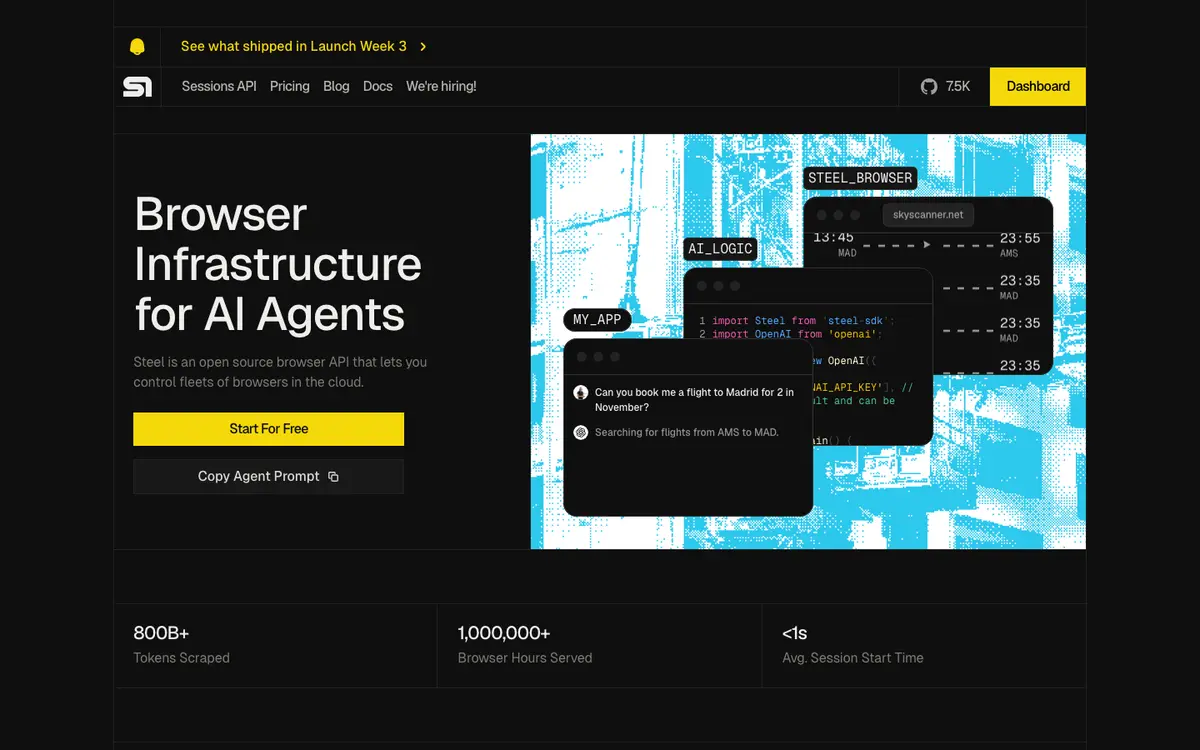
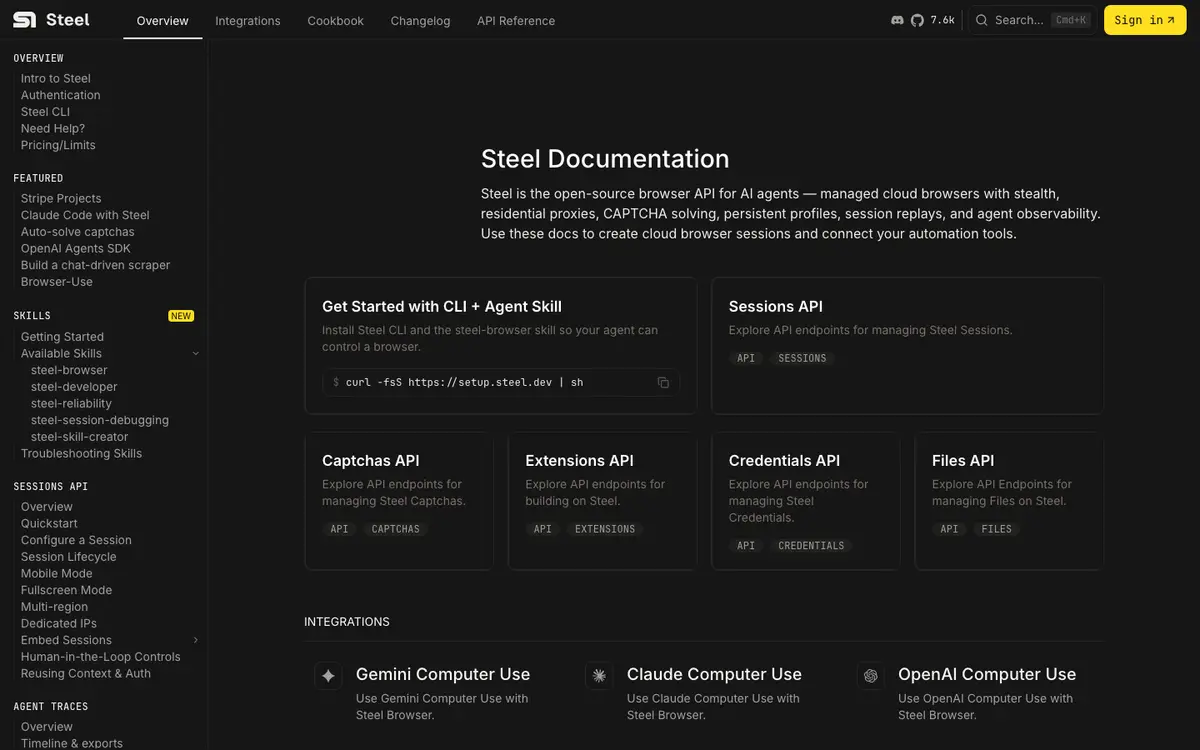
Try itExperimental
See what an agent can do with Steel before you ever sign up. Pick a story: recorded sessions replay real probe-harness transcripts; sandboxed self-drive sessions are designed and gated (docs/TRY-IT.md).
$HOME=$(mktemp -d) sh -c 'curl -sSf https://setup.steel.dev | sh -s -- --non-interactive && ~/.steel/bin/steel --version'recorded session — replayed, not liveVerified integrations
No integration evidence found in our corpus for this product yet — that means none was found, never that it doesn’t integrate.
By theme — the product's score on each story themeBy theme
Action primitives — stories about action primitives in this arenaAction primitivesevidence →
Stories about action primitives in this arena
Agenticness — how well agents can access and operate the productAgenticnessevidence →
How well agents can access and operate the product
Auth session persistence — stories about auth session persistence in this arenaAuth session persistenceevidence →
Stories about auth session persistence in this arena
Automation depth — how much of the product can run unattendedAutomation depthevidence →
How much of the product can run unattended
Deployment modes — stories about deployment modes in this arenaDeployment modesevidence →
Stories about deployment modes in this arena
Framework model support — stories about framework model support in this arenaFramework model supportevidence →
Stories about framework model support in this arena
Nl task execution — stories about nl task execution in this arenaNl task executionevidence →
Stories about nl task execution in this arena
Openness — open source, data portability, and self-hosting storiesOpennessevidence →
Open source, data portability, and self-hosting stories
Pricing limits — free-tier ceilings, usage caps, and rate limits before you have to payPricing limitsevidence →
Free-tier ceilings, usage caps, and rate limits before you have to pay
Privacy posture — data-handling and privacy storiesPrivacy postureevidence →
Data-handling and privacy stories
Replay debugging — stories about replay debugging in this arenaReplay debuggingevidence →
Stories about replay debugging in this arena
Scale parallelism — running many jobs at once — concurrency, fleets, queueingScale parallelismevidence →
Running many jobs at once — concurrency, fleets, queueing
Stealth captcha — stories about stealth captcha in this arenaStealth captchaevidence →
Stories about stealth captcha in this arena
Structured extraction — stories about structured extraction in this arenaStructured extractionevidence →
Stories about structured extraction in this arena
Story verdicts — every judged story with its evidenceStory verdicts
What’s free: 16 free · 0 paid · 0 enterprise · 12 not stated in evidence
Follow the green: where the map greys out is where Steel stops today. ✓ full · ~ partial · ! disputed · — none · n/a not applicable.
Action primitives — stories about action primitives in this arenaAction primitives
Stories about action primitives in this arena
Cache resolved actions or generated code so repeat runs replay deterministically at lower cost and latency than re-prompting the LLM
—–
Drive the page through DOM-understanding action primitives (act/click/type on described elements) that survive selector and layout changes
—0/10
Preview candidate actions on the current page (observe/plan) before committing the agent to act
~4/10
Switch to a vision or computer-use action mode that operates on screenshots for canvases and UIs the DOM path can't handle
—–
Agenticness — how well agents can access and operate the productAgenticness
How well agents can access and operate the product
API surface
Drive the product through a documented public API
✓9/10
unlocks → Webhooks · Scoped API keys · Versioning policy · Submit a browser task over a hosted HTTP API and receive the result by polling or webhook, without managing any browser myself · Compose repeatable multi-step workflows with loops, conditionals, and parameters instead of one-shot prompts
Subscribe to events via webhooks
—–
Build against official SDKs
✓8/10
Issue scoped/least-privilege API credentials for an agent
—–
Connect an agent via an official MCP server
~5/10
Download a machine-readable API spec (OpenAPI or equivalent)
✓9/10
Rely on versioned APIs with a documented deprecation policy
—–
Test against a sandbox environment without touching production data
✓7/10
Explore an interactive API reference with runnable examples
~6/10
Agentic features
Delegate tasks to a built-in AI assistant inside the product
n/an/a
Operate the product with natural-language commands
~5/10
unlocks → Autonomous automations
Plug MCP servers into this product so it can use their tools
n/an/a
Get AI-generated insights and suggestions from my data inside the product
n/an/a
Set up automations that run autonomously in the background
—0/10
Auth session persistence — stories about auth session persistence in this arenaAuth session persistence
Stories about auth session persistence in this arena
Connect my existing Playwright, Puppeteer, or CDP automation code to the product's browsers instead of rewriting it
✓9/10
Store credentials in a vault and have the agent complete logins including TOTP/2FA challenges without exposing secrets to the model
—0/10
Persist logged-in browser state in reusable profiles so agents skip the login wall on every subsequent run
✓8/10
Automation depth — how much of the product can run unattendedAutomation depth
How much of the product can run unattended
Deployment modes — stories about deployment modes in this arenaDeployment modes
Stories about deployment modes in this arena
Framework model support — stories about framework model support in this arenaFramework model support
Stories about framework model support in this arena
Nl task execution — stories about nl task execution in this arenaNl task execution
Stories about nl task execution in this arena
Openness — open source, data portability, and self-hosting storiesOpenness
Open source, data portability, and self-hosting stories
Pricing limits — free-tier ceilings, usage caps, and rate limits before you have to payPricing limits
Free-tier ceilings, usage caps, and rate limits before you have to pay
Privacy posture — data-handling and privacy storiesPrivacy posture
Data-handling and privacy stories
Replay debugging — stories about replay debugging in this arenaReplay debugging
Stories about replay debugging in this arena
Scale parallelism — running many jobs at once — concurrency, fleets, queueingScale parallelism
Running many jobs at once — concurrency, fleets, queueing
Stealth captcha — stories about stealth captcha in this arenaStealth captcha
Stories about stealth captcha in this arena
Rely on a documented captcha stance — automatic solving, human fallback, or explicit non-support — instead of silent task failures
✓8/10
Point to the vendor's published acceptable-use and anti-abuse posture governing what its stealth and automation features may be used for
—–
Enable stealth fingerprinting and residential or geo-targeted proxies so legitimate automations aren't blocked as bots
✓8/10
Structured extraction — stories about structured extraction in this arenaStructured extraction
Stories about structured extraction in this arena
Sorted by importance (agentic first) (high → low) · 52/52 stories · click a row’s chevron for the rationale and evidence
Drive the product through a documented public API G Agent access | ai-native user | Agenticness — how well agents can access and operate the productAgenticness | 3 | fullfree | 9/10 | Tprobed | |
Connect an agent via an official MCP server G Agent access | ai-native user | Agenticness — how well agents can access and operate the productAgenticness | 3 | partial | 5/10 | Cclaimed | |
Plug MCP servers into this product so it can use their tools G Agent access | ai-native user | Agenticness — how well agents can access and operate the productAgenticness | 3 | n/a | 0/10 | ||
Delegate tasks to a built-in AI assistant inside the product G Agentic features | ai-native user | Agenticness — how well agents can access and operate the productAgenticness | 3 | n/a | untested | none yet | |
Download a machine-readable API spec (OpenAPI or equivalent) G Api quality | ai-native user | Agenticness — how well agents can access and operate the productAgenticness | 2 | full | 9/10 | Tprobed | |
Point an agent at llms.txt or agent-oriented docs G Agent access | ai-native user | Agenticness — how well agents can access and operate the productAgenticness | 2 | full | 9/10 | Tprobed | |
Run the product headlessly / in CI for automation G Agent access | ai-native user | Agenticness — how well agents can access and operate the productAgenticness | 2 | fullfree | 9/10 | Tprobed | |
Build against official SDKs G Agent access | ai-native user | Agenticness — how well agents can access and operate the productAgenticness | 2 | fullfree | 8/10 | Tprobed | |
Use an official CLI G Agent access | ai-native user | Agenticness — how well agents can access and operate the productAgenticness | 2 | fullfree | 8/10 | Tprobed | |
Explore an interactive API reference with runnable examples G Api quality | ai-native user | Agenticness — how well agents can access and operate the productAgenticness | 2 | partial | 6/10 | Tprobed | |
Operate the product with natural-language commands G Agentic features | ai-native user | Agenticness — how well agents can access and operate the productAgenticness | 2 | partial± | 5/10 | Cclaimed | |
Get AI-generated insights and suggestions from my data inside the product G Agentic features | ai-native user | Agenticness — how well agents can access and operate the productAgenticness | 2 | n/a | 0/10 | ||
Set up automations that run autonomously in the background G Agentic features | ai-native user | Agenticness — how well agents can access and operate the productAgenticness | 2 | none± | 0/10 | ||
Issue scoped/least-privilege API credentials for an agent G Agent access | ai-native user | Agenticness — how well agents can access and operate the productAgenticness | 2 | none | untested | none yet | |
Rely on versioned APIs with a documented deprecation policy G Api quality | ai-native user | Agenticness — how well agents can access and operate the productAgenticness | 2 | none | untested | none yet | |
Subscribe to events via webhooks G Agent access | ai-native user | Agenticness — how well agents can access and operate the productAgenticness | 2 | none | untested | none yet | |
Test against a sandbox environment without touching production data G Api quality | ai-native user | Agenticness — how well agents can access and operate the productAgenticness | 1 | fullfree | 7/10 | Tprobed | |
Self-host the core product G | ai-native user | Openness — open source, data portability, and self-hosting storiesOpenness | 3 | fullfree | 10/10 | Tprobed | |
Persist logged-in browser state in reusable profiles so agents skip the login wall on every subsequent run C Profiles | developer | Auth session persistence — stories about auth session persistence in this arenaAuth session persistence | 3 | fullfree | 8/10 | Tprobed | |
Export all of my data in open formats and leave G | ai-native user | Openness — open source, data portability, and self-hosting storiesOpenness | 3 | partialfree | 5/10 | Tprobed | |
Hand the product a natural-language goal and it completes a multi-step web task end to end — navigating, filling forms, and clicking through flows C Tasks | developer | Nl task execution — stories about nl task execution in this arenaNl task execution | 3 | partialfree | 5/10 | Tprobed | |
Drive the page through DOM-understanding action primitives (act/click/type on described elements) that survive selector and layout changes C Dom | developer | Action primitives — stories about action primitives in this arenaAction primitives | 3 | none | 0/10 | ||
Extract typed, schema-validated data (Zod/Pydantic-style) from pages the agent visits, not just raw text C Extraction | developer | Structured extraction — stories about structured extraction in this arenaStructured extraction | 3 | none | 0/10 | ||
Define rules that trigger actions automatically on events G | ai-native user | Automation depth — how much of the product can run unattendedAutomation depth | 3 | none | untested | none yet | |
Prevent my data from being used to train AI models G | ai-native user | Privacy posture — data-handling and privacy storiesPrivacy posture | 3 | none | untested | none yet | |
Connect my existing Playwright, Puppeteer, or CDP automation code to the product's browsers instead of rewriting it C Compat | developer | Auth session persistence — stories about auth session persistence in this arenaAuth session persistence | 2 | fullfree | 9/10 | Tprobed | |
Run the agent against a local browser on my own machine for development, without any cloud account C Local | developer | Deployment modes — stories about deployment modes in this arenaDeployment modes | 2 | fullfree | 9/10 | Tprobed | |
Enable stealth fingerprinting and residential or geo-targeted proxies so legitimate automations aren't blocked as bots C Stealth | automation-engineer | Stealth captcha — stories about stealth captcha in this arenaStealth captcha | 2 | full | 8/10 | Xcommunity | |
Rely on a documented captcha stance — automatic solving, human fallback, or explicit non-support — instead of silent task failures C Captcha | automation-engineer | Stealth captcha — stories about stealth captcha in this arenaStealth captcha | 2 | full | 8/10 | Cclaimed | |
Watch a session live and take human control mid-run when the agent gets stuck C Live | automation-engineer | Replay debugging — stories about replay debugging in this arenaReplay debugging | 2 | fullfree | 8/10 | Tprobed | |
Debug a failed agent run from recorded replays — video, screenshots, step-by-step action timelines C Replay | automation-engineer | Replay debugging — stories about replay debugging in this arenaReplay debugging | 2 | full | 7/10 | Cclaimed | |
Do everything through the API that I can do in the UI G | ai-native user | Openness — open source, data portability, and self-hosting storiesOpenness | 2 | partialfree | 6/10 | Tprobed | |
Read the product's source under an open license G | ai-native user | Openness — open source, data portability, and self-hosting storiesOpenness | 2 | partialfree | 6/10 | Tprobed | |
Run a fleet of concurrent browser sessions with documented concurrency limits and programmatic session management C Fleets | automation-engineer | Scale parallelism — running many jobs at once — concurrency, fleets, queueingScale parallelism | 2 | partial | 6/10 | Tprobed | |
Plug the browser layer into agent frameworks (Claude Agent SDK, Vercel AI SDK, LangChain, CrewAI) through documented adapters C Frameworks | developer | Framework model support — stories about framework model support in this arenaFramework model support | 2 | partial | 5/10 | Cclaimed | |
Choose where my data is stored (region/residency) G | ai-native user | Privacy posture — data-handling and privacy storiesPrivacy posture | 2 | partialfree | 4/10 | Tprobed | |
Control data retention and deletion G | ai-native user | Privacy posture — data-handling and privacy storiesPrivacy posture | 2 | partialfree | 4/10 | Tprobed | |
Perform bulk operations across many items at once G | ai-native user | Automation depth — how much of the product can run unattendedAutomation depth | 2 | partial | 4/10 | Cclaimed | |
Compose repeatable multi-step workflows with loops, conditionals, and parameters instead of one-shot prompts C Workflows | automation-engineer | Nl task execution — stories about nl task execution in this arenaNl task execution | 2 | none | 0/10 | ||
See transparent per-task or per-browser-hour pricing and documented rate/concurrency limits before committing G Pricing | developer | Pricing limits — free-tier ceilings, usage caps, and rate limits before you have to payPricing limits | 2 | none | 0/10 | ||
Store credentials in a vault and have the agent complete logins including TOTP/2FA challenges without exposing secrets to the model G Credentials | automation-engineer | Auth session persistence — stories about auth session persistence in this arenaAuth session persistence | 2 | none | 0/10 | ||
Submit a browser task over a hosted HTTP API and receive the result by polling or webhook, without managing any browser myself C Tasks | ai agent | Nl task execution — stories about nl task execution in this arenaNl task execution | 2 | none | 0/10 | ||
Bring my own LLM provider — the framework is model-agnostic rather than locked to one vendor's models C Models | developer | Framework model support — stories about framework model support in this arenaFramework model support | 2 | none | untested | none yet | |
Cache resolved actions or generated code so repeat runs replay deterministically at lower cost and latency than re-prompting the LLM C Caching | developer | Action primitives — stories about action primitives in this arenaAction primitives | 2 | none | untested | none yet | |
Opt out of telemetry and usage tracking G | ai-native user | Privacy posture — data-handling and privacy storiesPrivacy posture | 2 | none | untested | none yet | |
Schedule recurring jobs or workflows G | ai-native user | Automation depth — how much of the product can run unattendedAutomation depth | 2 | none | untested | none yet | |
Switch to a vision or computer-use action mode that operates on screenshots for canvases and UIs the DOM path can't handle C Vision | developer | Action primitives — stories about action primitives in this arenaAction primitives | 2 | none | untested | none yet | |
Preview candidate actions on the current page (observe/plan) before committing the agent to act C Observe | developer | Action primitives — stories about action primitives in this arenaAction primitives | 1 | partial | 4/10 | Cclaimed | |
Get webhook notifications when tasks and sessions finish instead of polling for status C Lifecycle | developer | Scale parallelism — running many jobs at once — concurrency, fleets, queueingScale parallelism | 1 | none | untested | none yet | |
My agent can download files from and upload files to the sites it operates, with the artifacts retrievable afterwards C Files | developer | Structured extraction — stories about structured extraction in this arenaStructured extraction | 1 | none | untested | none yet | |
Point to the vendor's published acceptable-use and anti-abuse posture governing what its stealth and automation features may be used for C Posture | automation-engineer | Stealth captcha — stories about stealth captcha in this arenaStealth captcha | 1 | none | untested | none yet | |
Version, review, and roll back my automations G | ai-native user | Automation depth — how much of the product can run unattendedAutomation depth | 1 | n/a | untested | none yet |
Opportunities — the stories that would move this product's scores, from its own judged verdictsOpportunitiestop 8 of 33 stories with headroom
What would move Steel’s scores — derived from its own judged verdicts, biggest headroom first. Each line quotes what the judge found missing; shipping it (or evidencing it publicly) is the fix.
Automation depth — how much of the product can run unattendedDefine rules that trigger actions automatically on events
nonemoves PA Scoreimpact 30
Steel's evidence covers sessions, proxies, captcha solving, CLI, and agent traces, but nothing describes a rules engine or event-triggered automation (e.g., 'if X happens then do Y') that a user could configure declaratively.
Action primitives — stories about action primitives in this arenaDrive the page through DOM-understanding action primitives (act/click/type on described elements) that survive selector and layout changes
nonemoves PA Scoreimpact 30
Steel's evidence shows only traditional CDP/Puppeteer/Selenium-based control and CLI commands like click/fill/type (steel-docs-8, steel-gh-1), which are selector-based automation primitives, not AI/DOM-understanding 'act on described element' primitives that resolve targets semantically and survive selector/layout changes.
Privacy posture — data-handling and privacy storiesPrevent my data from being used to train AI models
nonemoves PA Scoreimpact 30
The axis applies to this product kind (peer products hold positive or none verdicts on this story), so lack of evidence for an applicable capability is "none", never "na".
Structured extraction — stories about structured extraction in this arenaExtract typed, schema-validated data (Zod/Pydantic-style) from pages the agent visits, not just raw text
nonemoves PA Scoreimpact 30
Steel's docs/GitHub only show raw content extraction utilities (markdown, readability, screenshots, PDF conversion) and generic 'extract content' CLI commands, with no mention of Zod/Pydantic-style schema validation or typed structured outputs.
Agenticness — how well agents can access and operate the productSet up automations that run autonomously in the background
nonemoves Built-in AIimpact 30
Steel provides on-demand browser sessions, CLI, SDK, and agent-trace tooling for agents to control browsers, but nothing in the evidence describes a scheduling/trigger mechanism or persistent background job runner that lets a user set up automations to run autonomously without invocation — sessions are explicitly spun up 'on demand' by an agent/script, not scheduled by Steel itself.
Agenticness — how well agents can access and operate the productIssue scoped/least-privilege API credentials for an agent
nonemoves agent-readyimpact 30
No evidence anywhere in the pack of scoped or least-privilege API key/credential issuance (e.g., role-based keys, permission scopes, restricted tokens) for agents — only session isolation, proxies, and CLI features are documented, none of which address credential scoping.
Agenticness — how well agents can access and operate the productSubscribe to events via webhooks
nonemoves agent-readyimpact 30
No evidence anywhere in the pack mentions webhooks or event subscriptions; Steel's documented surfaces are Sessions API, CLI, MCP tools, and agent traces, none of which describe a webhook/event notification mechanism.
Agenticness — how well agents can access and operate the productRely on versioned APIs with a documented deprecation policy
nonemoves API qualityimpact 30
No evidence pack item mentions API versioning scheme or a documented deprecation policy; only an OpenAPI spec and general docs are shown, neither of which discuss version lifecycle or deprecation commitments.
Showing the top 8 of 33 — every none/partial verdict in the story verdicts table is headroom.
Think a verdict is wrong? Every verdicts-table row has a Flag link — see the methodology.
Coverage map — which docs area, API section, or community source covers which judged storiesCoverage map6 surfaces · 28 covered stories
Where the cited evidence behind each covered verdict came from — the same citations the verdicts table shows, no extra judging.
Overview docs20 stories
- Preview candidate actions on the current page (observe/plan) before committing the agent to act
- Run the product headlessly / in CI for automation
- Use an official CLI
- Drive the product through a documented public API
- Build against official SDKs
- Operate the product with natural-language commands
- Test against a sandbox environment without touching production data
- Connect my existing Playwright, Puppeteer, or CDP automation code to the product's browsers instead of rewriting it
- Persist logged-in browser state in reusable profiles so agents skip the login wall on every subsequent run
- Perform bulk operations across many items at once
- Run the agent against a local browser on my own machine for development, without any cloud account
- Hand the product a natural-language goal and it completes a multi-step web task end to end — navigating, filling forms, and clicking through flows
- Do everything through the API that I can do in the UI
- Export all of my data in open formats and leave
- Control data retention and deletion
- Watch a session live and take human control mid-run when the agent gets stuck
- Debug a failed agent run from recorded replays — video, screenshots, step-by-step action timelines
- Run a fleet of concurrent browser sessions with documented concurrency limits and programmatic session management
- Rely on a documented captcha stance — automatic solving, human fallback, or explicit non-support — instead of silent task failures
- Enable stealth fingerprinting and residential or geo-targeted proxies so legitimate automations aren't blocked as bots
GitHub README19 stories
- Preview candidate actions on the current page (observe/plan) before committing the agent to act
- Run the product headlessly / in CI for automation
- Use an official CLI
- Drive the product through a documented public API
- Build against official SDKs
- Operate the product with natural-language commands
- Test against a sandbox environment without touching production data
- Connect my existing Playwright, Puppeteer, or CDP automation code to the product's browsers instead of rewriting it
- Persist logged-in browser state in reusable profiles so agents skip the login wall on every subsequent run
- Run the agent against a local browser on my own machine for development, without any cloud account
- Hand the product a natural-language goal and it completes a multi-step web task end to end — navigating, filling forms, and clicking through flows
- Do everything through the API that I can do in the UI
- Export all of my data in open formats and leave
- Read the product's source under an open license
- Self-host the core product
- Choose where my data is stored (region/residency)
- Control data retention and deletion
- Watch a session live and take human control mid-run when the agent gets stuck
- Run a fleet of concurrent browser sessions with documented concurrency limits and programmatic session management
OpenAPI spec6 stories
llms.txt5 stories
Integrations docs5 stories
- Connect an agent via an official MCP server
- Build against official SDKs
- Operate the product with natural-language commands
- Plug the browser layer into agent frameworks (Claude Agent SDK, Vercel AI SDK, LangChain, CrewAI) through documented adapters
- Hand the product a natural-language goal and it completes a multi-step web task end to end — navigating, filling forms, and clicking through flows
Probe proofs — replayable recordings from the probe harnessProbe proofs
Replayable recordings from our probe harness — see the Prove-It protocol to submit one.
$HOME=$(mktemp -d) sh -c 'curl -sSf https://setup.steel.dev | sh -s -- --non-interactive && ~/.steel/bin/steel --version'reproduced$ HOME=$(mktemp -d) sh -c 'curl -sSf https://setup.steel.dev | sh -s -- --non-interactive && ~/.steel/bin/steel --version' steel 0.4.4
$docker run -d --name pa-steel-probe -p 13000:3000 ghcr.io/steel-dev/steel-browser && curl localhost:13000/v1/health && curl -X POST localhost:13000/v1/sessions -d '{}' && curl localhost:13000/v1/sessionsreproduced$ docker run -d --name pa-steel-probe -p 13000:3000 ghcr.io/steel-dev/steel-browser && curl localhost:13000/v1/health && curl -X POST localhost:13000/v1/sessions -d '{}' && curl localhost:13000/v1/sessions
879a09ecaf26dc4a81f7542ac82d984c771b310cf595800870cfc2cc6369c8ce
{"status":"ok"}
{"id":"3f017875-755c-40b1-9456-ef9d3a4bab70","createdAt":"2026-09-05T01:15:05.836Z","status":"live","duration":0,"eventCount":0,"timeout":0,"creditsUsed":0,"websocketUrl":"ws://0.0.0.0:3000/","debugUrl":"http://0.0.0.0:3000/v1/sessions/debug","debuggerUrl":"http://0.0.0.0:3000/v1/devtools/inspector.
{"sessions":[{"id":"3f017875-755c-40b1-9456-ef9d3a4bab70","createdAt":"2026-09-05T01:15:05.836Z","status":"live","duration":291,"eventCount":0,"timeout":0,"creditsUsed":0,"websocketUrl":"ws://0.0.0.0:
$mktemp -d && npm install steel-sdk && node -e "console.log('PA_PROBE_OK Steel export:', typeof require('steel-sdk').Steel)"reproduced$ mktemp -d && npm install steel-sdk && node -e "console.log('PA_PROBE_OK Steel export:', typeof require('steel-sdk').Steel)"
\
added 37 packages in 256ms
\PA_PROBE_OK Steel export: function
Claims vs evidence — vendor claims reconciled against independent verdictsClaims vs evidence
8 of 11 testable claims verified · 0 contradicted → integrity 73/100
14 distinct capability claims found in Steel’s own claimed-docs/GitHub materials, reconciled against our judge’s independent verdicts.
8
Verified
3
Unverified
0
Contradicted
17
Undersold
Verified (8)
“Sessions API spins up isolated browser instances on demand, each with its own state, cookies, and storage”
Run a fleet of concurrent browser sessions with documented concurrency limits and programmatic session managementpartialproof ↗
“Supports built-in managed residential proxies or bring-your-own-proxy for stealth automation”
Enable stealth fingerprinting and residential or geo-targeted proxies so legitimate automations aren't blocked as botsfullproof ↗
“Maintains authenticated browser state across sessions so agents skip repeated logins”
Persist logged-in browser state in reusable profiles so agents skip the login wall on every subsequent runfullproof ↗
“Debug URL lets a human view and directly control a running browser session”
Watch a session live and take human control mid-run when the agent gets stuckfullproof ↗
“Run data can be exported as markdown, JSON, or a ZIP bundle with markdown and screenshots”
Export all of my data in open formats and leavepartialproof ↗
“Official CLI lets you run a full browser workflow (start session, navigate, interact, extract, stop) from the terminal”
“Full CDP control lets existing Puppeteer, Playwright, or Selenium automation code connect to Steel's browsers”
Connect my existing Playwright, Puppeteer, or CDP automation code to the product's browsers instead of rewriting itfullproof ↗
“Ships a pre-built Docker image combining API and UI for self-hosting”
Unverified (3)
“Single flag enables captcha detection, solving, and verification for an entire session”
Rely on a documented captcha stance — automatic solving, human fallback, or explicit non-support — instead of silent task failuresfullproof ↗
“Converts a session recording into a step-by-step timeline of agent activity for easier debugging”
Debug a failed agent run from recorded replays — video, screenshots, step-by-step action timelinesfullproof ↗
“Exposes the cloud browser as MCP tools so agents can connect and drive it via an official MCP server”
Undersold (17)
Preview candidate actions on the current page (observe/plan) before committing the agent to actpartialproof ↗
Point an agent at llms.txt or agent-oriented docsfullproof ↗
Run the product headlessly / in CI for automationfullproof ↗
Drive the product through a documented public APIfullproof ↗
Operate the product with natural-language commandspartialproof ↗
Explore an interactive API reference with runnable examplespartialproof ↗
Download a machine-readable API spec (OpenAPI or equivalent)fullproof ↗
Test against a sandbox environment without touching production datafullproof ↗
Perform bulk operations across many items at oncepartialproof ↗
Run the agent against a local browser on my own machine for development, without any cloud accountfullproof ↗
Plug the browser layer into agent frameworks (Claude Agent SDK, Vercel AI SDK, LangChain, CrewAI) through documented adapterspartialproof ↗
Hand the product a natural-language goal and it completes a multi-step web task end to end — navigating, filling forms, and clicking through flowspartialproof ↗
Do everything through the API that I can do in the UIpartialproof ↗
Read the product's source under an open licensepartialproof ↗
Choose where my data is stored (region/residency)partialproof ↗
Claims outside our story set (3)
Real capability claims found in Steel’s own materials, but no story in this arena’s taxonomy covers them yet — that’s feedback on the taxonomy, not a mark against the product.
“Session IDs can be auto-generated or supplied as a custom UUID before the browser session exists”
source ↗“Supports loading custom Chrome extensions into browser sessions”
source ↗“Provides browser tool APIs to convert pages to markdown, readability text, screenshots, or PDFs”
source ↗
Business model
Apache-2.0 open-source browser API you can self-host with Docker; Steel Cloud offers a free hobby tier and paid plans metered on browser hours, concurrency, and proxy/captcha usage.
pricing ↗Score trend
How this product’s scores have moved as evidence and verdicts are re-derived — a point per change, not per day.
Try Experimental
Run it in the microterminal →Recorded agent sessions — and a live MCP handshake where the vendor ships one.
Flag
⚑ Flag a verdictThink a verdict is wrong? Opens a prefilled GitHub issue — or use the ⚑ next to any verdict above.
For agents
Agent surface uptime llms.txt 100% · openapi.json 100% (30d, checked every 6h since Sep 8 '26)