Rank #6 of 6 in Document Extraction APIs

Access
Install
pip install mistralai vs Reducto
 vs LlamaParse
 vs Extend
 vs Datalab
 vs Unstructured
Showcase
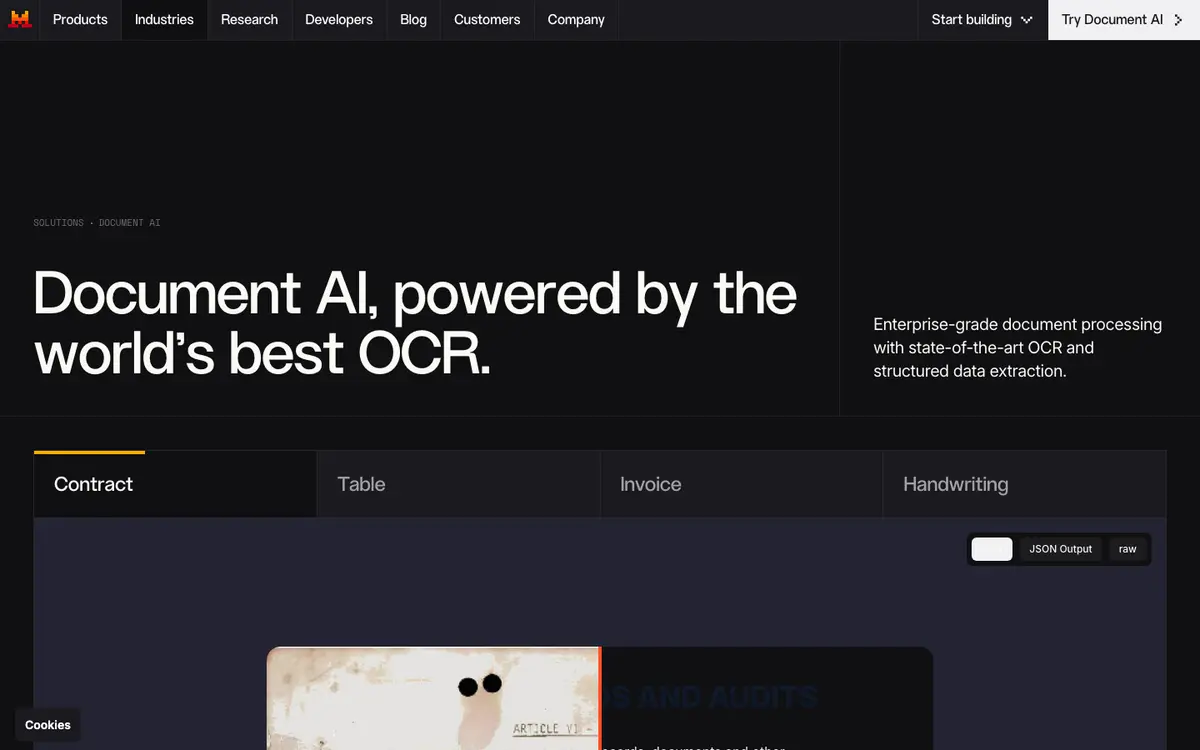
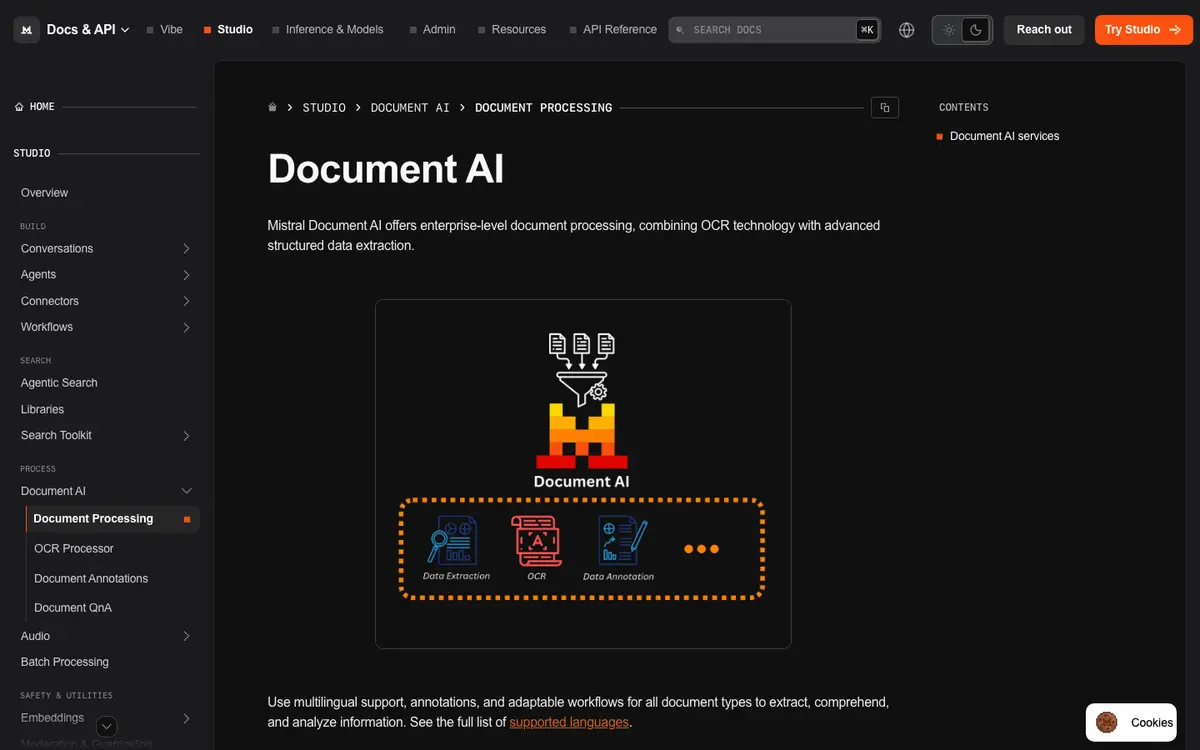
Try itExperimental
See what an agent can do with Mistral Document AI before you ever sign up. Pick a story: recorded sessions replay real probe-harness transcripts; commands tagged live-capable can re-run against the real endpoint from our edge, right now (▶ run live — the exact same request, live and recorded lines always labeled); sandboxed self-drive sessions are designed and gated (docs/TRY-IT.md).
$curl -s -X POST https://api.mistral.ai/v1/ocr -H 'Content-Type: application/json' -d '{}'recorded session — replayed, not liveVerified integrations
No integration evidence found in our corpus for this product yet — that means none was found, never that it doesn’t integrate.
By theme — the product's score on each story themeBy theme
Agenticness — how well agents can access and operate the productAgenticnessevidence →
How well agents can access and operate the product
Automation depth — how much of the product can run unattendedAutomation depthevidence →
How much of the product can run unattended
Deployment compliance — stories about deployment compliance in this arenaDeployment complianceevidence →
Stories about deployment compliance in this arena
Format coverage — stories about format coverage in this arenaFormat coverageevidence →
Stories about format coverage in this arena
Ocr multilingual — stories about ocr multilingual in this arenaOcr multilingualevidence →
Stories about ocr multilingual in this arena
Openness — open source, data portability, and self-hosting storiesOpennessevidence →
Open source, data portability, and self-hosting stories
Parse accuracy — stories about parse accuracy in this arenaParse accuracyevidence →
Stories about parse accuracy in this arena
Privacy posture — data-handling and privacy storiesPrivacy postureevidence →
Data-handling and privacy stories
Rag chunking — stories about rag chunking in this arenaRag chunkingevidence →
Stories about rag chunking in this arena
Scale async — stories about scale async in this arenaScale asyncevidence →
Stories about scale async in this arena
Sdk dx — stories about sdk dx in this arenaSdk dxevidence →
Stories about sdk dx in this arena
Structured extraction — stories about structured extraction in this arenaStructured extractionevidence →
Stories about structured extraction in this arena
Table extraction — stories about table extraction in this arenaTable extractionevidence →
Stories about table extraction in this arena
Story verdicts — every judged story with its evidenceStory verdicts
What’s free: 0 free · 6 paid · 1 enterprise · 15 not stated in evidence
Follow the green: where the map greys out is where Mistral Document AI stops today. ✓ full · ~ partial · ! disputed · — none · n/a not applicable.
Agenticness — how well agents can access and operate the productAgenticness
How well agents can access and operate the product
API surface
Drive the product through a documented public API
✓8/10
unlocks → Webhooks · Official SDKs · Machine-readable spec · Versioning policy · API sandbox · Official CLI · I drag a document into a web playground and see parse/extract results before writing any code · Official typed SDKs for Python and TypeScript cover the full API — parse, extract, jobs — with sensible defaults
Subscribe to events via webhooks
—–
Build against official SDKs
—–
Issue scoped/least-privilege API credentials for an agent
n/an/a
Connect an agent via an official MCP server
n/an/a
Download a machine-readable API spec (OpenAPI or equivalent)
—0/10
Rely on versioned APIs with a documented deprecation policy
—0/10
Test against a sandbox environment without touching production data
—–
Explore an interactive API reference with runnable examples
—0/10
Docs for agents
Point an agent at llms.txt or agent-oriented docs
~6/10
Agentic features
Delegate tasks to a built-in AI assistant inside the product
~4/10
Operate the product with natural-language commands
~4/10
unlocks → Autonomous automations
Plug MCP servers into this product so it can use their tools
n/an/a
Get AI-generated insights and suggestions from my data inside the product
✓7/10
Set up automations that run autonomously in the background
—–
Automation depth — how much of the product can run unattendedAutomation depth
How much of the product can run unattended
Deployment compliance — stories about deployment compliance in this arenaDeployment compliance
Stories about deployment compliance in this arena
Format coverage — stories about format coverage in this arenaFormat coverage
Stories about format coverage in this arena
Ocr multilingual — stories about ocr multilingual in this arenaOcr multilingual
Stories about ocr multilingual in this arena
Openness — open source, data portability, and self-hosting storiesOpenness
Open source, data portability, and self-hosting stories
Parse accuracy — stories about parse accuracy in this arenaParse accuracy
Stories about parse accuracy in this arena
Privacy posture — data-handling and privacy storiesPrivacy posture
Data-handling and privacy stories
Rag chunking — stories about rag chunking in this arenaRag chunking
Stories about rag chunking in this arena
Scale async — stories about scale async in this arenaScale async
Stories about scale async in this arena
Long parses run as async jobs with status polling and completion webhooks, so my pipeline never blocks
—0/10
A fast synchronous mode returns results in seconds for interactive apps, with latency documented per mode
—0/10
I push high-volume batches — millions of pages — with documented rate limits and predictable throughput
—0/10
Sdk dx — stories about sdk dx in this arenaSdk dx
Stories about sdk dx in this arena
Structured extraction — stories about structured extraction in this arenaStructured extraction
Stories about structured extraction in this arena
Every extracted field carries provenance — page number, bounding box, source snippet — so agents can cite and humans can verify
~7/10
Extractions carry calibrated confidence scores with a human-in-the-loop review path for low-confidence fields
~4/10
I supply a JSON schema and get back validated structured fields extracted from the document
~6/10
Multi-document packets are classified and split automatically — one upload, per-document results
—–
Table extraction — stories about table extraction in this arenaTable extraction
Stories about table extraction in this arena
Sorted by importance (agentic first) (high → low) · 53/53 stories · click a row’s chevron for the rationale and evidence
Drive the product through a documented public API G Agent access | ai-native user | Agenticness — how well agents can access and operate the productAgenticness | 3 | full | 8/10 | Tprobed | |
Delegate tasks to a built-in AI assistant inside the product G Agentic features | ai-native user | Agenticness — how well agents can access and operate the productAgenticness | 3 | partial | 4/10 | Cclaimed | |
Connect an agent via an official MCP server G Agent access | ai-native user | Agenticness — how well agents can access and operate the productAgenticness | 3 | n/a | 0/10 | ||
Plug MCP servers into this product so it can use their tools G Agent access | ai-native user | Agenticness — how well agents can access and operate the productAgenticness | 3 | n/a | untested | none yet | |
Get AI-generated insights and suggestions from my data inside the product G Agentic features | ai-native user | Agenticness — how well agents can access and operate the productAgenticness | 2 | full | 7/10 | Xcommunity | |
Point an agent at llms.txt or agent-oriented docs G Agent access | ai-native user | Agenticness — how well agents can access and operate the productAgenticness | 2 | partial | 6/10 | Tprobed | |
Run the product headlessly / in CI for automation G Agent access | ai-native user | Agenticness — how well agents can access and operate the productAgenticness | 2 | partial | 6/10 | Xcommunity | |
Operate the product with natural-language commands G Agentic features | ai-native user | Agenticness — how well agents can access and operate the productAgenticness | 2 | partial | 4/10 | Cclaimed | |
Download a machine-readable API spec (OpenAPI or equivalent) G Api quality | ai-native user | Agenticness — how well agents can access and operate the productAgenticness | 2 | none | 0/10 | ||
Explore an interactive API reference with runnable examples G Api quality | ai-native user | Agenticness — how well agents can access and operate the productAgenticness | 2 | none | 0/10 | ||
Rely on versioned APIs with a documented deprecation policy G Api quality | ai-native user | Agenticness — how well agents can access and operate the productAgenticness | 2 | none | 0/10 | ||
Use an official CLI G Agent access | ai-native user | Agenticness — how well agents can access and operate the productAgenticness | 2 | none | 0/10 | ||
Build against official SDKs G Agent access | ai-native user | Agenticness — how well agents can access and operate the productAgenticness | 2 | none | untested | none yet | |
Issue scoped/least-privilege API credentials for an agent G Agent access | ai-native user | Agenticness — how well agents can access and operate the productAgenticness | 2 | n/a | untested | none yet | |
Set up automations that run autonomously in the background G Agentic features | ai-native user | Agenticness — how well agents can access and operate the productAgenticness | 2 | none | untested | none yet | |
Subscribe to events via webhooks G Agent access | ai-native user | Agenticness — how well agents can access and operate the productAgenticness | 2 | none | untested | none yet | |
Test against a sandbox environment without touching production data G Api quality | ai-native user | Agenticness — how well agents can access and operate the productAgenticness | 1 | none | untested | none yet | |
I supply a JSON schema and get back validated structured fields extracted from the document C Schemas | developer | Structured extraction — stories about structured extraction in this arenaStructured extraction | 3 | partial | 6/10 | Cclaimed | |
Scanned and photographed documents OCR accurately — skewed pages, stamps, low quality scans included C Ocr | developer | Ocr multilingual — stories about ocr multilingual in this arenaOcr multilingual | 3 | disputed | 6/10 | Dcontradicted | |
The API parses complex real-world PDFs — multi-column layouts, headers, footers, footnotes — into clean, correctly ordered content C Layout | developer | Parse accuracy — stories about parse accuracy in this arenaParse accuracy | 3 | disputed | 6/10 | Dcontradicted | |
Complex tables — merged cells, nested headers, multi-page spans — come out as faithful HTML/markdown structure C Tables | data engineer | Table extraction — stories about table extraction in this arenaTable extraction | 3 | partialpaid | 5/10 | Xcommunity | |
Output comes pre-chunked for RAG — semantic boundaries, metadata, embedding-ready segments — not a wall of text C Chunking | ai-native user | Rag chunking — stories about rag chunking in this arenaRag chunking | 3 | partialpaid | 5/10 | Cclaimed | |
Export all of my data in open formats and leave G | ai-native user | Openness — open source, data portability, and self-hosting storiesOpenness | 3 | partial | 3/10 | Cclaimed | |
Self-host the core product G | ai-native user | Openness — open source, data portability, and self-hosting storiesOpenness | 3 | partial | 3/10 | Cclaimed | |
Long parses run as async jobs with status polling and completion webhooks, so my pipeline never blocks C Async | developer | Scale async — stories about scale async in this arenaScale async | 3 | none | 0/10 | ||
Prevent my data from being used to train AI models G | ai-native user | Privacy posture — data-handling and privacy storiesPrivacy posture | 3 | none | 0/10 | ||
Uploaded documents get zero-retention handling with SOC 2 and HIPAA options, so I can process contracts and medical records C Compliance | data engineer | Deployment compliance — stories about deployment compliance in this arenaDeployment compliance | 3 | none | 0/10 | ||
Define rules that trigger actions automatically on events G | ai-native user | Automation depth — how much of the product can run unattendedAutomation depth | 3 | n/a | untested | none yet | |
Official typed SDKs for Python and TypeScript cover the full API — parse, extract, jobs — with sensible defaults C Sdks | developer | Sdk dx — stories about sdk dx in this arenaSdk dx | 3 | none | untested | none yet | |
I get clean markdown/JSON designed for LLM consumption, with noise like repeated headers and page furniture stripped C Output | ai-native user | Rag chunking — stories about rag chunking in this arenaRag chunking | 2 | fullpaid | 8/10 | Xcommunity | |
Parsed output preserves document hierarchy — headings, sections, reading order — so downstream LLMs see structure, not soup C Layout | ml engineer | Parse accuracy — stories about parse accuracy in this arenaParse accuracy | 2 | fullpaid | 8/10 | Xcommunity | |
Every extracted field carries provenance — page number, bounding box, source snippet — so agents can cite and humans can verify C Grounding | ai-native user | Structured extraction — stories about structured extraction in this arenaStructured extraction | 2 | partialpaid | 7/10 | Xcommunity | |
One API handles my whole document mix — PDF, DOCX, PPTX, XLSX, HTML, images, email — without per-format plumbing C Formats | developer | Format coverage — stories about format coverage in this arenaFormat coverage | 2 | partialpaid | 7/10 | Xcommunity | |
Figures and charts are extracted or described (VLM summaries, image crops) with positions traceable back to the source page C Figures | ml engineer | Parse accuracy — stories about parse accuracy in this arenaParse accuracy | 2 | partial | 6/10 | Xcommunity | |
I turn extracted tables into typed rows/JSON I can load into a database without manual cleanup C Tables | data engineer | Table extraction — stories about table extraction in this arenaTable extraction | 2 | partial | 5/10 | Xcommunity | |
Extractions carry calibrated confidence scores with a human-in-the-loop review path for low-confidence fields C Review | data engineer | Structured extraction — stories about structured extraction in this arenaStructured extraction | 2 | partial | 4/10 | Xcommunity | |
Non-English documents — including CJK and right-to-left scripts — parse with the same fidelity as English C Languages | developer | Ocr multilingual — stories about ocr multilingual in this arenaOcr multilingual | 2 | disputed | 4/10 | Dcontradicted | |
Perform bulk operations across many items at once G | ai-native user | Automation depth — how much of the product can run unattendedAutomation depth | 2 | partial | 4/10 | Xcommunity | |
Thousand-page documents and multi-gigabyte files process reliably without timeouts or silent truncation C Scale limits | data engineer | Format coverage — stories about format coverage in this arenaFormat coverage | 2 | disputed | 4/10 | Dcontradicted | |
Choose where my data is stored (region/residency) G | ai-native user | Privacy posture — data-handling and privacy storiesPrivacy posture | 2 | partial | 3/10 | Cclaimed | |
Run the extraction stack in my own VPC or fully self-hosted when documents can't leave my infrastructure C Deployment | data engineer | Deployment compliance — stories about deployment compliance in this arenaDeployment compliance | 2 | partialenterprise | 3/10 | Cclaimed | |
A fast synchronous mode returns results in seconds for interactive apps, with latency documented per mode C Latency | developer | Scale async — stories about scale async in this arenaScale async | 2 | none | 0/10 | ||
Control data retention and deletion G | ai-native user | Privacy posture — data-handling and privacy storiesPrivacy posture | 2 | none | 0/10 | ||
I push high-volume batches — millions of pages — with documented rate limits and predictable throughput G Scale | data engineer | Scale async — stories about scale async in this arenaScale async | 2 | none | 0/10 | ||
Opt out of telemetry and usage tracking G | ai-native user | Privacy posture — data-handling and privacy storiesPrivacy posture | 2 | none | 0/10 | ||
Do everything through the API that I can do in the UI G | ai-native user | Openness — open source, data portability, and self-hosting storiesOpenness | 2 | n/a | untested | none yet | |
Multi-document packets are classified and split automatically — one upload, per-document results C Splitting | data engineer | Structured extraction — stories about structured extraction in this arenaStructured extraction | 2 | none | untested | none yet | |
Read the product's source under an open license G | ai-native user | Openness — open source, data portability, and self-hosting storiesOpenness | 2 | n/a | untested | none yet | |
Schedule recurring jobs or workflows G | ai-native user | Automation depth — how much of the product can run unattendedAutomation depth | 2 | n/a | untested | none yet | |
Handwritten fields and annotations are recognized and extracted, flagged with confidence when uncertain C Ocr | developer | Ocr multilingual — stories about ocr multilingual in this arenaOcr multilingual | 1 | partial | 6/10 | Xcommunity | |
I drag a document into a web playground and see parse/extract results before writing any code C Playground | developer | Sdk dx — stories about sdk dx in this arenaSdk dx | 1 | none | untested | none yet | |
The vendor publishes reproducible accuracy benchmarks and I can run my own evals before committing C Evals | ml engineer | Parse accuracy — stories about parse accuracy in this arenaParse accuracy | 1 | none | untested | none yet | |
Version, review, and roll back my automations G | ai-native user | Automation depth — how much of the product can run unattendedAutomation depth | 1 | n/a | untested | none yet |
Opportunities — the stories that would move this product's scores, from its own judged verdictsOpportunitiestop 8 of 37 stories with headroom
What would move Mistral Document AI’s scores — derived from its own judged verdicts, biggest headroom first. Each line quotes what the judge found missing; shipping it (or evidencing it publicly) is the fix.
Scale async — stories about scale async in this arenaLong parses run as async jobs with status polling and completion webhooks, so my pipeline never blocks
nonemoves PA Scoreimpact 30
No evidence anywhere in the docs pack of async job submission, status polling endpoints, or completion webhooks for Document AI OCR/annotation calls; the API appears to be synchronous (request/response), and one community report notes 900-page documents caused a timeout rather than being handled as a background job.
Deployment compliance — stories about deployment compliance in this arenaUploaded documents get zero-retention handling with SOC 2 and HIPAA options, so I can process contracts and medical records
nonemoves PA Scoreimpact 30
Evidence only shows generic marketing language about 'compliance-first organizations' and a 'Trust Center' link, with no concrete mention of zero-retention data handling, SOC 2 certification, or HIPAA compliance options for the Document AI product specifically.
Privacy posture — data-handling and privacy storiesPrevent my data from being used to train AI models
nonemoves PA Scoreimpact 30
Missing: explicit training-data opt-out policy, retention/data-use terms for API calls, independent confirmation of no-training defaults.
Sdk dx — stories about sdk dx in this arenaOfficial typed SDKs for Python and TypeScript cover the full API — parse, extract, jobs — with sensible defaults
nonemoves PA Scoreimpact 30
Missing: any mention of SDK packages, typed client libraries, installation/import examples, or SDK-specific defaults.
Agenticness — how well agents can access and operate the productSet up automations that run autonomously in the background
nonemoves Built-in AIimpact 30
The evidence pack covers only synchronous OCR/document-extraction capabilities (text extraction, annotations, Q&A) with no mention of scheduling, triggers, webhooks, or any mechanism for autonomous background automation runs.
Agenticness — how well agents can access and operate the productUse an official CLI
nonemoves agent-readyimpact 30
Evidence shows only official Python/TypeScript SDKs and a REST API for Document AI; there is no mention of an official CLI tool anywhere in the docs or community evidence.
Agenticness — how well agents can access and operate the productBuild against official SDKs
nonemoves agent-readyimpact 30
The evidence pack covers Document AI's OCR/annotation/QnA features and API endpoint details but contains no mention of official SDKs (Python, JS/TS, etc.) for building against Document AI — this is an applicable axis for an API product but no supporting evidence exists in the pack.
Agenticness — how well agents can access and operate the productSubscribe to events via webhooks
nonemoves agent-readyimpact 30
No evidence anywhere in the pack of webhook support or event subscription for Document AI; documentation covers OCR, annotations, and Q&A only, with no mention of webhooks or event-driven notifications.
Showing the top 8 of 37 — every none/partial verdict in the story verdicts table is headroom.
Think a verdict is wrong? Every verdicts-table row has a Flag link — see the methodology.
Coverage map — which docs area, API section, or community source covers which judged storiesCoverage map6 surfaces · 26 covered stories
Where the cited evidence behind each covered verdict came from — the same citations the verdicts table shows, no extra judging.
Studio docs23 stories
- Point an agent at llms.txt or agent-oriented docs
- Run the product headlessly / in CI for automation
- Drive the product through a documented public API
- Get AI-generated insights and suggestions from my data inside the product
- Delegate tasks to a built-in AI assistant inside the product
- Operate the product with natural-language commands
- Perform bulk operations across many items at once
- One API handles my whole document mix — PDF, DOCX, PPTX, XLSX, HTML, images, email — without per-format plumbing
- Thousand-page documents and multi-gigabyte files process reliably without timeouts or silent truncation
- Non-English documents — including CJK and right-to-left scripts — parse with the same fidelity as English
- Handwritten fields and annotations are recognized and extracted, flagged with confidence when uncertain
- Scanned and photographed documents OCR accurately — skewed pages, stamps, low quality scans included
- Export all of my data in open formats and leave
- Figures and charts are extracted or described (VLM summaries, image crops) with positions traceable back to the source page
- The API parses complex real-world PDFs — multi-column layouts, headers, footers, footnotes — into clean, correctly ordered content
- Parsed output preserves document hierarchy — headings, sections, reading order — so downstream LLMs see structure, not soup
- Output comes pre-chunked for RAG — semantic boundaries, metadata, embedding-ready segments — not a wall of text
- I get clean markdown/JSON designed for LLM consumption, with noise like repeated headers and page furniture stripped
- Every extracted field carries provenance — page number, bounding box, source snippet — so agents can cite and humans can verify
- Extractions carry calibrated confidence scores with a human-in-the-loop review path for low-confidence fields
- I supply a JSON schema and get back validated structured fields extracted from the document
- Complex tables — merged cells, nested headers, multi-page spans — come out as faithful HTML/markdown structure
- I turn extracted tables into typed rows/JSON I can load into a database without manual cleanup
Hacker News17 stories
- Run the product headlessly / in CI for automation
- Drive the product through a documented public API
- Get AI-generated insights and suggestions from my data inside the product
- Perform bulk operations across many items at once
- One API handles my whole document mix — PDF, DOCX, PPTX, XLSX, HTML, images, email — without per-format plumbing
- Thousand-page documents and multi-gigabyte files process reliably without timeouts or silent truncation
- Non-English documents — including CJK and right-to-left scripts — parse with the same fidelity as English
- Handwritten fields and annotations are recognized and extracted, flagged with confidence when uncertain
- Scanned and photographed documents OCR accurately — skewed pages, stamps, low quality scans included
- Figures and charts are extracted or described (VLM summaries, image crops) with positions traceable back to the source page
- The API parses complex real-world PDFs — multi-column layouts, headers, footers, footnotes — into clean, correctly ordered content
- Parsed output preserves document hierarchy — headings, sections, reading order — so downstream LLMs see structure, not soup
- I get clean markdown/JSON designed for LLM consumption, with noise like repeated headers and page furniture stripped
- Every extracted field carries provenance — page number, bounding box, source snippet — so agents can cite and humans can verify
- Extractions carry calibrated confidence scores with a human-in-the-loop review path for low-confidence fields
- Complex tables — merged cells, nested headers, multi-page spans — come out as faithful HTML/markdown structure
- I turn extracted tables into typed rows/JSON I can load into a database without manual cleanup
Solutions docs4 stories
Resources docs2 stories
Probe proofs — replayable recordings from the probe harnessProbe proofs
Replayable recordings from our probe harness — see the Prove-It protocol to submit one.
$curl -s -X POST https://api.mistral.ai/v1/ocr -H 'Content-Type: application/json' -d '{}'reproduced$ curl -s -X POST https://api.mistral.ai/v1/ocr -H 'Content-Type: application/json' -d '{}'
{"detail":"Invalid API [redacted]"}
$curl -s https://docs.mistral.ai/llms.txt | head -8reproduced$ curl -s https://docs.mistral.ai/llms.txt | head -8 # MistralAI ## Docs [Agents & Conversations](https://docs.mistral.ai/docs/agents/agents_and_conversations.md): Agents & Conversations API: Create, manage agents with tools, and handle interactive conversations with persistent history [Agents Function Calling](https://docs.mistral.ai/docs/agents/agents_function_calling.md): Agents use tools and function calling to perform tasks, with built-in and customizable options [Agents Introduction](https://docs.mistral.ai/docs/agents/agents_introduction.md): AI agents autonomously execute tasks using LLMs, with tools, state persistence, and multi-agent collaboration via the Agents API [Code Interpreter](https://docs.mistral.ai/docs/agents/connectors/code_interpreter.md): Code Interpreter enables safe, on-demand code execution for data analysis, graphing, and more in isolated containers
Claims vs evidence — vendor claims reconciled against independent verdictsClaims vs evidence
7 of 12 testable claims verified · 3 contradicted → integrity 8/100
17 distinct capability claims found in Mistral Document AI’s own claimed-docs/GitHub materials, reconciled against our judge’s independent verdicts.
7
Verified
2
Unverified
3
Contradicted
13
Undersold
Verified (7)
“Tables can be output as null, markdown, or HTML via a table_format parameter”
Complex tables — merged cells, nested headers, multi-page spans — come out as faithful HTML/markdown structurepartialproof ↗
“Block-level extraction returns paragraph bounding boxes, structural labels, and content in reading order”
Parsed output preserves document hierarchy — headings, sections, reading order — so downstream LLMs see structure, not soupfullproof ↗
“Block-level extraction returns paragraph bounding boxes, structural labels, and content in reading order”
Every extracted field carries provenance — page number, bounding box, source snippet — so agents can cite and humans can verifypartialproof ↗
“Confidence scores can be returned at page, block, or word granularity”
Extractions carry calibrated confidence scores with a human-in-the-loop review path for low-confidence fieldspartialproof ↗
“bbox_annotation feature annotates extracted bounding boxes (e.g. charts/figures) per a user-supplied format”
Figures and charts are extracted or described (VLM summaries, image crops) with positions traceable back to the source pagepartialproof ↗
“OCR works on low-quality or handwritten image sources”
Handwritten fields and annotations are recognized and extracted, flagged with confidence when uncertainpartialproof ↗
“Accepts a broad range of document/image formats (PNG, JPEG, AVIF, PDF, PPTX, DOCX, etc.) through one API”
One API handles my whole document mix — PDF, DOCX, PPTX, XLSX, HTML, images, email — without per-format plumbingpartialproof ↗
Unverified (2)
“document_annotation feature returns a whole-document annotation based on a user-supplied format”
I supply a JSON schema and get back validated structured fields extracted from the documentpartialproof ↗
“Offers secure, compliance-focused on-premises/self-hosted deployment for regulated organizations”
Run the extraction stack in my own VPC or fully self-hosted when documents can't leave my infrastructurepartialproof ↗
Contradicted (4)
“OCR processor extracts text and structured content from PDF documents and images”
Scanned and photographed documents OCR accurately — skewed pages, stamps, low quality scans includeddisputedproof ↗
“Headers and footers can be extracted separately into dedicated response fields”
The API parses complex real-world PDFs — multi-column layouts, headers, footers, footnotes — into clean, correctly ordered contentdisputedproof ↗
“OCR performs strongly across more than 40 languages”
Non-English documents — including CJK and right-to-left scripts — parse with the same fidelity as Englishdisputedproof ↗
“OCR works on low-quality or handwritten image sources”
Scanned and photographed documents OCR accurately — skewed pages, stamps, low quality scans includeddisputedproof ↗
Undersold (13)
Point an agent at llms.txt or agent-oriented docspartialproof ↗
Run the product headlessly / in CI for automationpartialproof ↗
Drive the product through a documented public APIfullproof ↗
Get AI-generated insights and suggestions from my data inside the productfullproof ↗
Delegate tasks to a built-in AI assistant inside the productpartialproof ↗
Operate the product with natural-language commandspartialproof ↗
Perform bulk operations across many items at oncepartialproof ↗
Export all of my data in open formats and leavepartialproof ↗
Choose where my data is stored (region/residency)partialproof ↗
Output comes pre-chunked for RAG — semantic boundaries, metadata, embedding-ready segments — not a wall of textpartialproof ↗
I get clean markdown/JSON designed for LLM consumption, with noise like repeated headers and page furniture strippedfullproof ↗
I turn extracted tables into typed rows/JSON I can load into a database without manual cleanuppartialproof ↗
Claims outside our story set (6)
Real capability claims found in Mistral Document AI’s own materials, but no story in this arena’s taxonomy covers them yet — that’s feedback on the taxonomy, not a mark against the product.
“Can extract vendor details and amounts from invoices for accounting automation”
source ↗“Can capture merchant names and transaction amounts from receipts for expense management”
source ↗“Can extract key clauses and terms from contracts for review and management”
source ↗“Document QnA combines OCR with an LLM to enable natural-language interaction with document content”
source ↗“Supports multi-document queries and comparisons”
source ↗“PDFs can be provided via public URL, base64 encoding, or direct file upload”
source ↗
Business model
Usage-based: OCR 4.1 at $4 per 1,000 pages and Document AI annotations at $5 per 1,000 pages; document-library OCR/indexing priced separately; enterprise deployments custom.
pricing ↗Score trend
How this product’s scores have moved as evidence and verdicts are re-derived — a point per change, not per day.
Try Experimental
Run it in the microterminal →Recorded agent sessions — and a live MCP handshake where the vendor ships one.
Flag
⚑ Flag a verdictThink a verdict is wrong? Opens a prefilled GitHub issue — or use the ⚑ next to any verdict above.
For agents
Agent surface uptime llms.txt up (tracking since Sep 11 '26)