Rank #2 of 5 in Expense Management

 vs Ramp
 vs Expensify
 vs Navan
 vs BILL Spend & Expense
Showcase

Try itExperimental
See what an agent can do with Brex before you ever sign up. Pick a story: recorded sessions replay real probe-harness transcripts; commands tagged live-capable can re-run against the real endpoint from our edge, right now (▶ run live — the exact same request, live and recorded lines always labeled); sandboxed self-drive sessions are designed and gated (docs/TRY-IT.md).
$curl -si https://platform.brexapis.com/v2/transactions/card/primary | head -1 # the documented platform API, keyless → 401recorded session — replayed, not liveVerified integrations
Connections to other tracked products — hover a chip for the verbatim evidence quote behind it.

By theme — the product's score on each story themeBy theme
Accounting close — stories about accounting close in this arenaAccounting closeevidence →
Stories about accounting close in this arena
Agenticness — how well agents can access and operate the productAgenticnessevidence →
How well agents can access and operate the product
Ai automation — stories about ai automation in this arenaAi automationevidence →
Stories about ai automation in this arena
Automation depth — how much of the product can run unattendedAutomation depthevidence →
How much of the product can run unattended
Bills ap — stories about bills ap in this arenaBills apevidence →
Stories about bills ap in this arena
Cards controls — stories about cards controls in this arenaCards controlsevidence →
Stories about cards controls in this arena
Expense data access — stories about expense data access in this arenaExpense data accessevidence →
Stories about expense data access in this arena
Openness — open source, data portability, and self-hosting storiesOpennessevidence →
Open source, data portability, and self-hosting stories
Policy approvals — stories about policy approvals in this arenaPolicy approvalsevidence →
Stories about policy approvals in this arena
Privacy posture — data-handling and privacy storiesPrivacy postureevidence →
Data-handling and privacy stories
Receipts capture — stories about receipts capture in this arenaReceipts captureevidence →
Stories about receipts capture in this arena
Reimbursements — stories about reimbursements in this arenaReimbursementsevidence →
Stories about reimbursements in this arena
Spend visibility — stories about spend visibility in this arenaSpend visibilityevidence →
Stories about spend visibility in this arena
Travel — stories about travel in this arenaTravelevidence →
Stories about travel in this arena
Story verdicts — every judged story with its evidenceStory verdicts
Follow the green: where the map greys out is where Brex stops today. ✓ full · ~ partial · ! disputed · — none · n/a not applicable.
Accounting close — stories about accounting close in this arenaAccounting close
Stories about accounting close in this arena
Transactions sync to QuickBooks, NetSuite, or Xero with GL account, class, and department mappings I control
—0/10
Spend is coded as it happens — merchant, category, memo, receipt — so month-end close is a review, not an archaeology dig
✓8/10
Run multiple legal entities and currencies in one account with consolidated reporting and per-entity books
~3/10
Agenticness — how well agents can access and operate the productAgenticness
How well agents can access and operate the product
API surface
Drive the product through a documented public API
✓8/10
unlocks → Official SDKs · Versioning policy · API sandbox · Official CLI
Subscribe to events via webhooks
✓8/10
Build against official SDKs
—–
Issue scoped/least-privilege API credentials for an agent
✓7/10
Connect an agent via an official MCP server
✓8/10
Download a machine-readable API spec (OpenAPI or equivalent)
~4/10
unlocks → Official SDKs
Rely on versioned APIs with a documented deprecation policy
—0/10
Test against a sandbox environment without touching production data
—–
Explore an interactive API reference with runnable examples
~4/10
Docs for agents
Point an agent at llms.txt or agent-oriented docs
✓9/10
Agentic features
Delegate tasks to a built-in AI assistant inside the product
✓7/10
unlocks → MCP client
Operate the product with natural-language commands
~7/10
Plug MCP servers into this product so it can use their tools
—0/10
Get AI-generated insights and suggestions from my data inside the product
✓7/10
Set up automations that run autonomously in the background
✓7/10
Ai automation — stories about ai automation in this arenaAi automation
Stories about ai automation in this arena
Automation depth — how much of the product can run unattendedAutomation depth
How much of the product can run unattended
Bills ap — stories about bills ap in this arenaBills ap
Stories about bills ap in this arena
Cards controls — stories about cards controls in this arenaCards controls
Stories about cards controls in this arena
Restrict cards by category, merchant, and amount — and the platform auto-locks or declines out-of-policy spend at the point of sale
✓7/10
Issue physical and virtual corporate cards to the team in minutes, each with its own spend limit
✓8/10
Create single-vendor virtual cards for SaaS subscriptions and procurement so one compromised vendor never exposes shared credit
✓7/10
Expense data access — stories about expense data access in this arenaExpense data access
Stories about expense data access in this arena
An agent can pull uncoded transactions via API or MCP, propose categorizations and policy flags, and push clean coding back for review
~6/10
Pull transactions, expenses, and receipts through a documented REST API with OAuth and scoped tokens
~7/10
Issue and manage cards programmatically — create a card with a limit, lock it, update controls — via the public API
~4/10
Openness — open source, data portability, and self-hosting storiesOpenness
Open source, data portability, and self-hosting stories
Policy approvals — stories about policy approvals in this arenaPolicy approvals
Stories about policy approvals in this arena
Build multi-step approval chains — manager, budget owner, finance — with delegation and escalation when approvers sit on requests
~5/10
Every expense carries a full audit trail — edits, approvals, policy checks — that survives an external audit
~6/10
Codify our expense policy — limits by category, role, and context — so in-policy expenses auto-approve and only exceptions reach a human
✓8/10
Privacy posture — data-handling and privacy storiesPrivacy posture
Data-handling and privacy stories
Receipts capture — stories about receipts capture in this arenaReceipts capture
Stories about receipts capture in this arena
Log mileage with map-based distance and claim per-diem rates without building the expense by hand
—0/10
Snap a photo or forward an email and the platform OCRs the receipt and files it against the right transaction
~6/10
Receipts match to card transactions automatically — with e-receipts pulled from integrations — and I get nudged only when one is genuinely missing
~6/10
Reimbursements — stories about reimbursements in this arenaReimbursements
Stories about reimbursements in this arena
Spend visibility — stories about spend visibility in this arenaSpend visibility
Stories about spend visibility in this arena
Travel — stories about travel in this arenaTravel
Stories about travel in this arena
Sorted by importance (agentic first) (high → low) · 53/53 stories · click a row’s chevron for the rationale and evidence
Connect an agent via an official MCP server G Agent access | ai-native user | Agenticness — how well agents can access and operate the productAgenticness | 3 | full | 8/10 | Tprobed | |
Drive the product through a documented public API G Agent access | ai-native user | Agenticness — how well agents can access and operate the productAgenticness | 3 | full | 8/10 | Tprobed | |
Delegate tasks to a built-in AI assistant inside the product G Agentic features | ai-native user | Agenticness — how well agents can access and operate the productAgenticness | 3 | full | 7/10 | Cclaimed | |
Plug MCP servers into this product so it can use their tools G Agent access | ai-native user | Agenticness — how well agents can access and operate the productAgenticness | 3 | none | 0/10 | ||
Point an agent at llms.txt or agent-oriented docs G Agent access | ai-native user | Agenticness — how well agents can access and operate the productAgenticness | 2 | full | 9/10 | Tprobed | |
Subscribe to events via webhooks G Agent access | ai-native user | Agenticness — how well agents can access and operate the productAgenticness | 2 | full | 8/10 | Cclaimed | |
Get AI-generated insights and suggestions from my data inside the product G Agentic features | ai-native user | Agenticness — how well agents can access and operate the productAgenticness | 2 | full | 7/10 | Cclaimed | |
Issue scoped/least-privilege API credentials for an agent G Agent access | ai-native user | Agenticness — how well agents can access and operate the productAgenticness | 2 | full | 7/10 | Tprobed | |
Operate the product with natural-language commands G Agentic features | ai-native user | Agenticness — how well agents can access and operate the productAgenticness | 2 | partial | 7/10 | Tprobed | |
Set up automations that run autonomously in the background G Agentic features | ai-native user | Agenticness — how well agents can access and operate the productAgenticness | 2 | full | 7/10 | Cclaimed | |
Run the product headlessly / in CI for automation G Agent access | ai-native user | Agenticness — how well agents can access and operate the productAgenticness | 2 | partial | 6/10 | Cclaimed | |
Download a machine-readable API spec (OpenAPI or equivalent) G Api quality | ai-native user | Agenticness — how well agents can access and operate the productAgenticness | 2 | partial | 4/10 | Tprobed | |
Explore an interactive API reference with runnable examples G Api quality | ai-native user | Agenticness — how well agents can access and operate the productAgenticness | 2 | partial | 4/10 | Tprobed | |
Rely on versioned APIs with a documented deprecation policy G Api quality | ai-native user | Agenticness — how well agents can access and operate the productAgenticness | 2 | none | 0/10 | ||
Use an official CLI G Agent access | ai-native user | Agenticness — how well agents can access and operate the productAgenticness | 2 | none | 0/10 | ||
Build against official SDKs G Agent access | ai-native user | Agenticness — how well agents can access and operate the productAgenticness | 2 | none | untested | none yet | |
Test against a sandbox environment without touching production data G Api quality | ai-native user | Agenticness — how well agents can access and operate the productAgenticness | 1 | none | untested | none yet | |
Codify our expense policy — limits by category, role, and context — so in-policy expenses auto-approve and only exceptions reach a human C Policy engine | finance lead | Policy approvals — stories about policy approvals in this arenaPolicy approvals | 3 | full | 8/10 | Cclaimed | |
Issue physical and virtual corporate cards to the team in minutes, each with its own spend limit C Card issuance | founder | Cards controls — stories about cards controls in this arenaCards controls | 3 | full | 8/10 | Cclaimed | |
Define rules that trigger actions automatically on events G | ai-native user | Automation depth — how much of the product can run unattendedAutomation depth | 3 | partial | 7/10 | Cclaimed | |
Pull transactions, expenses, and receipts through a documented REST API with OAuth and scoped tokens C Api access | developer | Expense data access — stories about expense data access in this arenaExpense data access | 3 | partial | 7/10 | Tprobed | |
Restrict cards by category, merchant, and amount — and the platform auto-locks or declines out-of-policy spend at the point of sale C Card controls | finance lead | Cards controls — stories about cards controls in this arenaCards controls | 3 | full | 7/10 | Cclaimed | |
See company spend in real time — by team, category, and merchant — the day it happens, not when statements land C Dashboards | founder | Spend visibility — stories about spend visibility in this arenaSpend visibility | 3 | full | 7/10 | Cclaimed | |
An agent can pull uncoded transactions via API or MCP, propose categorizations and policy flags, and push clean coding back for review C Agent access | ai-native user | Expense data access — stories about expense data access in this arenaExpense data access | 3 | partial | 6/10 | Tprobed | |
Snap a photo or forward an email and the platform OCRs the receipt and files it against the right transaction C Receipt capture | employee | Receipts capture — stories about receipts capture in this arenaReceipts capture | 3 | partial | 6/10 | Cclaimed | |
Submit an out-of-pocket expense and get reimbursed by direct deposit in days, tracked from submission to payout C Domestic | employee | Reimbursements — stories about reimbursements in this arenaReimbursements | 3 | partial | 5/10 | Cclaimed | |
Export all of my data in open formats and leave G | ai-native user | Openness — open source, data portability, and self-hosting storiesOpenness | 3 | partial | 4/10 | Cclaimed | |
Transactions sync to QuickBooks, NetSuite, or Xero with GL account, class, and department mappings I control C Accounting sync | finance lead | Accounting close — stories about accounting close in this arenaAccounting close | 3 | none | 0/10 | ||
Prevent my data from being used to train AI models G | ai-native user | Privacy posture — data-handling and privacy storiesPrivacy posture | 3 | none | untested | none yet | |
Self-host the core product G | ai-native user | Openness — open source, data portability, and self-hosting storiesOpenness | 3 | n/a | untested | none yet | |
AI codes and audits expenses for me — reading receipts, suggesting categories and memos, and catching duplicates or fraud C Ai coding | ai-native user | Ai automation — stories about ai automation in this arenaAi automation | 2 | full | 8/10 | Cclaimed | |
Allocate budgets to teams and projects and have card limits and approvals actually enforce them C Budgets | finance lead | Spend visibility — stories about spend visibility in this arenaSpend visibility | 2 | full | 8/10 | Cclaimed | |
Book flights and hotels in-platform with travel policy applied at booking time, not expensed and argued about later C Booking | employee | Travel — stories about travel in this arenaTravel | 2 | full | 8/10 | Xcommunity | |
Perform bulk operations across many items at once G | ai-native user | Automation depth — how much of the product can run unattendedAutomation depth | 2 | full | 8/10 | Cclaimed | |
Run accounts payable in the same platform — capture invoices, route approvals, and pay vendors by ACH, check, or wire C Bill pay | finance lead | Bills ap — stories about bills ap in this arenaBills ap | 2 | full | 8/10 | Cclaimed | |
Spend is coded as it happens — merchant, category, memo, receipt — so month-end close is a review, not an archaeology dig C Close | finance lead | Accounting close — stories about accounting close in this arenaAccounting close | 2 | full | 8/10 | Cclaimed | |
An AI assistant enforces policy conversationally — chasing missing receipts, explaining declines, and answering "can I expense this?" before the spend happens C Ai policy | ai-native user | Ai automation — stories about ai automation in this arenaAi automation | 2 | partial | 7/10 | Cclaimed | |
Create single-vendor virtual cards for SaaS subscriptions and procurement so one compromised vendor never exposes shared credit C Virtual cards | finance lead | Cards controls — stories about cards controls in this arenaCards controls | 2 | full | 7/10 | Cclaimed | |
Every expense carries a full audit trail — edits, approvals, policy checks — that survives an external audit C Audit trail | finance lead | Policy approvals — stories about policy approvals in this arenaPolicy approvals | 2 | partial | 6/10 | Cclaimed | |
Receipts match to card transactions automatically — with e-receipts pulled from integrations — and I get nudged only when one is genuinely missing C Receipt matching | employee | Receipts capture — stories about receipts capture in this arenaReceipts capture | 2 | partial | 6/10 | Cclaimed | |
Build multi-step approval chains — manager, budget owner, finance — with delegation and escalation when approvers sit on requests C Approvals | finance lead | Policy approvals — stories about policy approvals in this arenaPolicy approvals | 2 | partial | 5/10 | Cclaimed | |
Do everything through the API that I can do in the UI G | ai-native user | Openness — open source, data portability, and self-hosting storiesOpenness | 2 | partial | 5/10 | Tprobed | |
Issue and manage cards programmatically — create a card with a limit, lock it, update controls — via the public API C Card api | developer | Expense data access — stories about expense data access in this arenaExpense data access | 2 | partial | 4/10 | Cclaimed | |
Run multiple legal entities and currencies in one account with consolidated reporting and per-entity books C Multi entity | finance lead | Accounting close — stories about accounting close in this arenaAccounting close | 2 | partial | 3/10 | Cclaimed | |
Schedule recurring jobs or workflows G | ai-native user | Automation depth — how much of the product can run unattendedAutomation depth | 2 | partial | 3/10 | Cclaimed | |
Log mileage with map-based distance and claim per-diem rates without building the expense by hand C Mileage perdiem | employee | Receipts capture — stories about receipts capture in this arenaReceipts capture | 2 | none | 0/10 | ||
Choose where my data is stored (region/residency) G | ai-native user | Privacy posture — data-handling and privacy storiesPrivacy posture | 2 | none | untested | none yet | |
Control data retention and deletion G | ai-native user | Privacy posture — data-handling and privacy storiesPrivacy posture | 2 | none | untested | none yet | |
Opt out of telemetry and usage tracking G | ai-native user | Privacy posture — data-handling and privacy storiesPrivacy posture | 2 | none | untested | none yet | |
Read the product's source under an open license G | ai-native user | Openness — open source, data portability, and self-hosting storiesOpenness | 2 | n/a | untested | none yet | |
Reimburse employees abroad in their local currency without running a separate international payments process C International | finance lead | Reimbursements — stories about reimbursements in this arenaReimbursements | 2 | none | untested | none yet | |
A trip's expenses — bookings, cards, receipts — collect themselves into one itinerary-linked report C Trip expenses | employee | Travel — stories about travel in this arenaTravel | 1 | partial | 5/10 | Cclaimed | |
Version, review, and roll back my automations G | ai-native user | Automation depth — how much of the product can run unattendedAutomation depth | 1 | none | untested | none yet |
Opportunities — the stories that would move this product's scores, from its own judged verdictsOpportunitiestop 8 of 32 stories with headroom
What would move Brex’s scores — derived from its own judged verdicts, biggest headroom first. Each line quotes what the judge found missing; shipping it (or evidencing it publicly) is the fix.
Agenticness — how well agents can access and operate the productPlug MCP servers into this product so it can use their tools
nonemoves agent-readyimpact 45
Evidence only shows Brex publishing its own MCP server so external AI assistants can call Brex's tools (docs-3, docs-24, probe-3) — the reverse of this story, which asks whether Brex can consume/plug in external MCP servers to use their tools.
Accounting close — stories about accounting close in this arenaTransactions sync to QuickBooks, NetSuite, or Xero with GL account, class, and department mappings I control
nonemoves PA Scoreimpact 30
The evidence pack shows Brex has a one-click accounting sync feature, but it is documented only as syncing to Puzzle (brex-docs-17, 18, 40), with no mention of QuickBooks, NetSuite, or Xero, nor any documentation of finance-lead-controlled GL account, class, or department mapping for such syncs.
Privacy posture — data-handling and privacy storiesPrevent my data from being used to train AI models
nonemoves PA Scoreimpact 30
No evidence pack item addresses AI training data usage, opt-out settings, or a data-privacy policy regarding model training; the evidence only covers API/product features and unrelated community complaints about account closures.
Agenticness — how well agents can access and operate the productUse an official CLI
nonemoves agent-readyimpact 30
Evidence pack shows Brex's developer platform (APIs, Postman collection, MCP server, Zapier/Pipedream/Workato integrations) but no mention of an official CLI tool anywhere in docs or changelog.
Agenticness — how well agents can access and operate the productBuild against official SDKs
nonemoves agent-readyimpact 30
Brex documents REST APIs (OpenAPI specs), authentication, webhooks, a Postman workspace, and third-party integrations (Pipedream, Zapier, Workato), but nowhere in the evidence pack is there mention of official client-library SDKs (e.g., Node.js, Python, Java packages) that AI-native developers could build against.
Agenticness — how well agents can access and operate the productRely on versioned APIs with a documented deprecation policy
nonemoves API qualityimpact 30
The evidence shows a changelog tracking feature additions (e.g., new filter params, policy fields) but nothing documenting API versioning scheme or a deprecation policy for breaking changes.
Reimbursements — stories about reimbursements in this arenaReimburse employees abroad in their local currency without running a separate international payments process
nonemoves PA Scoreimpact 20
Evidence covers global card acceptance (210+ countries), bill pay wires 'in more currencies' for vendor payments, and general 'global spend' messaging, but nothing specifically addresses reimbursing employees abroad in their local currency or eliminating a separate international payments process for reimbursements.
Receipts capture — stories about receipts capture in this arenaLog mileage with map-based distance and claim per-diem rates without building the expense by hand
nonemoves PA Scoreimpact 20
No evidence in the pack mentions mileage tracking, GPS/map-based distance calculation, or per-diem rate claims; Brex's expense documentation focuses on card transactions, receipt upload/matching, and policy enforcement but never describes mileage or per-diem automation.
Showing the top 8 of 32 — every none/partial verdict in the story verdicts table is headroom.
Think a verdict is wrong? Every verdicts-table row has a Flag link — see the methodology.
Coverage map — which docs area, API section, or community source covers which judged storiesCoverage map10 surfaces · 38 covered stories
Where the cited evidence behind each covered verdict came from — the same citations the verdicts table shows, no extra judging.
Openapi docs25 stories
- Spend is coded as it happens — merchant, category, memo, receipt — so month-end close is a review, not an archaeology dig
- Run the product headlessly / in CI for automation
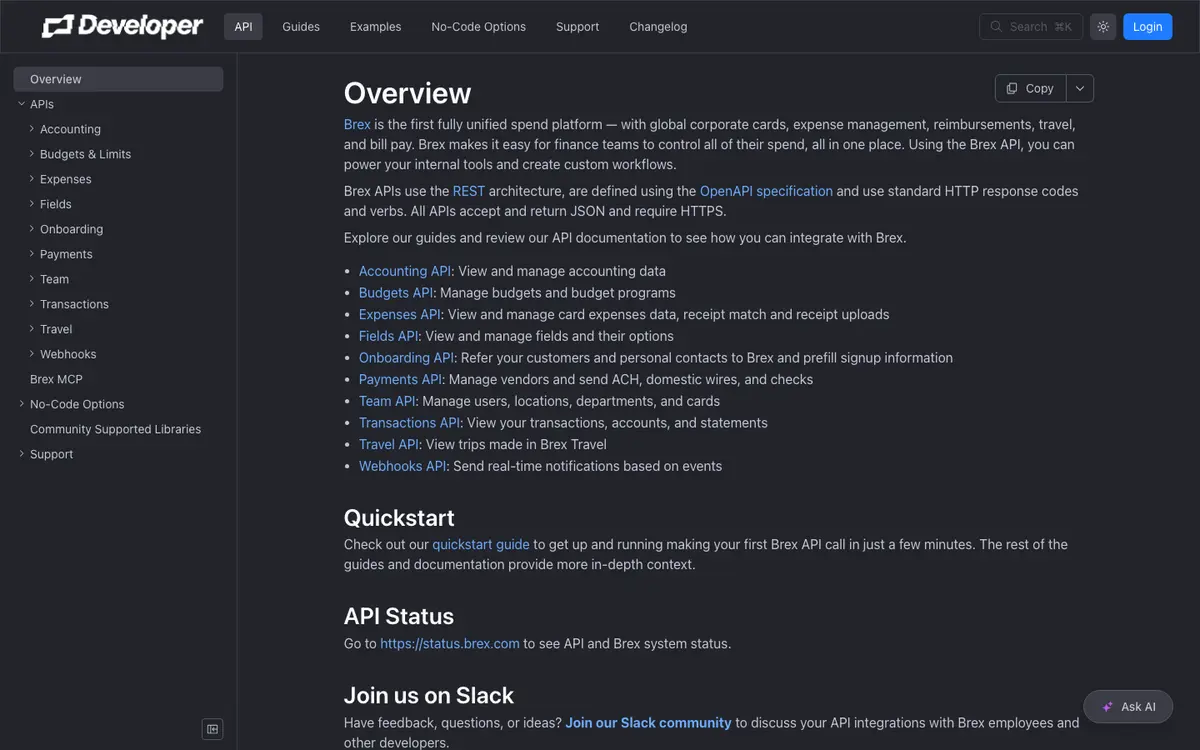
- Drive the product through a documented public API
- Subscribe to events via webhooks
- Set up automations that run autonomously in the background
- Explore an interactive API reference with runnable examples
- Download a machine-readable API spec (OpenAPI or equivalent)
- AI codes and audits expenses for me — reading receipts, suggesting categories and memos, and catching duplicates or fraud
- Define rules that trigger actions automatically on events
- Schedule recurring jobs or workflows
- Run accounts payable in the same platform — capture invoices, route approvals, and pay vendors by ACH, check, or wire
- Restrict cards by category, merchant, and amount — and the platform auto-locks or declines out-of-policy spend at the point of sale
- Issue physical and virtual corporate cards to the team in minutes, each with its own spend limit
- An agent can pull uncoded transactions via API or MCP, propose categorizations and policy flags, and push clean coding back for review
- Pull transactions, expenses, and receipts through a documented REST API with OAuth and scoped tokens
- Issue and manage cards programmatically — create a card with a limit, lock it, update controls — via the public API
- Do everything through the API that I can do in the UI
- Export all of my data in open formats and leave
- Codify our expense policy — limits by category, role, and context — so in-policy expenses auto-approve and only exceptions reach a human
- Snap a photo or forward an email and the platform OCRs the receipt and files it against the right transaction
- Receipts match to card transactions automatically — with e-receipts pulled from integrations — and I get nudged only when one is genuinely missing
- Submit an out-of-pocket expense and get reimbursed by direct deposit in days, tracked from submission to payout
- Allocate budgets to teams and projects and have card limits and approvals actually enforce them
- See company spend in real time — by team, category, and merchant — the day it happens, not when statements land
- A trip's expenses — bookings, cards, receipts — collect themselves into one itinerary-linked report
Product docs20 stories
- Spend is coded as it happens — merchant, category, memo, receipt — so month-end close is a review, not an archaeology dig
- Run multiple legal entities and currencies in one account with consolidated reporting and per-entity books
- Get AI-generated insights and suggestions from my data inside the product
- Delegate tasks to a built-in AI assistant inside the product
- An AI assistant enforces policy conversationally — chasing missing receipts, explaining declines, and answering "can I expense this?" before the spend happens
- Define rules that trigger actions automatically on events
- Run accounts payable in the same platform — capture invoices, route approvals, and pay vendors by ACH, check, or wire
- Restrict cards by category, merchant, and amount — and the platform auto-locks or declines out-of-policy spend at the point of sale
- Issue physical and virtual corporate cards to the team in minutes, each with its own spend limit
- Create single-vendor virtual cards for SaaS subscriptions and procurement so one compromised vendor never exposes shared credit
- Issue and manage cards programmatically — create a card with a limit, lock it, update controls — via the public API
- Do everything through the API that I can do in the UI
- Build multi-step approval chains — manager, budget owner, finance — with delegation and escalation when approvers sit on requests
- Every expense carries a full audit trail — edits, approvals, policy checks — that survives an external audit
- Codify our expense policy — limits by category, role, and context — so in-policy expenses auto-approve and only exceptions reach a human
- Submit an out-of-pocket expense and get reimbursed by direct deposit in days, tracked from submission to payout
- Allocate budgets to teams and projects and have card limits and approvals actually enforce them
- See company spend in real time — by team, category, and merchant — the day it happens, not when statements land
- Book flights and hotels in-platform with travel policy applied at booking time, not expensed and argued about later
- A trip's expenses — bookings, cards, receipts — collect themselves into one itinerary-linked report
docs19 stories
- Point an agent at llms.txt or agent-oriented docs
- Run the product headlessly / in CI for automation
- Connect an agent via an official MCP server
- Drive the product through a documented public API
- Issue scoped/least-privilege API credentials for an agent
- Set up automations that run autonomously in the background
- Operate the product with natural-language commands
- Explore an interactive API reference with runnable examples
- Download a machine-readable API spec (OpenAPI or equivalent)
- An AI assistant enforces policy conversationally — chasing missing receipts, explaining declines, and answering "can I expense this?" before the spend happens
- Perform bulk operations across many items at once
- Define rules that trigger actions automatically on events
- Schedule recurring jobs or workflows
- Issue physical and virtual corporate cards to the team in minutes, each with its own spend limit
- Create single-vendor virtual cards for SaaS subscriptions and procurement so one compromised vendor never exposes shared credit
- An agent can pull uncoded transactions via API or MCP, propose categorizations and policy flags, and push clean coding back for review
- Issue and manage cards programmatically — create a card with a limit, lock it, update controls — via the public API
- Do everything through the API that I can do in the UI
- Export all of my data in open formats and leave
AI docs16 stories
- Spend is coded as it happens — merchant, category, memo, receipt — so month-end close is a review, not an archaeology dig
- Get AI-generated insights and suggestions from my data inside the product
- Set up automations that run autonomously in the background
- Delegate tasks to a built-in AI assistant inside the product
- Operate the product with natural-language commands
- AI codes and audits expenses for me — reading receipts, suggesting categories and memos, and catching duplicates or fraud
- An AI assistant enforces policy conversationally — chasing missing receipts, explaining declines, and answering "can I expense this?" before the spend happens
- Define rules that trigger actions automatically on events
- Restrict cards by category, merchant, and amount — and the platform auto-locks or declines out-of-policy spend at the point of sale
- An agent can pull uncoded transactions via API or MCP, propose categorizations and policy flags, and push clean coding back for review
- Build multi-step approval chains — manager, budget owner, finance — with delegation and escalation when approvers sit on requests
- Every expense carries a full audit trail — edits, approvals, policy checks — that survives an external audit
- Codify our expense policy — limits by category, role, and context — so in-policy expenses auto-approve and only exceptions reach a human
- Snap a photo or forward an email and the platform OCRs the receipt and files it against the right transaction
- Receipts match to card transactions automatically — with e-receipts pulled from integrations — and I get nudged only when one is genuinely missing
- Submit an out-of-pocket expense and get reimbursed by direct deposit in days, tracked from submission to payout
Changelog docs11 stories
- Run multiple legal entities and currencies in one account with consolidated reporting and per-entity books
- Perform bulk operations across many items at once
- An agent can pull uncoded transactions via API or MCP, propose categorizations and policy flags, and push clean coding back for review
- Pull transactions, expenses, and receipts through a documented REST API with OAuth and scoped tokens
- Do everything through the API that I can do in the UI
- Export all of my data in open formats and leave
- Every expense carries a full audit trail — edits, approvals, policy checks — that survives an external audit
- Codify our expense policy — limits by category, role, and context — so in-policy expenses auto-approve and only exceptions reach a human
- See company spend in real time — by team, category, and merchant — the day it happens, not when statements land
- Book flights and hotels in-platform with travel policy applied at booking time, not expensed and argued about later
- A trip's expenses — bookings, cards, receipts — collect themselves into one itinerary-linked report
Guides docs9 stories
- Run the product headlessly / in CI for automation
- Drive the product through a documented public API
- Issue scoped/least-privilege API credentials for an agent
- Subscribe to events via webhooks
- Set up automations that run autonomously in the background
- Define rules that trigger actions automatically on events
- Schedule recurring jobs or workflows
- Pull transactions, expenses, and receipts through a documented REST API with OAuth and scoped tokens
- Do everything through the API that I can do in the UI
OpenAPI spec5 stories
- Drive the product through a documented public API
- Explore an interactive API reference with runnable examples
- Download a machine-readable API spec (OpenAPI or equivalent)
- Pull transactions, expenses, and receipts through a documented REST API with OAuth and scoped tokens
- Do everything through the API that I can do in the UI
llms.txt3 stories
One click accounting docs2 stories
Probe proofs — replayable recordings from the probe harnessProbe proofs
Replayable recordings from our probe harness — see the Prove-It protocol to submit one.
$curl -si https://platform.brexapis.com/v2/transactions/card/primary | head -1 # the documented platform API, keyless → 401reproduced$ curl -si https://platform.brexapis.com/v2/transactions/card/primary | head -1 # the documented platform API, [redacted]less → 401 HTTP/2 401
$curl -si -X POST https://api.brex.com/mcp -H 'Content-Type: application/json' -d '<jsonrpc initialize>' # Brex's hosted MCP server, keyless → OAuth challengereproduced$ curl -si -X POST https://api.brex.com/mcp -H 'Content-Type: application/json' -d '<jsonrpc initialize>' # Brex's hosted MCP server, [redacted]less → OAuth challenge HTTP/2 401 www-authenticate: Bearer realm="api", error="invalid_[redacted]", error_description="Missing or invalid Authorization header", authorization_uri="https://accounts-api.brex.com/oauth2/default/v1/authorize", resource_metadata="https://api.brex.com/.well-known/oauth-protected-resource/mcp"
$curl -s https://developer.brex.com/_bundle/openapi/expenses_api.yaml | head -3 # published OpenAPI specreproduced$ curl -s https://developer.brex.com/_bundle/openapi/expenses_api.yaml | head -3 # published OpenAPI spec openapi: 3.0.1 info: title: Expenses API
$curl -sL https://www.brex.com/llms.txt | head -3reproduced$ curl -sL https://www.brex.com/llms.txt | head -3 # LLM documentation for Brex Brex is an AI-powered financial platform providing corporate credit cards, expense management, bill pay, and business banking for modern companies. Use the following documentation to understand Brex's capabilities and find relevant information for business financial operations.
Claims vs evidence — vendor claims reconciled against independent verdictsClaims vs evidence
5 of 16 testable claims verified · 1 contradicted → integrity 19/100
22 distinct capability claims found in Brex’s own claimed-docs/GitHub materials, reconciled against our judge’s independent verdicts.
5
Verified
10
Unverified
1
Contradicted
23
Undersold
Verified (5)
“Admins can create scoped API tokens with configurable data-access levels”
Issue scoped/least-privilege API credentials for an agentfullproof ↗
“Official MCP server lets AI assistants manage expenses, users, cards, transactions and bills via natural language”
“Transactions API exposes transactions, accounts, and statements”
Pull transactions, expenses, and receipts through a documented REST API with OAuth and scoped tokenspartialproof ↗
“Booking objects expose travel policy compliance and which rules were violated”
Book flights and hotels in-platform with travel policy applied at booking time, not expensed and argued about laterfullproof ↗
“List users endpoint supports filtering by name, email, status, manager, department, location, title, cost center, legal entity, and custom fields”
Drive the product through a documented public APIfullproof ↗
Unverified (16)
“Lets you register a URL to receive webhook events”
“Budgets API lets you manage budgets and spend limits programmatically”
Allocate budgets to teams and projects and have card limits and approvals actually enforce themfullproof ↗
“Receipts can be uploaded via a pre-signed URL and are auto-matched to existing expenses”
Receipts match to card transactions automatically — with e-receipts pulled from integrations — and I get nudged only when one is genuinely missingpartialproof ↗
“You can set spend rules covering documentation and approval requirements, applied automatically to transactions”
Codify our expense policy — limits by category, role, and context — so in-policy expenses auto-approve and only exceptions reach a humanfullproof ↗
“Auto-enforced spend limits can be created for stipends, travel, procurement, and more”
Allocate budgets to teams and projects and have card limits and approvals actually enforce themfullproof ↗
“Top-line budgets can be assigned to teams with real-time spend tracking”
See company spend in real time — by team, category, and merchant — the day it happens, not when statements landfullproof ↗
“Multi-level approval flows can be tailored by amount, vendor, role, etc., with automatic routing”
Build multi-step approval chains — manager, budget owner, finance — with delegation and escalation when approvers sit on requestspartialproof ↗
“Vendors can be sent a secure link to submit their own payment details”
Run accounts payable in the same platform — capture invoices, route approvals, and pay vendors by ACH, check, or wirefullproof ↗
“AI captures itemized invoice details, suggests matching purchase orders, and drafts payments”
Run accounts payable in the same platform — capture invoices, route approvals, and pay vendors by ACH, check, or wirefullproof ↗
“Vendors can be paid instantly via virtual card, or via ACH, check, or wire from any bank account”
Run accounts payable in the same platform — capture invoices, route approvals, and pay vendors by ACH, check, or wirefullproof ↗
“An audit agent monitors expenses against internal policy and categorizes violations by risk level”
AI codes and audits expenses for me — reading receipts, suggesting categories and memos, and catching duplicates or fraudfullproof ↗
“A review agent auto-approves low-risk expenses, escalates exceptions, and follows up on non-compliance”
An AI assistant enforces policy conversationally — chasing missing receipts, explaining declines, and answering "can I expense this?" before the spend happenspartialproof ↗
“Cards run on the Mastercard network with acceptance in 210+ countries and territories”
Issue physical and virtual corporate cards to the team in minutes, each with its own spend limitfullproof ↗
“Card limits scale dynamically with business financial factors like revenue or funds raised”
Issue physical and virtual corporate cards to the team in minutes, each with its own spend limitfullproof ↗
“AI assistants handle employee expenses end-to-end — writing memos, fetching receipts, giving policy guidance, and auto-filing reimbursements”
AI codes and audits expenses for me — reading receipts, suggesting categories and memos, and catching duplicates or fraudfullproof ↗
“AI assistants handle employee expenses end-to-end — writing memos, fetching receipts, giving policy guidance, and auto-filing reimbursements”
An AI assistant enforces policy conversationally — chasing missing receipts, explaining declines, and answering "can I expense this?" before the spend happenspartialproof ↗
Contradicted (1)
“Prepared expense data syncs automatically to Puzzle accounting with no manual matching”
Transactions sync to QuickBooks, NetSuite, or Xero with GL account, class, and department mappings I controlnoneproof ↗
Undersold (23)
Spend is coded as it happens — merchant, category, memo, receipt — so month-end close is a review, not an archaeology digfullproof ↗
Run multiple legal entities and currencies in one account with consolidated reporting and per-entity bookspartialproof ↗
Point an agent at llms.txt or agent-oriented docsfullproof ↗
Run the product headlessly / in CI for automationpartialproof ↗
Get AI-generated insights and suggestions from my data inside the productfullproof ↗
Set up automations that run autonomously in the backgroundfullproof ↗
Delegate tasks to a built-in AI assistant inside the productfullproof ↗
Operate the product with natural-language commandspartialproof ↗
Explore an interactive API reference with runnable examplespartialproof ↗
Download a machine-readable API spec (OpenAPI or equivalent)partialproof ↗
Perform bulk operations across many items at oncefullproof ↗
Define rules that trigger actions automatically on eventspartialproof ↗
Restrict cards by category, merchant, and amount — and the platform auto-locks or declines out-of-policy spend at the point of salefullproof ↗
Create single-vendor virtual cards for SaaS subscriptions and procurement so one compromised vendor never exposes shared creditfullproof ↗
An agent can pull uncoded transactions via API or MCP, propose categorizations and policy flags, and push clean coding back for reviewpartialproof ↗
Issue and manage cards programmatically — create a card with a limit, lock it, update controls — via the public APIpartialproof ↗
Do everything through the API that I can do in the UIpartialproof ↗
Export all of my data in open formats and leavepartialproof ↗
Every expense carries a full audit trail — edits, approvals, policy checks — that survives an external auditpartialproof ↗
Snap a photo or forward an email and the platform OCRs the receipt and files it against the right transactionpartialproof ↗
Submit an out-of-pocket expense and get reimbursed by direct deposit in days, tracked from submission to payoutpartialproof ↗
A trip's expenses — bookings, cards, receipts — collect themselves into one itinerary-linked reportpartialproof ↗
Claims outside our story set (1)
Real capability claims found in Brex’s own materials, but no story in this arena’s taxonomy covers them yet — that’s feedback on the taxonomy, not a mark against the product.
“Card can be managed from a mobile app, including Apple Pay, cancellation, and spend viewing”
source ↗
Business model
Essentials is free and interchange-funded; Premium is $12/user/mo; Enterprise is custom — still sold standalone under the Brex brand since Capital One's April 2026 acquisition.
pricing ↗Score trend
How this product’s scores have moved as evidence and verdicts are re-derived — a point per change, not per day.
Try Experimental
Run it in the microterminal →Recorded agent sessions — and a live MCP handshake where the vendor ships one.
Flag
⚑ Flag a verdictThink a verdict is wrong? Opens a prefilled GitHub issue — or use the ⚑ next to any verdict above.
For agents