Rank #3 of 7 in AI Inference Providers

Access
 vs Groq
 vs Together AI
 vs Fireworks AI
 vs DeepInfra
 vs Baseten
Showcase
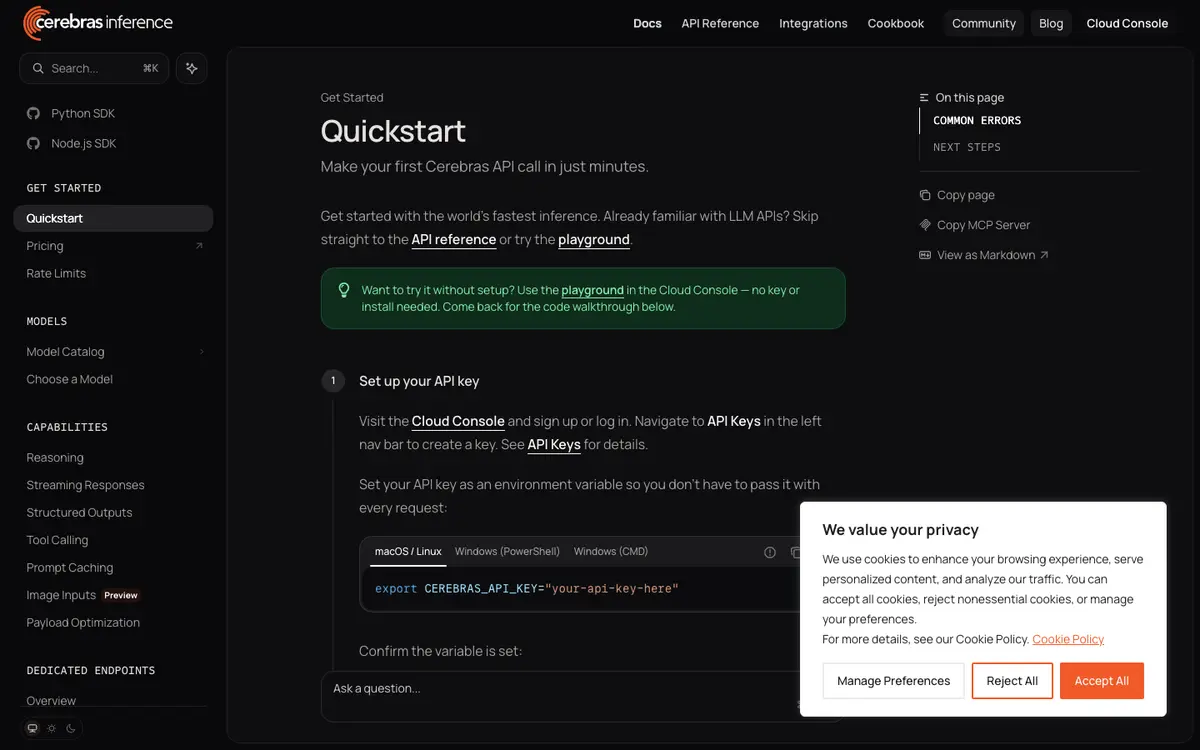
Verified integrations
Connections to other tracked products — hover a chip for the verbatim evidence quote behind it.

By theme — the product's score on each story themeBy theme
Agenticness — how well agents can access and operate the productAgenticnessevidence →
How well agents can access and operate the product
Automation depth — how much of the product can run unattendedAutomation depthevidence →
How much of the product can run unattended
Batch async — stories about batch async in this arenaBatch asyncevidence →
Stories about batch async in this arena
Dedicated capacity — stories about dedicated capacity in this arenaDedicated capacityevidence →
Stories about dedicated capacity in this arena
Fine tune serving — stories about fine tune serving in this arenaFine tune servingevidence →
Stories about fine tune serving in this arena
Model catalog — stories about model catalog in this arenaModel catalogevidence →
Stories about model catalog in this arena
Multimodal — stories about multimodal in this arenaMultimodalevidence →
Stories about multimodal in this arena
Openai compat — stories about openai compat in this arenaOpenai compatevidence →
Stories about openai compat in this arena
Openness — open source, data portability, and self-hosting storiesOpennessevidence →
Open source, data portability, and self-hosting stories
Pricing limits — free-tier ceilings, usage caps, and rate limits before you have to payPricing limitsevidence →
Free-tier ceilings, usage caps, and rate limits before you have to pay
Privacy posture — data-handling and privacy storiesPrivacy postureevidence →
Data-handling and privacy stories
Reliability status — stories about reliability status in this arenaReliability statusevidence →
Stories about reliability status in this arena
Speed latency — stories about speed latency in this arenaSpeed latencyevidence →
Stories about speed latency in this arena
Structured tool calling — stories about structured tool calling in this arenaStructured tool callingevidence →
Stories about structured tool calling in this arena
Story verdicts — every judged story with its evidenceStory verdicts
What’s free: 16 free · 0 paid · 0 enterprise · 13 not stated in evidence
Follow the green: where the map greys out is where Cerebras Inference stops today. ✓ full · ~ partial · ! disputed · — none · n/a not applicable.
Agenticness — how well agents can access and operate the productAgenticness
How well agents can access and operate the product
API surface
Drive the product through a documented public API
✓9/10
unlocks → Webhooks · Scoped API keys · MCP server · Machine-readable spec · Versioning policy · Official CLI · Full data export
Subscribe to events via webhooks
—–
Build against official SDKs
✓8/10
Issue scoped/least-privilege API credentials for an agent
—0/10
Connect an agent via an official MCP server
—–
Download a machine-readable API spec (OpenAPI or equivalent)
—0/10
Rely on versioned APIs with a documented deprecation policy
—0/10
Test against a sandbox environment without touching production data
~4/10
Explore an interactive API reference with runnable examples
~5/10
Docs for agents
Point an agent at llms.txt or agent-oriented docs
✓9/10
Agentic features
Delegate tasks to a built-in AI assistant inside the product
—–
Operate the product with natural-language commands
—–
Plug MCP servers into this product so it can use their tools
—–
Get AI-generated insights and suggestions from my data inside the product
n/an/a
Set up automations that run autonomously in the background
~3/10
Automation depth — how much of the product can run unattendedAutomation depth
How much of the product can run unattended
Batch async — stories about batch async in this arenaBatch async
Stories about batch async in this arena
Dedicated capacity — stories about dedicated capacity in this arenaDedicated capacity
Stories about dedicated capacity in this arena
Fine tune serving — stories about fine tune serving in this arenaFine tune serving
Stories about fine tune serving in this arena
Model catalog — stories about model catalog in this arenaModel catalog
Stories about model catalog in this arena
Catalog
Multimodal — stories about multimodal in this arenaMultimodal
Stories about multimodal in this arena
Openai compat — stories about openai compat in this arenaOpenai compat
Stories about openai compat in this arena
Compat
Openness — open source, data portability, and self-hosting storiesOpenness
Open source, data portability, and self-hosting stories
Pricing limits — free-tier ceilings, usage caps, and rate limits before you have to payPricing limits
Free-tier ceilings, usage caps, and rate limits before you have to pay
Privacy posture — data-handling and privacy storiesPrivacy posture
Data-handling and privacy stories
Reliability status — stories about reliability status in this arenaReliability status
Stories about reliability status in this arena
Speed latency — stories about speed latency in this arenaSpeed latency
Stories about speed latency in this arena
Structured tool calling — stories about structured tool calling in this arenaStructured tool calling
Stories about structured tool calling in this arena
Sorted by importance (agentic first) (high → low) · 53/53 stories · click a row’s chevron for the rationale and evidence
Drive the product through a documented public API G Agent access | ai-native user | Agenticness — how well agents can access and operate the productAgenticness | 3 | fullfree | 9/10 | Tprobed⚿ | |
Connect an agent via an official MCP server G Agent access | ai-native user | Agenticness — how well agents can access and operate the productAgenticness | 3 | none | untested | none yet | |
Delegate tasks to a built-in AI assistant inside the product G Agentic features | ai-native user | Agenticness — how well agents can access and operate the productAgenticness | 3 | none | untested | none yet | |
Plug MCP servers into this product so it can use their tools G Agent access | ai-native user | Agenticness — how well agents can access and operate the productAgenticness | 3 | none | untested | none yet | |
Point an agent at llms.txt or agent-oriented docs G Agent access | ai-native user | Agenticness — how well agents can access and operate the productAgenticness | 2 | full | 9/10 | Tprobed | |
Build against official SDKs G Agent access | ai-native user | Agenticness — how well agents can access and operate the productAgenticness | 2 | fullfree | 8/10 | Xcommunity | |
Run the product headlessly / in CI for automation G Agent access | ai-native user | Agenticness — how well agents can access and operate the productAgenticness | 2 | fullfree | 7/10 | Xcommunity | |
Explore an interactive API reference with runnable examples G Api quality | ai-native user | Agenticness — how well agents can access and operate the productAgenticness | 2 | partialfree | 5/10 | Tprobed | |
Set up automations that run autonomously in the background G Agentic features | ai-native user | Agenticness — how well agents can access and operate the productAgenticness | 2 | partial | 3/10 | Cclaimed | |
Download a machine-readable API spec (OpenAPI or equivalent) G Api quality | ai-native user | Agenticness — how well agents can access and operate the productAgenticness | 2 | none | 0/10 | ||
Issue scoped/least-privilege API credentials for an agent G Agent access | ai-native user | Agenticness — how well agents can access and operate the productAgenticness | 2 | none | 0/10 | ⚿ | |
Rely on versioned APIs with a documented deprecation policy G Api quality | ai-native user | Agenticness — how well agents can access and operate the productAgenticness | 2 | none | 0/10 | ||
Use an official CLI G Agent access | ai-native user | Agenticness — how well agents can access and operate the productAgenticness | 2 | none | 0/10 | ||
Get AI-generated insights and suggestions from my data inside the product G Agentic features | ai-native user | Agenticness — how well agents can access and operate the productAgenticness | 2 | n/a | untested | none yet | |
Operate the product with natural-language commands G Agentic features | ai-native user | Agenticness — how well agents can access and operate the productAgenticness | 2 | none | untested | none yet | |
Subscribe to events via webhooks G Agent access | ai-native user | Agenticness — how well agents can access and operate the productAgenticness | 2 | none | untested | none yet | |
Test against a sandbox environment without touching production data G Api quality | ai-native user | Agenticness — how well agents can access and operate the productAgenticness | 1 | partialfree | 4/10 | Cclaimed | |
Point an existing OpenAI SDK client at the provider by changing only the base URL and API key C Compat | developer | Openai compat — stories about openai compat in this arenaOpenai compat | 3 | fullfree | 9/10 | Tprobed⚿ | |
Serve latency-sensitive workloads with fast time-to-first-token and high-throughput generation C Serving | developer | Speed latency — stories about speed latency in this arenaSpeed latency | 3 | fullfree | 9/10 | Xcommunity | |
Stream completions token by token over SSE for responsive user experiences C Serving | developer | Speed latency — stories about speed latency in this arenaSpeed latency | 3 | fullfree | 8/10 | Xcommunity | |
Choose among a broad catalog of current open-weight model families (Llama, Qwen, DeepSeek, GPT-OSS and peers) on shared serverless endpoints C Catalog | developer | Model catalog — stories about model catalog in this arenaModel catalog | 3 | partialfree | 7/10 | Xcommunity | |
Enforce structured outputs against a JSON schema (or grammar) so model responses parse reliably C Structured | developer | Structured tool calling — stories about structured tool calling in this arenaStructured tool calling | 3 | fullfree | 7/10 | Cclaimed | |
Have an agent switch to or away from this provider mid-workflow because it speaks the standard chat-completions API without provider-specific code changes C Compat | ai-native user | Openai compat — stories about openai compat in this arenaOpenai compat | 3 | partialfree | 7/10 | Xcommunity | |
Rely on faithful function/tool calling — including parallel and multi-step tool use — so agent loops run on open models without breaking C Tools | ai-native user | Structured tool calling — stories about structured tool calling in this arenaStructured tool calling | 3 | partialfree | 5/10 | Xcommunity | |
See public per-token prices for every hosted model without talking to sales G Pricing | founder | Pricing limits — free-tier ceilings, usage caps, and rate limits before you have to payPricing limits | 3 | partialfree | 4/10 | Xcommunity | |
Define rules that trigger actions automatically on events G | ai-native user | Automation depth — how much of the product can run unattendedAutomation depth | 3 | n/a | untested | none yet | |
Export all of my data in open formats and leave G | ai-native user | Openness — open source, data portability, and self-hosting storiesOpenness | 3 | none | untested | none yet | |
Prevent my data from being used to train AI models G | ai-native user | Privacy posture — data-handling and privacy storiesPrivacy posture | 3 | none | untested | none yet | |
Self-host the core product G | ai-native user | Openness — open source, data portability, and self-hosting storiesOpenness | 3 | n/a | untested | none yet | |
Have an agent enumerate the live model catalog programmatically via a documented GET /v1/models-style endpoint C Catalog | ai-native user | Model catalog — stories about model catalog in this arenaModel catalog | 2 | partialfree | 7/10 | Tprobed⚿ | |
Perform bulk operations across many items at once G | ai-native user | Automation depth — how much of the product can run unattendedAutomation depth | 2 | full | 7/10 | Cclaimed | |
Check a public status page with incident history before betting production traffic on the platform G Reliability | founder | Reliability status — stories about reliability status in this arenaReliability status | 2 | partial | 6/10 | Tprobed | |
Do everything through the API that I can do in the UI G | ai-native user | Openness — open source, data portability, and self-hosting storiesOpenness | 2 | partial | 6/10 | Xcommunity | |
Plug the provider into coding agents and agent frameworks through documented, first-party integration guides C Compat | ai-native user | Openai compat — stories about openai compat in this arenaOpenai compat | 2 | partialfree | 6/10 | Xcommunity | |
Read documented rate limits and how they scale across usage tiers before I hit them in production G Limits | developer | Pricing limits — free-tier ceilings, usage caps, and rate limits before you have to payPricing limits | 2 | partial | 6/10 | Xcommunity | |
Deploy a model on dedicated GPU capacity with autoscaling so my traffic is isolated from the shared serverless pool C Dedicated | ml-engineer | Dedicated capacity — stories about dedicated capacity in this arenaDedicated capacity | 2 | partial | 5/10 | Cclaimed | |
See published tokens-per-second or latency numbers, benchmarks, or load-testing guides backing the provider's speed claims C Benchmarks | ml-engineer | Speed latency — stories about speed latency in this arenaSpeed latency | 2 | partial | 5/10 | Xcommunity | |
Fine-tune a supported base model on my own data and serve the result on the same platform C Fine tune | ml-engineer | Fine tune serving — stories about fine tune serving in this arenaFine tune serving | 2 | partial | 4/10 | Cclaimed | |
Submit asynchronous batch inference jobs at a documented discount versus real-time pricing G Batch | ml-engineer | Batch async — stories about batch async in this arenaBatch async | 2 | partial | 4/10 | Cclaimed | |
Upload and serve my own custom model weights or LoRA adapters C Fine tune | ml-engineer | Fine tune serving — stories about fine tune serving in this arenaFine tune serving | 2 | partial | 4/10 | Cclaimed | |
Get newly released open-weight models on the platform quickly after their public release C Catalog | ml-engineer | Model catalog — stories about model catalog in this arenaModel catalog | 2 | partial | 3/10 | Xcommunity | |
Choose where my data is stored (region/residency) G | ai-native user | Privacy posture — data-handling and privacy storiesPrivacy posture | 2 | none | untested | none yet | |
Control data retention and deletion G | ai-native user | Privacy posture — data-handling and privacy storiesPrivacy posture | 2 | none | untested | none yet | |
Opt out of telemetry and usage tracking G | ai-native user | Privacy posture — data-handling and privacy storiesPrivacy posture | 2 | none | untested | none yet | |
Read the product's source under an open license G | ai-native user | Openness — open source, data portability, and self-hosting storiesOpenness | 2 | none | untested | none yet | |
Schedule recurring jobs or workflows G | ai-native user | Automation depth — how much of the product can run unattendedAutomation depth | 2 | n/a | untested | none yet | |
Benefit from prompt/prefix caching that reduces latency or cost on repeated context C Serving | ml-engineer | Speed latency — stories about speed latency in this arenaSpeed latency | 1 | partial | 6/10 | Cclaimed | |
Call vision, audio, or image-generation models beyond text chat on the same platform C Modalities | developer | Multimodal — stories about multimodal in this arenaMultimodal | 1 | partialfree | 3/10 | Cclaimed | |
Get a stated availability SLA on paid or enterprise tiers C Reliability | founder | Reliability status — stories about reliability status in this arenaReliability status | 1 | none | 0/10 | ||
Set spending caps or budget alerts so a runaway workload cannot generate an unbounded bill G Pricing | founder | Pricing limits — free-tier ceilings, usage caps, and rate limits before you have to payPricing limits | 1 | none | 0/10 | ||
Generate embeddings (and rerank results) for retrieval pipelines without a second vendor C Modalities | developer | Multimodal — stories about multimodal in this arenaMultimodal | 1 | none | untested | none yet | |
Rely on a documented deprecation policy with advance notice before a hosted model is removed C Catalog | developer | Model catalog — stories about model catalog in this arenaModel catalog | 1 | none | untested | none yet | |
Version, review, and roll back my automations G | ai-native user | Automation depth — how much of the product can run unattendedAutomation depth | 1 | n/a | untested | none yet |
Opportunities — the stories that would move this product's scores, from its own judged verdictsOpportunitiestop 8 of 39 stories with headroom
What would move Cerebras Inference’s scores — derived from its own judged verdicts, biggest headroom first. Each line quotes what the judge found missing; shipping it (or evidencing it publicly) is the fix.
Agenticness — how well agents can access and operate the productDelegate tasks to a built-in AI assistant inside the product
nonemoves Built-in AIimpact 45
The axis applies to this product kind (peer products hold positive or none verdicts on this story), so lack of evidence for an applicable capability is "none", never "na".
Agenticness — how well agents can access and operate the productPlug MCP servers into this product so it can use their tools
nonemoves agent-readyimpact 45
The axis applies to this product kind (peer products hold positive or none verdicts on this story), so lack of evidence for an applicable capability is "none", never "na".
Agenticness — how well agents can access and operate the productConnect an agent via an official MCP server
nonemoves agent-readyimpact 45
The axis applies to this product kind (peer products hold positive or none verdicts on this story), so lack of evidence for an applicable capability is "none", never "na".
Openness — open source, data portability, and self-hosting storiesExport all of my data in open formats and leave
nonemoves PA Scoreimpact 30
Missing: any documented data export feature, format, or exit/offboarding process.
Privacy posture — data-handling and privacy storiesPrevent my data from being used to train AI models
nonemoves PA Scoreimpact 30
No evidence pack item addresses a data-privacy/training-opt-out policy, data retention terms, or zero-retention agreement for Cerebras Inference API usage; nothing confirms user data is excluded from model training.
Agenticness — how well agents can access and operate the productOperate the product with natural-language commands
nonemoves Built-in AIimpact 30
The axis applies to this product kind (peer products hold positive or none verdicts on this story), so lack of evidence for an applicable capability is "none", never "na".
Agenticness — how well agents can access and operate the productUse an official CLI
nonemoves agent-readyimpact 30
Evidence only shows Python/Node SDKs and a web playground/quickstart; there is no mention of an official Cerebras CLI tool anywhere in the docs, GitHub repos, or community discussion.
Agenticness — how well agents can access and operate the productIssue scoped/least-privilege API credentials for an agent
nonemoves agent-readyimpact 30
Missing: any mention of scoped/permissioned API keys, role-based access control, or credential restriction features for agents.
Showing the top 8 of 39 — every none/partial verdict in the story verdicts table is headroom.
Think a verdict is wrong? Every verdicts-table row has a Flag link — see the methodology.
Coverage map — which docs area, API section, or community source covers which judged storiesCoverage map14 surfaces · 29 covered stories
Where the cited evidence behind each covered verdict came from — the same citations the verdicts table shows, no extra judging.
Hacker News16 stories
- Run the product headlessly / in CI for automation
- Drive the product through a documented public API
- Build against official SDKs
- Get newly released open-weight models on the platform quickly after their public release
- Choose among a broad catalog of current open-weight model families (Llama, Qwen, DeepSeek, GPT-OSS and peers) on shared serverless endpoints
- Plug the provider into coding agents and agent frameworks through documented, first-party integration guides
- Have an agent switch to or away from this provider mid-workflow because it speaks the standard chat-completions API without provider-specific code changes
- Point an existing OpenAI SDK client at the provider by changing only the base URL and API key
- Do everything through the API that I can do in the UI
- Read documented rate limits and how they scale across usage tiers before I hit them in production
- See public per-token prices for every hosted model without talking to sales
- Check a public status page with incident history before betting production traffic on the platform
- See published tokens-per-second or latency numbers, benchmarks, or load-testing guides backing the provider's speed claims
- Serve latency-sensitive workloads with fast time-to-first-token and high-throughput generation
- Stream completions token by token over SSE for responsive user experiences
- Rely on faithful function/tool calling — including parallel and multi-step tool use — so agent loops run on open models without breaking
Resources docs12 stories
- Run the product headlessly / in CI for automation
- Drive the product through a documented public API
- Build against official SDKs
- Explore an interactive API reference with runnable examples
- Have an agent enumerate the live model catalog programmatically via a documented GET /v1/models-style endpoint
- Call vision, audio, or image-generation models beyond text chat on the same platform
- Plug the provider into coding agents and agent frameworks through documented, first-party integration guides
- Have an agent switch to or away from this provider mid-workflow because it speaks the standard chat-completions API without provider-specific code changes
- Point an existing OpenAI SDK client at the provider by changing only the base URL and API key
- Do everything through the API that I can do in the UI
- Stream completions token by token over SSE for responsive user experiences
- Enforce structured outputs against a JSON schema (or grammar) so model responses parse reliably
Inference docs11 stories
- Drive the product through a documented public API
- Build against official SDKs
- Test against a sandbox environment without touching production data
- Have an agent enumerate the live model catalog programmatically via a documented GET /v1/models-style endpoint
- Plug the provider into coding agents and agent frameworks through documented, first-party integration guides
- Have an agent switch to or away from this provider mid-workflow because it speaks the standard chat-completions API without provider-specific code changes
- Point an existing OpenAI SDK client at the provider by changing only the base URL and API key
- Do everything through the API that I can do in the UI
- See public per-token prices for every hosted model without talking to sales
- Stream completions token by token over SSE for responsive user experiences
- Enforce structured outputs against a JSON schema (or grammar) so model responses parse reliably
Capabilities docs10 stories
- Run the product headlessly / in CI for automation
- Drive the product through a documented public API
- Build against official SDKs
- Set up automations that run autonomously in the background
- Perform bulk operations across many items at once
- Submit asynchronous batch inference jobs at a documented discount versus real-time pricing
- Serve latency-sensitive workloads with fast time-to-first-token and high-throughput generation
- Stream completions token by token over SSE for responsive user experiences
- Enforce structured outputs against a JSON schema (or grammar) so model responses parse reliably
- Rely on faithful function/tool calling — including parallel and multi-step tool use — so agent loops run on open models without breaking
Quickstart docs7 stories
- Point an agent at llms.txt or agent-oriented docs
- Run the product headlessly / in CI for automation
- Drive the product through a documented public API
- Build against official SDKs
- Explore an interactive API reference with runnable examples
- Test against a sandbox environment without touching production data
- Do everything through the API that I can do in the UI
GitHub README6 stories
- Run the product headlessly / in CI for automation
- Drive the product through a documented public API
- Build against official SDKs
- Plug the provider into coding agents and agent frameworks through documented, first-party integration guides
- See published tokens-per-second or latency numbers, benchmarks, or load-testing guides backing the provider's speed claims
- Serve latency-sensitive workloads with fast time-to-first-token and high-throughput generation
Support docs6 stories
- Perform bulk operations across many items at once
- Submit asynchronous batch inference jobs at a documented discount versus real-time pricing
- Read documented rate limits and how they scale across usage tiers before I hit them in production
- See public per-token prices for every hosted model without talking to sales
- Serve latency-sensitive workloads with fast time-to-first-token and high-throughput generation
- Benefit from prompt/prefix caching that reduces latency or cost on repeated context
Dedicated docs5 stories
- Deploy a model on dedicated GPU capacity with autoscaling so my traffic is isolated from the shared serverless pool
- Fine-tune a supported base model on my own data and serve the result on the same platform
- Upload and serve my own custom model weights or LoRA adapters
- Do everything through the API that I can do in the UI
- Serve latency-sensitive workloads with fast time-to-first-token and high-throughput generation
Models docs4 stories
- Get newly released open-weight models on the platform quickly after their public release
- Have an agent enumerate the live model catalog programmatically via a documented GET /v1/models-style endpoint
- Choose among a broad catalog of current open-weight model families (Llama, Qwen, DeepSeek, GPT-OSS and peers) on shared serverless endpoints
- Call vision, audio, or image-generation models beyond text chat on the same platform
Pricing docs4 stories
- Test against a sandbox environment without touching production data
- Submit asynchronous batch inference jobs at a documented discount versus real-time pricing
- Read documented rate limits and how they scale across usage tiers before I hit them in production
- See public per-token prices for every hosted model without talking to sales
llms.txt3 stories
OpenAPI spec3 stories
V1 docs3 stories
Claims vs evidence — vendor claims reconciled against independent verdictsClaims vs evidence
8 of 14 testable claims verified · 0 contradicted → integrity 57/100
21 distinct capability claims found in Cerebras Inference’s own claimed-docs/GitHub materials, reconciled against our judge’s independent verdicts.
8
Verified
6
Unverified
0
Contradicted
15
Undersold
Verified (12)
“Existing OpenAI-based apps can switch to Cerebras by changing API key, base URL, and model ID”
Point an existing OpenAI SDK client at the provider by changing only the base URL and API keyfullproof ↗
“OpenAI API compatibility lets developers build on Cerebras with only two code changes”
Have an agent switch to or away from this provider mid-workflow because it speaks the standard chat-completions API without provider-specific code changespartialproof ↗
“OpenAI API compatibility lets developers build on Cerebras with only two code changes”
Point an existing OpenAI SDK client at the provider by changing only the base URL and API keyfullproof ↗
“API supports streaming responses that are sent back incrementally in chunks”
Stream completions token by token over SSE for responsive user experiencesfullproof ↗
“Supports tool calling / function calling so models can invoke app-defined functions”
Rely on faithful function/tool calling — including parallel and multi-step tool use — so agent loops run on open models without breakingpartialproof ↗
“Documentation guide helps you pick the right model for your use case”
Choose among a broad catalog of current open-weight model families (Llama, Qwen, DeepSeek, GPT-OSS and peers) on shared serverless endpointspartialproof ↗
“Self-serve paid tier offers 10x higher rate limits than the free tier and higher priority processing”
Read documented rate limits and how they scale across usage tiers before I hit them in productionpartialproof ↗
“SDK sends warm-up requests to /v1/tcp_warming on construction to reduce time-to-first-token”
Serve latency-sensitive workloads with fast time-to-first-token and high-throughput generationfullproof ↗
“Official Python SDK installable via pip (cerebras_cloud_sdk)”
“Doc catalog highlights open-source model alternatives to Claude, GPT, and Gemini”
Choose among a broad catalog of current open-weight model families (Llama, Qwen, DeepSeek, GPT-OSS and peers) on shared serverless endpointspartialproof ↗
“Official TypeScript/JavaScript library provides server-side access to the Cerebras REST API”
“Docs let you browse all models available on Cerebras public endpoints”
Choose among a broad catalog of current open-weight model families (Llama, Qwen, DeepSeek, GPT-OSS and peers) on shared serverless endpointspartialproof ↗
Unverified (7)
“Playground available in Cloud Console without needing an API key or install”
Test against a sandbox environment without touching production datapartialproof ↗
“Structured Outputs constrains model responses to a JSON schema for reliable parsing”
Enforce structured outputs against a JSON schema (or grammar) so model responses parse reliablyfullproof ↗
“Dedicated endpoints provide a private, reserved inference instance exclusive to your org”
Deploy a model on dedicated GPU capacity with autoscaling so my traffic is isolated from the shared serverless poolpartialproof ↗
“Dedicated endpoint runs on reserved, unshared capacity so performance isn't affected by other customers' workloads”
Deploy a model on dedicated GPU capacity with autoscaling so my traffic is isolated from the shared serverless poolpartialproof ↗
“Custom fine-tuned models can be deployed alongside standard model variants”
Fine-tune a supported base model on my own data and serve the result on the same platformpartialproof ↗
“Cached tokens don't count toward the uncached TPM limit, so higher cache hit rate lets you process more total tokens”
Benefit from prompt/prefix caching that reduces latency or cost on repeated contextpartialproof ↗
“Supports standard OpenAI image_url content shape for image inputs via base64 data URI”
Call vision, audio, or image-generation models beyond text chat on the same platformpartialproof ↗
Undersold (15)
Point an agent at llms.txt or agent-oriented docsfullproof ↗
Run the product headlessly / in CI for automationfullproof ↗
Drive the product through a documented public APIfullproof ↗
Set up automations that run autonomously in the backgroundpartialproof ↗
Explore an interactive API reference with runnable examplespartialproof ↗
Perform bulk operations across many items at oncefullproof ↗
Submit asynchronous batch inference jobs at a documented discount versus real-time pricingpartialproof ↗
Upload and serve my own custom model weights or LoRA adapterspartialproof ↗
Get newly released open-weight models on the platform quickly after their public releasepartialproof ↗
Have an agent enumerate the live model catalog programmatically via a documented GET /v1/models-style endpointpartialproof ↗
Plug the provider into coding agents and agent frameworks through documented, first-party integration guidespartialproof ↗
Do everything through the API that I can do in the UIpartialproof ↗
See public per-token prices for every hosted model without talking to salespartialproof ↗
Check a public status page with incident history before betting production traffic on the platformpartialproof ↗
See published tokens-per-second or latency numbers, benchmarks, or load-testing guides backing the provider's speed claimspartialproof ↗
Claims outside our story set (3)
Real capability claims found in Cerebras Inference’s own materials, but no story in this arena’s taxonomy covers them yet — that’s feedback on the taxonomy, not a mark against the product.
“Batch API lets you submit groups of requests for asynchronous processing”
source ↗“Also accessible via partner APIs”
source ↗“Free tier includes $5 in credit to prototype prompts, agents, and real-time apps before paying”
source ↗
Pricing signals
- freeper 1M tokensfree tierNew accounts receive $5 in free credits to use across Cerebras-powered models; no per-token rate is printed on this page.source ↗as of 2026-09-07
Extracted verbatim from the vendor’s own pricing page — hover a figure for the exact quote.
Business model
Free tier with daily token allowances, per-token pay-as-you-go developer pricing per model, and enterprise dedicated endpoints on wafer-scale hardware priced via sales.
pricing ↗Score trend
How this product’s scores have moved as evidence and verdicts are re-derived — a point per change, not per day.
Flag
⚑ Flag a verdictThink a verdict is wrong? Opens a prefilled GitHub issue — or use the ⚑ next to any verdict above.
For agents
Agent surface uptime llms.txt 100% (30d, checked every 6h since Sep 8 '26)