
Install
brew install --cask lm-studio vs Ollama
 vs llama.cpp
 vs vLLM
 vs Jan
 vs LocalAI
 vs llamafile
Showcase
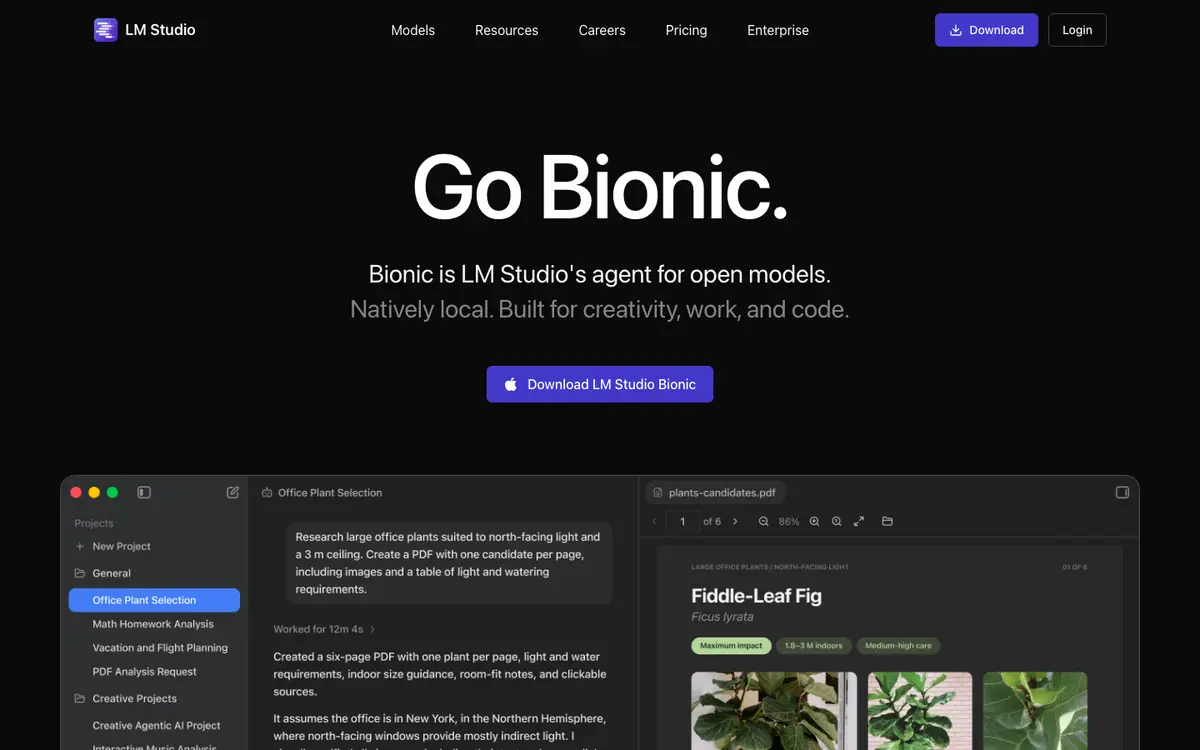
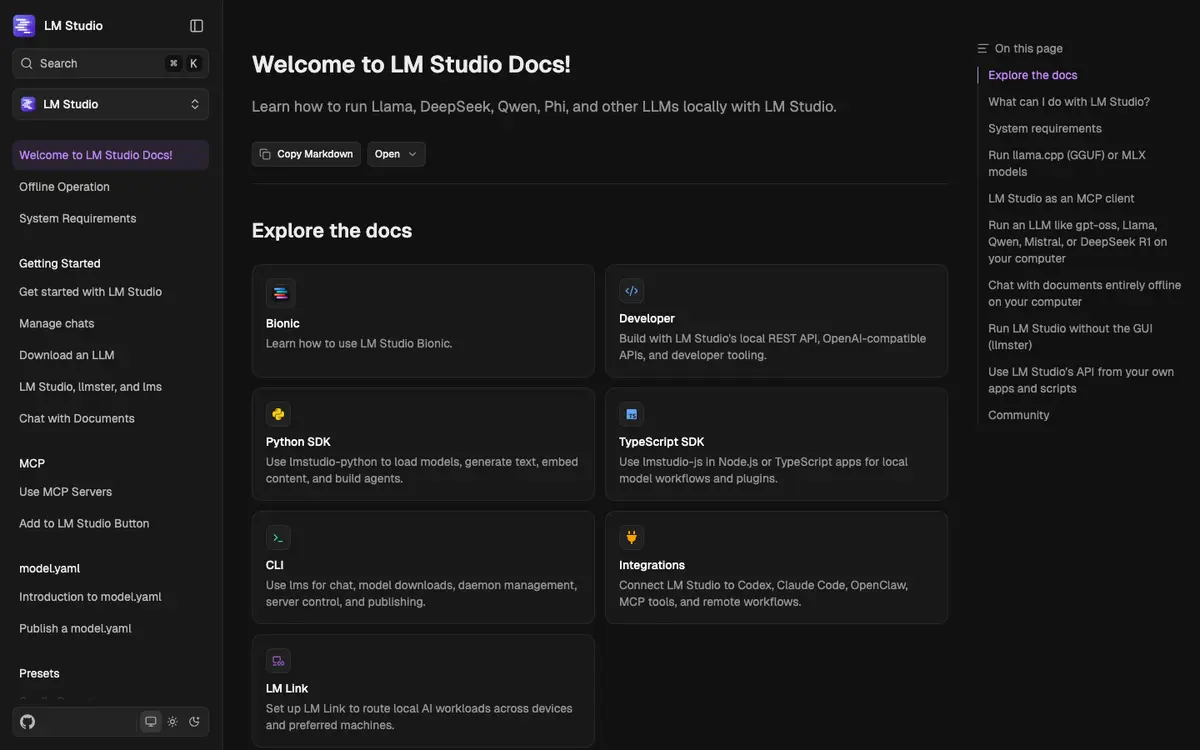
Verified integrations
No integration evidence found in our corpus for this product yet — that means none was found, never that it doesn’t integrate.
By theme — the product's score on each story themeBy theme
Agenticness — how well agents can access and operate the productAgenticnessevidence →
How well agents can access and operate the product
Automation depth — how much of the product can run unattendedAutomation depthevidence →
How much of the product can run unattended
Ecosystem — integrations, plugins, and third-party ecosystem storiesEcosystemevidence →
Integrations, plugins, and third-party ecosystem stories
Model support — which models run and how well — coverage, formats, update cadenceModel supportevidence →
Which models run and how well — coverage, formats, update cadence
Openness — open source, data portability, and self-hosting storiesOpennessevidence →
Open source, data portability, and self-hosting stories
Performance hardware — raw speed and hardware efficiency — throughput, latency, resource usePerformance hardwareevidence →
Raw speed and hardware efficiency — throughput, latency, resource use
Privacy posture — data-handling and privacy storiesPrivacy postureevidence →
Data-handling and privacy stories
Quantization formats — stories about quantization formats in this arenaQuantization formatsevidence →
Stories about quantization formats in this arena
Serving api — serving models over an API — endpoints, compatibility, reliabilityServing apievidence →
Serving models over an API — endpoints, compatibility, reliability
Ux tooling — the working surface itself — layout, ergonomics, quality-of-life toolingUx toolingevidence →
The working surface itself — layout, ergonomics, quality-of-life tooling
Story verdicts — every judged story with its evidenceStory verdicts
Follow the green: where the map greys out is where LM Studio stops today. ✓ full · ~ partial · ! disputed · — none · n/a not applicable.
Agenticness — how well agents can access and operate the productAgenticness
How well agents can access and operate the product
API surface
Drive the product through a documented public API
✓8/10
unlocks → Official SDKs · Machine-readable spec · Versioning policy · API sandbox · Full data export · Call the server through an Anthropic-compatible messages endpoint · Constrain model output to structured formats like JSON using grammars · Use native tool-calling and reasoning-parser support in my requests · The documented maximum concurrent requests or connections the local server can handle before throughput degrades · Override low-level engine settings like memory locking or mmap behavior instead of being limited to opinionated defaults
Subscribe to events via webhooks
n/an/a
Build against official SDKs
—0/10
Issue scoped/least-privilege API credentials for an agent
n/an/a
Connect an agent via an official MCP server
n/an/a
Download a machine-readable API spec (OpenAPI or equivalent)
—–
Rely on versioned APIs with a documented deprecation policy
—0/10
Test against a sandbox environment without touching production data
—0/10
Explore an interactive API reference with runnable examples
—0/10
Docs for agents
Point an agent at llms.txt or agent-oriented docs
✓8/10
Agentic features
Delegate tasks to a built-in AI assistant inside the product
~6/10
Operate the product with natural-language commands
~6/10
unlocks → Autonomous automations
Plug MCP servers into this product so it can use their tools
~6/10
Get AI-generated insights and suggestions from my data inside the product
~6/10
Set up automations that run autonomously in the background
—0/10
Connect a coding agent to this product as a working backend
~7/10
Automation depth — how much of the product can run unattendedAutomation depth
How much of the product can run unattended
Ecosystem — integrations, plugins, and third-party ecosystem storiesEcosystem
Integrations, plugins, and third-party ecosystem stories
Build and install
Contribute code and become a recognized collaborator through the project's open-source process
—0/10
Call the runtime from official client libraries in languages like Python or JavaScript
—0/10
Whether commercial or enterprise use requires a paid license or subscription beyond the free community edition
—0/10
How quickly the project ships patches for critical bugs and security vulnerabilities based on its public release history
—–
Whether downloaded model files and caches can be reused by other runtimes without re-downloading or re-converting them
—0/10
Run inference entirely on my own machine so my data and prompts never leave my device
✓9/10
Model support — which models run and how well — coverage, formats, update cadenceModel support
Which models run and how well — coverage, formats, update cadence
Openness — open source, data portability, and self-hosting storiesOpenness
Open source, data portability, and self-hosting stories
Performance hardware — raw speed and hardware efficiency — throughput, latency, resource usePerformance hardware
Raw speed and hardware efficiency — throughput, latency, resource use
Distributed serving
Gpu acceleration
Control how context memory is allocated when running multiple model instances concurrently
~6/10
Platform acceleration
Get a fast cold start from a lightweight runtime binary instead of waiting seconds before inference begins
!4/10
Throughput optimization
Privacy posture — data-handling and privacy storiesPrivacy posture
Data-handling and privacy stories
Quantization formats — stories about quantization formats in this arenaQuantization formats
Stories about quantization formats in this arena
Serving api — serving models over an API — endpoints, compatibility, reliabilityServing api
Serving models over an API — endpoints, compatibility, reliability
Api compatibility
Run the runtime headlessly with no GUI for use in servers or CI pipelines
✓8/10
Generation controls
Model lifecycle
Serve models over my local network for access from other devices
~6/10
The documented maximum concurrent requests or connections the local server can handle before throughput degrades
—0/10
Override low-level engine settings like memory locking or mmap behavior instead of being limited to opinionated defaults
—0/10
Ux tooling — the working surface itself — layout, ergonomics, quality-of-life toolingUx tooling
The working surface itself — layout, ergonomics, quality-of-life tooling
Rely on an AI assistant to recommend which local model best fits my hardware and task before I download it
—0/10
Chat with local models using a built-in graphical chat interface
✓9/10
Cli tooling
Document intelligence
Manage my downloaded models, saved prompts, and per-model configurations in one place
~7/10
Sorted by importance (agentic first) (high → low) · 92/92 stories · click a row’s chevron for the rationale and evidence
Drive the product through a documented public API G Agent access | ai-native user | Agenticness — how well agents can access and operate the productAgenticness | 3 | full | 8/10 | Xcommunity | |
Connect a coding agent to this product as a working backend C Agent access | ai-native user | Agenticness — how well agents can access and operate the productAgenticness | 3 | partial | 7/10 | Xcommunity | |
Delegate tasks to a built-in AI assistant inside the product G Agentic features | ai-native user | Agenticness — how well agents can access and operate the productAgenticness | 3 | partial | 6/10 | Xcommunity | |
Plug MCP servers into this product so it can use their tools G Agent access | ai-native user | Agenticness — how well agents can access and operate the productAgenticness | 3 | partial | 6/10 | Xcommunity | |
Connect an agent via an official MCP server G Agent access | ai-native user | Agenticness — how well agents can access and operate the productAgenticness | 3 | n/a | 0/10 | ||
Point an agent at llms.txt or agent-oriented docs G Agent access | ai-native user | Agenticness — how well agents can access and operate the productAgenticness | 2 | full | 8/10 | Tprobed | |
Run the product headlessly / in CI for automation G Agent access | ai-native user | Agenticness — how well agents can access and operate the productAgenticness | 2 | full | 8/10 | Xcommunity | |
Use an official CLI G Agent access | ai-native user | Agenticness — how well agents can access and operate the productAgenticness | 2 | full | 8/10 | Xcommunity | |
Get AI-generated insights and suggestions from my data inside the product G Agentic features | ai-native user | Agenticness — how well agents can access and operate the productAgenticness | 2 | partial | 6/10 | Xcommunity | |
Operate the product with natural-language commands G Agentic features | ai-native user | Agenticness — how well agents can access and operate the productAgenticness | 2 | partial | 6/10 | Xcommunity | |
Build against official SDKs G Agent access | ai-native user | Agenticness — how well agents can access and operate the productAgenticness | 2 | none | 0/10 | ||
Explore an interactive API reference with runnable examples G Api quality | ai-native user | Agenticness — how well agents can access and operate the productAgenticness | 2 | none | 0/10 | ||
Rely on versioned APIs with a documented deprecation policy G Api quality | ai-native user | Agenticness — how well agents can access and operate the productAgenticness | 2 | none | 0/10 | ||
Set up automations that run autonomously in the background G Agentic features | ai-native user | Agenticness — how well agents can access and operate the productAgenticness | 2 | none | 0/10 | ||
Download a machine-readable API spec (OpenAPI or equivalent) G Api quality | ai-native user | Agenticness — how well agents can access and operate the productAgenticness | 2 | none | untested | none yet | |
Issue scoped/least-privilege API credentials for an agent G Agent access | ai-native user | Agenticness — how well agents can access and operate the productAgenticness | 2 | n/a | untested | none yet | |
Subscribe to events via webhooks G Agent access | ai-native user | Agenticness — how well agents can access and operate the productAgenticness | 2 | n/a | untested | none yet | |
Test against a sandbox environment without touching production data G Api quality | ai-native user | Agenticness — how well agents can access and operate the productAgenticness | 1 | none | 0/10 | ||
Chat with local models using a built-in graphical chat interface C Chat interface | power-user | Ux tooling — the working surface itself — layout, ergonomics, quality-of-life toolingUx tooling | 3 | full | 9/10 | Xcommunity | |
Launch a local OpenAI-compatible API server for any loaded model C Api compatibility | developer | Serving api — serving models over an API — endpoints, compatibility, reliabilityServing api | 3 | full | 9/10 | Xcommunity | |
Run inference entirely on my own machine so my data and prompts never leave my device C Privacy control | power-user | Ecosystem — integrations, plugins, and third-party ecosystem storiesEcosystem | 3 | full | 9/10 | Xcommunity | |
Download and run open models directly from Hugging Face C Model hub download | power-user | Model support — which models run and how well — coverage, formats, update cadenceModel support | 3 | full | 8/10 | Xcommunity | |
Self-host the core product G | ai-native user | Openness — open source, data portability, and self-hosting storiesOpenness | 3 | full | 8/10 | Xcommunity | |
Get accelerated inference on Apple Silicon via native ARM and Metal optimizations C Platform acceleration | power-user | Performance hardware — raw speed and hardware efficiency — throughput, latency, resource usePerformance hardware | 3 | partial | 5/10 | Xcommunity | |
Load and run models packaged in the GGUF format C File formats | power-user | Quantization formats — stories about quantization formats in this arenaQuantization formats | 3 | partial | 5/10 | Xcommunity | |
Prevent my data from being used to train AI models G | ai-native user | Privacy posture — data-handling and privacy storiesPrivacy posture | 3 | partial | 5/10 | Cclaimed | |
Run hundreds of different model architectures including LLMs, MoE, multi-modal, and embedding models C Architecture coverage | developer | Model support — which models run and how well — coverage, formats, update cadenceModel support | 3 | partial | 5/10 | Xcommunity | |
Run models on NVIDIA, AMD, or other GPU vendors using vendor-specific acceleration kernels C Gpu acceleration | power-user | Performance hardware — raw speed and hardware efficiency — throughput, latency, resource usePerformance hardware | 3 | partial | 4/10 | Xcommunity | |
Stream generated tokens back to my application as they are produced C Generation controls | developer | Serving api — serving models over an API — endpoints, compatibility, reliabilityServing api | 3 | partial | 4/10 | Xcommunity | |
Run models larger than my available VRAM using combined CPU+GPU offload C Gpu acceleration | power-user | Performance hardware — raw speed and hardware efficiency — throughput, latency, resource usePerformance hardware | 3 | partial | 3/10 | Cclaimed | |
Achieve high serving throughput via continuous batching and chunked prefill C Throughput optimization | power-user | Performance hardware — raw speed and hardware efficiency — throughput, latency, resource usePerformance hardware | 3 | none | 0/10 | ||
Export all of my data in open formats and leave G | ai-native user | Openness — open source, data portability, and self-hosting storiesOpenness | 3 | none | 0/10 | ||
The documented maximum concurrent requests or connections the local server can handle before throughput degrades C Scale limits | developer | Serving api — serving models over an API — endpoints, compatibility, reliabilityServing api | 3 | none | 0/10 | ||
Define rules that trigger actions automatically on events G | ai-native user | Automation depth — how much of the product can run unattendedAutomation depth | 3 | none | untested | none yet | |
Reduce memory footprint using integer quantization ranging from very low-bit to 8-bit precision C Quantization levels | power-user | Quantization formats — stories about quantization formats in this arenaQuantization formats | 3 | none | untested | none yet | |
Run the runtime headlessly with no GUI for use in servers or CI pipelines C Deployment modes | developer | Serving api — serving models over an API — endpoints, compatibility, reliabilityServing api | 2 | full | 8/10 | Xcommunity | |
Search, download, and manage models from a command-line interface C Cli tooling | developer | Ux tooling — the working surface itself — layout, ergonomics, quality-of-life toolingUx tooling | 2 | full | 8/10 | Cclaimed | |
Start an interactive chat session with a model directly from the terminal C Cli tooling | developer | Ux tooling — the working surface itself — layout, ergonomics, quality-of-life toolingUx tooling | 2 | full | 8/10 | Cclaimed | |
Chat with my own documents entirely offline using automatic retrieval-augmented generation C Document intelligence | ai-native user | Ux tooling — the working surface itself — layout, ergonomics, quality-of-life toolingUx tooling | 2 | full | 7/10 | Xcommunity | |
Install using prebuilt binaries or packages instead of compiling from source C Build and install | developer | Ecosystem — integrations, plugins, and third-party ecosystem storiesEcosystem | 2 | full | 7/10 | Xcommunity | |
Manage my downloaded models, saved prompts, and per-model configurations in one place C Local model management | power-user | Ux tooling — the working surface itself — layout, ergonomics, quality-of-life toolingUx tooling | 2 | partial | 7/10 | Xcommunity | |
Control how context memory is allocated when running multiple model instances concurrently C Memory management | power-user | Performance hardware — raw speed and hardware efficiency — throughput, latency, resource usePerformance hardware | 2 | partial | 6/10 | Cclaimed | |
Do everything through the API that I can do in the UI G | ai-native user | Openness — open source, data portability, and self-hosting storiesOpenness | 2 | partial | 6/10 | Xcommunity | |
Load and switch between multiple models without restarting the server C Model lifecycle | power-user | Serving api — serving models over an API — endpoints, compatibility, reliabilityServing api | 2 | partial | 6/10 | Cclaimed | |
Serve models over my local network for access from other devices C Remote serving | power-user | Serving api — serving models over an API — endpoints, compatibility, reliabilityServing api | 2 | partial | 6/10 | Xcommunity | |
Control data retention and deletion G | ai-native user | Privacy posture — data-handling and privacy storiesPrivacy posture | 2 | partial | 4/10 | Cclaimed | |
Create specialized custom assistants configured for specific tasks C Custom assistants | power-user | Model support — which models run and how well — coverage, formats, update cadenceModel support | 2 | partial | 4/10 | Cclaimed | |
Get a fast cold start from a lightweight runtime binary instead of waiting seconds before inference begins C Startup footprint | power-user | Performance hardware — raw speed and hardware efficiency — throughput, latency, resource usePerformance hardware | 2 | disputed | 4/10 | Dcontradicted | |
Accelerate inference on AMD GPUs via a Vulkan backend without needing a full ROCm install C Gpu acceleration | power-user | Performance hardware — raw speed and hardware efficiency — throughput, latency, resource usePerformance hardware | 2 | none | 0/10 | ||
Build the runtime from source with minimal external dependencies C Build and install | developer | Ecosystem — integrations, plugins, and third-party ecosystem storiesEcosystem | 2 | none | 0/10 | ||
Call the runtime from official client libraries in languages like Python or JavaScript C Language bindings | developer | Ecosystem — integrations, plugins, and third-party ecosystem storiesEcosystem | 2 | none | 0/10 | ||
Choose where my data is stored (region/residency) G | ai-native user | Privacy posture — data-handling and privacy storiesPrivacy posture | 2 | n/a | 0/10 | ||
Connect to cloud AI providers alongside local models within the same interface C Hybrid cloud local | power-user | Model support — which models run and how well — coverage, formats, update cadenceModel support | 2 | none | 0/10 | ||
Constrain model output to structured formats like JSON using grammars C Generation controls | developer | Serving api — serving models over an API — endpoints, compatibility, reliabilityServing api | 2 | none | 0/10 | ||
Distribute inference across multiple GPUs using tensor, pipeline, or data parallelism C Distributed serving | developer | Performance hardware — raw speed and hardware efficiency — throughput, latency, resource usePerformance hardware | 2 | none | 0/10 | ||
Launch popular third-party coding agent CLIs pre-configured to use my local models with a single command P Cli tooling | developer | Ux tooling — the working surface itself — layout, ergonomics, quality-of-life toolingUx tooling | 2 | none | 0/10 | ||
Override low-level engine settings like memory locking or mmap behavior instead of being limited to opinionated defaults C Server configuration | power-user | Serving api — serving models over an API — endpoints, compatibility, reliabilityServing api | 2 | none | 0/10 | ||
Perform bulk operations across many items at once G | ai-native user | Automation depth — how much of the product can run unattendedAutomation depth | 2 | none | 0/10 | ||
Read the product's source under an open license G | ai-native user | Openness — open source, data portability, and self-hosting storiesOpenness | 2 | none | 0/10 | ||
Rely on an AI assistant to recommend which local model best fits my hardware and task before I download it C Ai assisted setup | ai-native user | Ux tooling — the working surface itself — layout, ergonomics, quality-of-life toolingUx tooling | 2 | none | 0/10 | ||
Run the runtime inside a container for reproducible deployment C Build and install | developer | Ecosystem — integrations, plugins, and third-party ecosystem storiesEcosystem | 2 | none | 0/10 | ||
Serve embedding models for retrieval and search applications C Architecture coverage | developer | Model support — which models run and how well — coverage, formats, update cadenceModel support | 2 | none | 0/10 | ||
The runtime reserves dedicated capacity so throughput holds steady when multiple agents or sessions issue requests concurrently C Throughput optimization | power-user | Performance hardware — raw speed and hardware efficiency — throughput, latency, resource usePerformance hardware | 2 | none | 0/10 | ||
Use native tool-calling and reasoning-parser support in my requests C Generation controls | developer | Serving api — serving models over an API — endpoints, compatibility, reliabilityServing api | 2 | none | 0/10 | ||
Whether commercial or enterprise use requires a paid license or subscription beyond the free community edition G Licensing and cost | power-user | Ecosystem — integrations, plugins, and third-party ecosystem storiesEcosystem | 2 | none | 0/10 | ||
Whether downloaded model files and caches can be reused by other runtimes without re-downloading or re-converting them C Model portability | developer | Ecosystem — integrations, plugins, and third-party ecosystem storiesEcosystem | 2 | none | 0/10 | ||
Accelerate generation speed using speculative decoding techniques C Throughput optimization | power-user | Performance hardware — raw speed and hardware efficiency — throughput, latency, resource usePerformance hardware | 2 | none | untested | none yet | |
Efficiently serve multiple LoRA adapters on top of a base model C Adapters | developer | Quantization formats — stories about quantization formats in this arenaQuantization formats | 2 | none | untested | none yet | |
How quickly the project ships patches for critical bugs and security vulnerabilities based on its public release history C Maintenance health | developer | Ecosystem — integrations, plugins, and third-party ecosystem storiesEcosystem | 2 | none | untested | none yet | |
Leverage advanced x86 CPU instruction sets like AVX, AVX2, AVX512, and AMX for faster inference C Platform acceleration | power-user | Performance hardware — raw speed and hardware efficiency — throughput, latency, resource usePerformance hardware | 2 | none | untested | none yet | |
Load models quantized in formats like FP8, INT4, GPTQ, or AWQ C Quantization levels | developer | Quantization formats — stories about quantization formats in this arenaQuantization formats | 2 | none | untested | none yet | |
Opt out of telemetry and usage tracking G | ai-native user | Privacy posture — data-handling and privacy storiesPrivacy posture | 2 | none | untested | none yet | |
Rely on paged memory management for attention key/value cache to maximize concurrent request capacity without memory fragmentation P Throughput optimization | developer | Performance hardware — raw speed and hardware efficiency — throughput, latency, resource usePerformance hardware | 2 | none | untested | none yet | |
Run vision-language models that understand images alongside text C Multi modal support | power-user | Model support — which models run and how well — coverage, formats, update cadenceModel support | 2 | none | untested | none yet | |
Schedule recurring jobs or workflows G | ai-native user | Automation depth — how much of the product can run unattendedAutomation depth | 2 | none | untested | none yet | |
Speed up repeated-prompt workloads using prefix caching C Throughput optimization | power-user | Performance hardware — raw speed and hardware efficiency — throughput, latency, resource usePerformance hardware | 2 | none | untested | none yet | |
The pricing tiers, rate limits, and usage caps that apply when offloading inference to the vendor's hosted cloud tier G Hybrid cloud local | power-user | Model support — which models run and how well — coverage, formats, update cadenceModel support | 2 | n/a | untested | none yet | |
Whether upgrading the runtime can break compatibility with previously downloaded quantized model files C File formats | developer | Quantization formats — stories about quantization formats in this arenaQuantization formats | 2 | none | untested | none yet | |
Start and stop the local model server from the command line C Cli tooling | developer | Ux tooling — the working surface itself — layout, ergonomics, quality-of-life toolingUx tooling | 1 | full | 9/10 | Cclaimed | |
Assign a custom identifier to a loaded model for consistent reference in API calls C Model lifecycle | developer | Serving api — serving models over an API — endpoints, compatibility, reliabilityServing api | 1 | full | 8/10 | Cclaimed | |
Load a model with custom GPU offload and context length settings from the command line C Cli tooling | developer | Ux tooling — the working surface itself — layout, ergonomics, quality-of-life toolingUx tooling | 1 | full | 8/10 | Xcommunity | |
Have an AI agent draft and edit documents in an integrated workspace with changes saved automatically C Document intelligence | ai-native user | Ux tooling — the working surface itself — layout, ergonomics, quality-of-life toolingUx tooling | 1 | full | 7/10 | Xcommunity | |
Dictate speech that gets transcribed in real time by an on-device model C Document intelligence | ai-native user | Ux tooling — the working surface itself — layout, ergonomics, quality-of-life toolingUx tooling | 1 | full | 5/10 | Cclaimed | |
Call the server through an Anthropic-compatible messages endpoint C Api compatibility | developer | Serving api — serving models over an API — endpoints, compatibility, reliabilityServing api | 1 | none | 0/10 | ||
Contribute code and become a recognized collaborator through the project's open-source process G Community contribution | developer | Ecosystem — integrations, plugins, and third-party ecosystem storiesEcosystem | 1 | none | 0/10 | ||
Offload very large models to a hosted cloud tier without downloading them when my local hardware is insufficient C Hybrid cloud local | power-user | Model support — which models run and how well — coverage, formats, update cadenceModel support | 1 | none | 0/10 | ||
Run inference on diverse CPU architectures beyond x86 and ARM, such as PowerPC P Platform acceleration | developer | Performance hardware — raw speed and hardware efficiency — throughput, latency, resource usePerformance hardware | 1 | none | 0/10 | ||
Run inference on specialized accelerators like TPUs or Gaudi through plugin support C Gpu acceleration | developer | Performance hardware — raw speed and hardware efficiency — throughput, latency, resource usePerformance hardware | 1 | none | 0/10 | ||
Why GPU acceleration failed and silently fell back to CPU through clear diagnostic output C Gpu acceleration | power-user | Performance hardware — raw speed and hardware efficiency — throughput, latency, resource usePerformance hardware | 1 | none | 0/10 | ||
Disaggregate prefill and decode phases for optimized large-scale serving C Distributed serving | developer | Performance hardware — raw speed and hardware efficiency — throughput, latency, resource usePerformance hardware | 1 | n/a | untested | none yet | |
Install the runtime quickly using a standard package manager C Build and install | developer | Ecosystem — integrations, plugins, and third-party ecosystem storiesEcosystem | 1 | none | untested | none yet | |
Version, review, and roll back my automations G | ai-native user | Automation depth — how much of the product can run unattendedAutomation depth | 1 | n/a | untested | none yet |
Opportunities — the stories that would move this product's scores, from its own judged verdictsOpportunitiestop 8 of 65 stories with headroom
What would move LM Studio’s scores — derived from its own judged verdicts, biggest headroom first. Each line quotes what the judge found missing; shipping it (or evidencing it publicly) is the fix.
Automation depth — how much of the product can run unattendedDefine rules that trigger actions automatically on events
nonemoves PA Scoreimpact 30
No evidence of any rules/triggers/event-based automation engine in LM Studio; docs describe chat, RAG, model management, MCP connections, REST API, and CLI but nothing resembling an 'if event then action' automation system.
Serving api — serving models over an API — endpoints, compatibility, reliabilityThe documented maximum concurrent requests or connections the local server can handle before throughput degrades
nonemoves PA Scoreimpact 30
No evidence anywhere in the pack documents concurrency limits, throughput benchmarks, or max concurrent requests/connections for LM Studio's local server; docs only describe serving an OpenAI-like endpoint and community comments discuss speed comparisons and network access, not documented capacity limits.
Performance hardware — raw speed and hardware efficiency — throughput, latency, resource useAchieve high serving throughput via continuous batching and chunked prefill
nonemoves PA Scoreimpact 30
Missing: any mention of continuous batching, chunked prefill, or multi-request concurrent serving throughput benchmarks.
Quantization formats — stories about quantization formats in this arenaReduce memory footprint using integer quantization ranging from very low-bit to 8-bit precision
nonemoves PA Scoreimpact 30
Missing: any documentation or community evidence of supported quantization levels (e.g., GGUF/INT4/INT8), memory footprint comparisons, or model format details.
Openness — open source, data portability, and self-hosting storiesExport all of my data in open formats and leave
nonemoves PA Scoreimpact 30
The evidence pack documents LM Studio's model downloading, chat, RAG, API, and CLI features but contains no mention of an export function for chat histories, prompts, or configurations in open/portable formats, nor any documented 'leave with your data' capability.
Agenticness — how well agents can access and operate the productSet up automations that run autonomously in the background
nonemoves Built-in AIimpact 30
LM Studio offers a headless server mode, REST API, CLI, and MCP integration, but nothing in the evidence describes a way to schedule or trigger tasks that run autonomously without user interaction (e.g., cron-like automations, triggers, or background agent runs).
Agenticness — how well agents can access and operate the productBuild against official SDKs
nonemoves agent-readyimpact 30
Missing: any first-party SDK documentation, package/repo references, or independent confirmation of SDK usage.
Agenticness — how well agents can access and operate the productExplore an interactive API reference with runnable examples
nonemoves API qualityimpact 30
Missing: interactive API explorer, runnable code examples, any documented 'try it' functionality.
Showing the top 8 of 65 — every none/partial verdict in the story verdicts table is headroom.
Think a verdict is wrong? Every verdicts-table row has a Flag link — see the methodology.
Coverage map — which docs area, API section, or community source covers which judged storiesCoverage map4 surfaces · 39 covered stories
Where the cited evidence behind each covered verdict came from — the same citations the verdicts table shows, no extra judging.
docs35 stories
- Point an agent at llms.txt or agent-oriented docs
- Run the product headlessly / in CI for automation
- Plug MCP servers into this product so it can use their tools
- Use an official CLI
- Drive the product through a documented public API
- Connect a coding agent to this product as a working backend
- Get AI-generated insights and suggestions from my data inside the product
- Operate the product with natural-language commands
- Install using prebuilt binaries or packages instead of compiling from source
- Run inference entirely on my own machine so my data and prompts never leave my device
- Run hundreds of different model architectures including LLMs, MoE, multi-modal, and embedding models
- Create specialized custom assistants configured for specific tasks
- Download and run open models directly from Hugging Face
- Do everything through the API that I can do in the UI
- Self-host the core product
- Run models larger than my available VRAM using combined CPU+GPU offload
- Run models on NVIDIA, AMD, or other GPU vendors using vendor-specific acceleration kernels
- Control how context memory is allocated when running multiple model instances concurrently
- Get a fast cold start from a lightweight runtime binary instead of waiting seconds before inference begins
- Prevent my data from being used to train AI models
- Control data retention and deletion
- Load and run models packaged in the GGUF format
- Launch a local OpenAI-compatible API server for any loaded model
- Run the runtime headlessly with no GUI for use in servers or CI pipelines
- Stream generated tokens back to my application as they are produced
- Assign a custom identifier to a loaded model for consistent reference in API calls
- Load and switch between multiple models without restarting the server
- Serve models over my local network for access from other devices
- Chat with local models using a built-in graphical chat interface
- Start an interactive chat session with a model directly from the terminal
- Search, download, and manage models from a command-line interface
- Load a model with custom GPU offload and context length settings from the command line
- Start and stop the local model server from the command line
- Chat with my own documents entirely offline using automatic retrieval-augmented generation
- Manage my downloaded models, saved prompts, and per-model configurations in one place
Hacker News27 stories
- Run the product headlessly / in CI for automation
- Plug MCP servers into this product so it can use their tools
- Use an official CLI
- Drive the product through a documented public API
- Connect a coding agent to this product as a working backend
- Get AI-generated insights and suggestions from my data inside the product
- Delegate tasks to a built-in AI assistant inside the product
- Operate the product with natural-language commands
- Install using prebuilt binaries or packages instead of compiling from source
- Run inference entirely on my own machine so my data and prompts never leave my device
- Run hundreds of different model architectures including LLMs, MoE, multi-modal, and embedding models
- Download and run open models directly from Hugging Face
- Do everything through the API that I can do in the UI
- Self-host the core product
- Run models on NVIDIA, AMD, or other GPU vendors using vendor-specific acceleration kernels
- Get accelerated inference on Apple Silicon via native ARM and Metal optimizations
- Get a fast cold start from a lightweight runtime binary instead of waiting seconds before inference begins
- Load and run models packaged in the GGUF format
- Launch a local OpenAI-compatible API server for any loaded model
- Run the runtime headlessly with no GUI for use in servers or CI pipelines
- Stream generated tokens back to my application as they are produced
- Serve models over my local network for access from other devices
- Chat with local models using a built-in graphical chat interface
- Load a model with custom GPU offload and context length settings from the command line
- Chat with my own documents entirely offline using automatic retrieval-augmented generation
- Have an AI agent draft and edit documents in an integrated workspace with changes saved automatically
- Manage my downloaded models, saved prompts, and per-model configurations in one place
lmstudio.ai6 stories
- Get AI-generated insights and suggestions from my data inside the product
- Delegate tasks to a built-in AI assistant inside the product
- Operate the product with natural-language commands
- Prevent my data from being used to train AI models
- Have an AI agent draft and edit documents in an integrated workspace with changes saved automatically
- Dictate speech that gets transcribed in real time by an on-device model
Claims vs evidence — vendor claims reconciled against independent verdictsClaims vs evidence
13 of 18 testable claims verified · 0 contradicted → integrity 72/100
18 distinct capability claims found in LM Studio’s own claimed-docs/GitHub materials, reconciled against our judge’s independent verdicts.
13
Verified
5
Unverified
0
Contradicted
20
Undersold
Verified (13)
“Simple, flexible chat interface for interacting with local models”
Chat with local models using a built-in graphical chat interfacefullproof ↗
“Connect MCP servers so local models can use their tools”
Plug MCP servers into this product so it can use their toolspartialproof ↗
“Search and download models directly from Hugging Face”
Download and run open models directly from Hugging Facefullproof ↗
“Serve local models on OpenAI-compatible endpoints, both locally and over the network”
Launch a local OpenAI-compatible API server for any loaded modelfullproof ↗
“Serve local models on OpenAI-compatible endpoints, both locally and over the network”
Serve models over my local network for access from other devicespartialproof ↗
“Manage downloaded models, saved prompts, and per-model configurations in one place”
Manage my downloaded models, saved prompts, and per-model configurations in one placepartialproof ↗
“Attach documents to chat and interact with them offline via RAG”
Chat with my own documents entirely offline using automatic retrieval-augmented generationfullproof ↗
“Headless version (llmster) runs without a GUI, suited for servers and CI”
Run the runtime headlessly with no GUI for use in servers or CI pipelinesfullproof ↗
“Headless version (llmster) runs without a GUI, suited for servers and CI”
Run the product headlessly / in CI for automationfullproof ↗
“Provides a REST API to interact with local models from custom apps and scripts”
Drive the product through a documented public APIfullproof ↗
“CLI load command supports GPU offload and context-length configuration”
Load a model with custom GPU offload and context length settings from the command linefullproof ↗
“Built-in agent (Bionic) drafts and edits documents with changes auto-saved”
Have an AI agent draft and edit documents in an integrated workspace with changes saved automaticallyfullproof ↗
“Download latest local LLMs within the app for simple chats or advanced agentic tasks”
Delegate tasks to a built-in AI assistant inside the productpartialproof ↗
Unverified (5)
“CLI command to start an interactive chat session with a model”
Start an interactive chat session with a model directly from the terminalfullproof ↗
“CLI command to search and download models”
Search, download, and manage models from a command-line interfacefullproof ↗
“CLI commands to start and stop the local model server”
Start and stop the local model server from the command linefullproof ↗
“CLI load command lets you assign a custom identifier to a loaded model”
Assign a custom identifier to a loaded model for consistent reference in API callsfullproof ↗
“Real-time speech transcription when talking to the built-in agent”
Dictate speech that gets transcribed in real time by an on-device modelfullproof ↗
Undersold (20)
Point an agent at llms.txt or agent-oriented docsfullproof ↗
Connect a coding agent to this product as a working backendpartialproof ↗
Get AI-generated insights and suggestions from my data inside the productpartialproof ↗
Operate the product with natural-language commandspartialproof ↗
Install using prebuilt binaries or packages instead of compiling from sourcefullproof ↗
Run inference entirely on my own machine so my data and prompts never leave my devicefullproof ↗
Run hundreds of different model architectures including LLMs, MoE, multi-modal, and embedding modelspartialproof ↗
Create specialized custom assistants configured for specific taskspartialproof ↗
Do everything through the API that I can do in the UIpartialproof ↗
Run models larger than my available VRAM using combined CPU+GPU offloadpartialproof ↗
Run models on NVIDIA, AMD, or other GPU vendors using vendor-specific acceleration kernelspartialproof ↗
Control how context memory is allocated when running multiple model instances concurrentlypartialproof ↗
Get accelerated inference on Apple Silicon via native ARM and Metal optimizationspartialproof ↗
Prevent my data from being used to train AI modelspartialproof ↗
Load and run models packaged in the GGUF formatpartialproof ↗
Stream generated tokens back to my application as they are producedpartialproof ↗
Load and switch between multiple models without restarting the serverpartialproof ↗
Claims outside our story set (2)
Real capability claims found in LM Studio’s own materials, but no story in this arena’s taxonomy covers them yet — that’s feedback on the taxonomy, not a mark against the product.
“Download and run local LLMs such as gpt-oss, Llama, and Qwen”
source ↗“Run the built-in agent with large frontier open models for demanding tasks”
source ↗
Business model
Free for personal/local use; paid usage-based cloud inference credits, an upcoming subscription tier, and custom Enterprise deals.
pricing ↗Score trend
How this product’s scores have moved as evidence and verdicts are re-derived — a point per change, not per day.
Flag
⚑ Flag a verdictThink a verdict is wrong? Opens a prefilled GitHub issue — or use the ⚑ next to any verdict above.
For agents
Agent surface uptime llms.txt 100% (30d, checked every 6h since Sep 8 '26)