Rank #5 of 6 in Notes & Knowledge Bases

Access
Install
npm install @logseq/libs vs Obsidian
 vs Anytype
 vs Capacities
 vs Reflect
 vs Poly
Showcase
Try itExperimental
See what an agent can do with Logseq before you ever sign up. Pick a story: recorded sessions replay real probe-harness transcripts; sandboxed self-drive sessions are designed and gated (docs/TRY-IT.md).
$curl -s https://api.github.com/repos/logseq/marketplace/contents/packages | python3 -c 'import json,sys; print("PA_PROBE_OK logseq marketplace packages:", len(json.load(sys.stdin)))'recorded session — replayed, not liveVerified integrations
No integration evidence found in our corpus for this product yet — that means none was found, never that it doesn’t integrate.
By theme — the product's score on each story themeBy theme
Agenticness — how well agents can access and operate the productAgenticnessevidence →
How well agents can access and operate the product
Ai in notes — stories about ai in notes in this arenaAi in notesevidence →
Stories about ai in notes in this arena
Automation depth — how much of the product can run unattendedAutomation depthevidence →
How much of the product can run unattended
Capture editing — stories about capture editing in this arenaCapture editingevidence →
Stories about capture editing in this arena
Import export — stories about import export in this arenaImport exportevidence →
Stories about import export in this arena
Linking graph — stories about linking graph in this arenaLinking graphevidence →
Stories about linking graph in this arena
Local first ownership — stories about local first ownership in this arenaLocal first ownershipevidence →
Stories about local first ownership in this arena
Mobile capture — stories about mobile capture in this arenaMobile captureevidence →
Stories about mobile capture in this arena
Openness — open source, data portability, and self-hosting storiesOpennessevidence →
Open source, data portability, and self-hosting stories
Organization retrieval — stories about organization retrieval in this arenaOrganization retrievalevidence →
Stories about organization retrieval in this arena
Plugins extensibility — stories about plugins extensibility in this arenaPlugins extensibilityevidence →
Stories about plugins extensibility in this arena
Privacy posture — data-handling and privacy storiesPrivacy postureevidence →
Data-handling and privacy stories
Publish sharing — stories about publish sharing in this arenaPublish sharingevidence →
Stories about publish sharing in this arena
Sync collaboration — stories about sync collaboration in this arenaSync collaborationevidence →
Stories about sync collaboration in this arena
Story verdicts — every judged story with its evidenceStory verdicts
What’s free: 6 free · 0 paid · 0 enterprise · 17 not stated in evidence
Follow the green: where the map greys out is where Logseq stops today. ✓ full · ~ partial · ! disputed · — none · n/a not applicable.
Agenticness — how well agents can access and operate the productAgenticness
How well agents can access and operate the product
API surface
Drive the product through a documented public API
~6/10
unlocks → Webhooks · Scoped API keys · MCP server · Machine-readable spec · Versioning policy · API sandbox · Official CLI · Headless / CI · API/UI parity
Subscribe to events via webhooks
—–
Build against official SDKs
~6/10
Issue scoped/least-privilege API credentials for an agent
—0/10
Connect an agent via an official MCP server
—0/10
Download a machine-readable API spec (OpenAPI or equivalent)
—0/10
Rely on versioned APIs with a documented deprecation policy
—0/10
Test against a sandbox environment without touching production data
—–
Explore an interactive API reference with runnable examples
—0/10
Docs for agents
Point an agent at llms.txt or agent-oriented docs
—0/10
Agentic features
Delegate tasks to a built-in AI assistant inside the product
—0/10
Operate the product with natural-language commands
—0/10
Plug MCP servers into this product so it can use their tools
—0/10
Get AI-generated insights and suggestions from my data inside the product
—0/10
Set up automations that run autonomously in the background
—0/10
Ai in notes — stories about ai in notes in this arenaAi in notes
Stories about ai in notes in this arena
Automation depth — how much of the product can run unattendedAutomation depth
How much of the product can run unattended
Capture editing — stories about capture editing in this arenaCapture editing
Stories about capture editing in this arena
Import export — stories about import export in this arenaImport export
Stories about import export in this arena
Linking graph — stories about linking graph in this arenaLinking graph
Stories about linking graph in this arena
Local first ownership — stories about local first ownership in this arenaLocal first ownership
Stories about local first ownership in this arena
Mobile capture — stories about mobile capture in this arenaMobile capture
Stories about mobile capture in this arena
Openness — open source, data portability, and self-hosting storiesOpenness
Open source, data portability, and self-hosting stories
Openness
Self-host the core product
~5/10
unlocks → My notes are stored or exportable in open, documented formats (Markdown, JSON) so my archive outlives the vendor
Export all of my data in open formats and leave
~6/10
unlocks → Export my entire knowledge base at any time in open formats, so leaving is as easy as arriving · Import my existing notes from Notion, Evernote, Roam, or plain Markdown with structure, links, and attachments preserved
Do everything through the API that I can do in the UI
!4/10
Read the product's source under an open license
✓8/10
Organization retrieval — stories about organization retrieval in this arenaOrganization retrieval
Stories about organization retrieval in this arena
Attach typed properties and tags to notes and use them consistently for organization and retrieval
~6/10
Query my notes by their structured properties and render live database-style views (tables, boards, lists) from those queries
~3/10
Instantly search all my notes with full-text search plus filters on tags, properties, and paths — including offline
!5/10
Plugins extensibility — stories about plugins extensibility in this arenaPlugins extensibility
Stories about plugins extensibility in this arena
Privacy posture — data-handling and privacy storiesPrivacy posture
Data-handling and privacy stories
Publish sharing — stories about publish sharing in this arenaPublish sharing
Stories about publish sharing in this arena
Sync collaboration — stories about sync collaboration in this arenaSync collaboration
Stories about sync collaboration in this arena
Sorted by importance (agentic first) (high → low) · 55/55 stories · click a row’s chevron for the rationale and evidence
Drive the product through a documented public API G Agent access | ai-native user | Agenticness — how well agents can access and operate the productAgenticness | 3 | partial | 6/10 | Tprobed | |
Connect an agent via an official MCP server G Agent access | ai-native user | Agenticness — how well agents can access and operate the productAgenticness | 3 | none | 0/10 | ||
Delegate tasks to a built-in AI assistant inside the product G Agentic features | ai-native user | Agenticness — how well agents can access and operate the productAgenticness | 3 | none | 0/10 | ||
Plug MCP servers into this product so it can use their tools G Agent access | ai-native user | Agenticness — how well agents can access and operate the productAgenticness | 3 | none | 0/10 | ||
Build against official SDKs G Agent access | ai-native user | Agenticness — how well agents can access and operate the productAgenticness | 2 | partial | 6/10 | Tprobed | |
Download a machine-readable API spec (OpenAPI or equivalent) G Api quality | ai-native user | Agenticness — how well agents can access and operate the productAgenticness | 2 | none | 0/10 | ||
Explore an interactive API reference with runnable examples G Api quality | ai-native user | Agenticness — how well agents can access and operate the productAgenticness | 2 | none | 0/10 | ||
Get AI-generated insights and suggestions from my data inside the product G Agentic features | ai-native user | Agenticness — how well agents can access and operate the productAgenticness | 2 | none | 0/10 | ||
Issue scoped/least-privilege API credentials for an agent G Agent access | ai-native user | Agenticness — how well agents can access and operate the productAgenticness | 2 | none | 0/10 | ||
Operate the product with natural-language commands G Agentic features | ai-native user | Agenticness — how well agents can access and operate the productAgenticness | 2 | none | 0/10 | ||
Point an agent at llms.txt or agent-oriented docs G Agent access | ai-native user | Agenticness — how well agents can access and operate the productAgenticness | 2 | none | 0/10 | ||
Rely on versioned APIs with a documented deprecation policy G Api quality | ai-native user | Agenticness — how well agents can access and operate the productAgenticness | 2 | none | 0/10 | ||
Run the product headlessly / in CI for automation G Agent access | ai-native user | Agenticness — how well agents can access and operate the productAgenticness | 2 | none | 0/10 | ||
Set up automations that run autonomously in the background G Agentic features | ai-native user | Agenticness — how well agents can access and operate the productAgenticness | 2 | none | 0/10 | ||
Subscribe to events via webhooks G Agent access | ai-native user | Agenticness — how well agents can access and operate the productAgenticness | 2 | none | untested | none yet | |
Use an official CLI G Agent access | ai-native user | Agenticness — how well agents can access and operate the productAgenticness | 2 | none | untested | none yet | |
Test against a sandbox environment without touching production data G Api quality | ai-native user | Agenticness — how well agents can access and operate the productAgenticness | 1 | none | untested | none yet | |
Browse and install from a large catalog of community plugins/extensions to add features the core app doesn't ship C Plugins | power-user | Plugins extensibility — stories about plugins extensibility in this arenaPlugins extensibility | 3 | full | 8/10 | Tprobed | |
I get an automatic daily note for each day, pre-filled from a template, as the default landing place for journaling and capture C Daily notes | power-user | Capture editing — stories about capture editing in this arenaCapture editing | 3 | full | 8/10 | Cclaimed | |
Link notes with [[wiki-style]] links and see every backlink and unlinked mention of a note in context C Links | researcher | Linking graph — stories about linking graph in this arenaLinking graph | 3 | partial | 7/10 | Xcommunity | |
Export all of my data in open formats and leave G | ai-native user | Openness — open source, data portability, and self-hosting storiesOpenness | 3 | partial | 6/10 | Xcommunity | |
My notes live in local files or a local-first store that I own and can read without the app, and everything keeps working fully offline C Ownership | power-user | Local first ownership — stories about local first ownership in this arenaLocal first ownership | 3 | partialfree | 6/10 | Xcommunity | |
An official sync service keeps my notes updated across all my devices with end-to-end encryption the vendor can't read C Sync | power-user | Sync collaboration — stories about sync collaboration in this arenaSync collaboration | 3 | disputed | 5/10 | Dcontradicted | |
Instantly search all my notes with full-text search plus filters on tags, properties, and paths — including offline C Search | researcher | Organization retrieval — stories about organization retrieval in this arenaOrganization retrieval | 3 | disputed | 5/10 | Dcontradicted | |
My coding agent or assistant can read AND write my notes headlessly — through a documented local API, vendor API, or MCP server — without me touching the GUI C Agent ops | ai-native user | Ai in notes — stories about ai in notes in this arenaAi in notes | 3 | disputed | 5/10 | Dcontradicted | |
Self-host the core product G | ai-native user | Openness — open source, data portability, and self-hosting storiesOpenness | 3 | partialfree | 5/10 | Xcommunity | |
Prevent my data from being used to train AI models G | ai-native user | Privacy posture — data-handling and privacy storiesPrivacy posture | 3 | partial | 3/10 | Xcommunity | |
Query my notes by their structured properties and render live database-style views (tables, boards, lists) from those queries C Queries | power-user | Organization retrieval — stories about organization retrieval in this arenaOrganization retrieval | 3 | partial | 3/10 | Cclaimed | |
Define rules that trigger actions automatically on events G | ai-native user | Automation depth — how much of the product can run unattendedAutomation depth | 3 | none | 0/10 | ||
Import my existing notes from Notion, Evernote, Roam, or plain Markdown with structure, links, and attachments preserved C Migration | switcher | Import export — stories about import export in this arenaImport export | 3 | none | 0/10 | ||
Drive the app from outside — create or open notes via a URI scheme, deep links, or a local endpoint — to wire it into my scripts and workflows C Automation hooks | developer | Plugins extensibility — stories about plugins extensibility in this arenaPlugins extensibility | 2 | full | 8/10 | Tprobed | |
Read the product's source under an open license G | ai-native user | Openness — open source, data portability, and self-hosting storiesOpenness | 2 | fullfree | 8/10 | Xcommunity | |
Reference or transclude an individual block or section of one note inside another and have it stay in sync C Links | power-user | Linking graph — stories about linking graph in this arenaLinking graph | 2 | full | 8/10 | Cclaimed | |
Publish selected notes as a browsable website — a digital garden with working links — without leaving the app C Publish | researcher | Publish sharing — stories about publish sharing in this arenaPublish sharing | 2 | full | 7/10 | Cclaimed | |
Run the whole system without the vendor's cloud — local-only mode or a self-hosted sync backend I operate myself C Self host | developer | Local first ownership — stories about local first ownership in this arenaLocal first ownership | 2 | fullfree | 7/10 | Xcommunity | |
Attach typed properties and tags to notes and use them consistently for organization and retrieval C Metadata | power-user | Organization retrieval — stories about organization retrieval in this arenaOrganization retrieval | 2 | partial | 6/10 | Cclaimed | |
Build my own plugins against a documented extension API/SDK with samples and developer docs C Plugins | developer | Plugins extensibility — stories about plugins extensibility in this arenaPlugins extensibility | 2 | partial | 6/10 | Tprobed | |
Choose where my data is stored (region/residency) G | ai-native user | Privacy posture — data-handling and privacy storiesPrivacy posture | 2 | partialfree | 6/10 | Xcommunity | |
Connect external LLMs and AI tools to my notes through first-party connectors or an ecosystem of AI plugins C Ai assist | ai-native user | Ai in notes — stories about ai in notes in this arenaAi in notes | 2 | partial | 5/10 | Tprobed | |
Control data retention and deletion G | ai-native user | Privacy posture — data-handling and privacy storiesPrivacy posture | 2 | partialfree | 5/10 | Cclaimed | |
Export my entire knowledge base at any time in open formats, so leaving is as easy as arriving C Migration | switcher | Import export — stories about import export in this arenaImport export | 2 | disputed | 5/10 | Dcontradicted | |
My notes are stored or exportable in open, documented formats (Markdown, JSON) so my archive outlives the vendor C Ownership | researcher | Local first ownership — stories about local first ownership in this arenaLocal first ownership | 2 | disputed | 5/10 | Dcontradicted | |
Clip web pages, articles, and highlights from my browser straight into my notes with an official clipper or capture flow C Capture | researcher | Capture editing — stories about capture editing in this arenaCapture editing | 2 | partial | 4/10 | Cclaimed | |
Do everything through the API that I can do in the UI G | ai-native user | Openness — open source, data portability, and self-hosting storiesOpenness | 2 | disputed | 4/10 | Dcontradicted | |
Perform bulk operations across many items at once G | ai-native user | Automation depth — how much of the product can run unattendedAutomation depth | 2 | partial | 4/10 | Cclaimed | |
Write and format notes with headings, callouts, tables, code blocks, and embedded media in a fast keyboard-driven editor C Editor | power-user | Capture editing — stories about capture editing in this arenaCapture editing | 2 | disputed | 4/10 | Dcontradicted | |
A built-in AI assistant can answer questions, summarize, and draft grounded in my own notes — with clear controls over what data it sees C Ai assist | ai-native user | Ai in notes — stories about ai in notes in this arenaAi in notes | 2 | none | 0/10 | ||
Full-featured iOS and Android apps give me my whole knowledge base — capture, search, and linking — not a stripped-down companion C Mobile | power-user | Mobile capture — stories about mobile capture in this arenaMobile capture | 2 | none | 0/10 | ||
Opt out of telemetry and usage tracking G | ai-native user | Privacy posture — data-handling and privacy storiesPrivacy posture | 2 | none | 0/10 | ||
Share a vault or space with collaborators and edit notes together without stepping on each other's changes C Collaboration | researcher | Sync collaboration — stories about sync collaboration in this arenaSync collaboration | 2 | none | 0/10 | ||
View a note's version history and restore earlier versions or recover deleted notes C Sync | power-user | Sync collaboration — stories about sync collaboration in this arenaSync collaboration | 2 | none | 0/10 | ||
Define reusable templates (with variables like date and title) and apply them when creating recurring kinds of notes C Editor | power-user | Capture editing — stories about capture editing in this arenaCapture editing | 2 | none | untested | none yet | |
Schedule recurring jobs or workflows G | ai-native user | Automation depth — how much of the product can run unattendedAutomation depth | 2 | none | untested | none yet | |
Explore my knowledge base as an interactive graph of notes and connections, filtered to what I care about C Graph | researcher | Linking graph — stories about linking graph in this arenaLinking graph | 1 | partial | 5/10 | Xcommunity | |
Version, review, and roll back my automations G | ai-native user | Automation depth — how much of the product can run unattendedAutomation depth | 1 | none | 0/10 |
Opportunities — the stories that would move this product's scores, from its own judged verdictsOpportunitiestop 8 of 41 stories with headroom
What would move Logseq’s scores — derived from its own judged verdicts, biggest headroom first. Each line quotes what the judge found missing; shipping it (or evidencing it publicly) is the fix.
Agenticness — how well agents can access and operate the productDelegate tasks to a built-in AI assistant inside the product
nonemoves Built-in AIimpact 45
No evidence in the docs or community pack of a built-in AI assistant inside Logseq; only third-party plugins, HTTP API, and protocol integrations exist, and one community comment references using external tools like Claude/Codex to edit pages, not a native assistant.
Agenticness — how well agents can access and operate the productPlug MCP servers into this product so it can use their tools
nonemoves agent-readyimpact 45
Logseq documents a plugin system, HTTP API, and URL protocol for third-party integration, but nothing in the evidence pack mentions MCP servers or any mechanism for Logseq to consume MCP tools.
Agenticness — how well agents can access and operate the productConnect an agent via an official MCP server
nonemoves agent-readyimpact 45
Logseq documents a local HTTP API and a plugin ecosystem for third-party integrations, but there is no mention anywhere in the evidence of an official Model Context Protocol (MCP) server or endpoint.
Automation depth — how much of the product can run unattendedDefine rules that trigger actions automatically on events
nonemoves PA Scoreimpact 30
Logseq's docs describe journaling, queries, plugins, HTTP APIs, and protocol handlers, but nowhere document a rules/trigger system where user-defined events automatically fire actions (e.g., 'when block tagged X, do Y').
Import export — stories about import export in this arenaImport my existing notes from Notion, Evernote, Roam, or plain Markdown with structure, links, and attachments preserved
nonemoves PA Scoreimpact 30
The evidence pack documents Logseq's export formats and journal/page structure comparisons to Roam, but contains no mention of an import feature for Notion, Evernote, Roam exports, or Markdown migration with links/attachments preserved.
Agenticness — how well agents can access and operate the productPoint an agent at llms.txt or agent-oriented docs
nonemoves agent-readyimpact 30
There is no llms.txt file (probe returned 404) and no evidence of agent-oriented docs formatted for LLM consumption; the docs are standard human-facing markdown/wiki pages.
Agenticness — how well agents can access and operate the productGet AI-generated insights and suggestions from my data inside the product
nonemoves Built-in AIimpact 30
Logseq's docs describe queries, plugins, journaling, sync, and export, but nowhere document a native AI-generated insights or suggestion feature.
Agenticness — how well agents can access and operate the productSet up automations that run autonomously in the background
nonemoves Built-in AIimpact 30
Evidence shows Logseq has a plugin system, local HTTP API, and a custom URL protocol for third-party integration, but nothing describes autonomous, unattended background automations (e.g., schedulers, triggers, agent workflows) running without user action.
Showing the top 8 of 41 — every none/partial verdict in the story verdicts table is headroom.
Think a verdict is wrong? Every verdicts-table row has a Flag link — see the methodology.
Coverage map — which docs area, API section, or community source covers which judged storiesCoverage map6 surfaces · 30 covered stories
Where the cited evidence behind each covered verdict came from — the same citations the verdicts table shows, no extra judging.
GitHub README29 stories
- Drive the product through a documented public API
- Build against official SDKs
- My coding agent or assistant can read AND write my notes headlessly — through a documented local API, vendor API, or MCP server — without me touching the GUI
- Connect external LLMs and AI tools to my notes through first-party connectors or an ecosystem of AI plugins
- Perform bulk operations across many items at once
- Clip web pages, articles, and highlights from my browser straight into my notes with an official clipper or capture flow
- I get an automatic daily note for each day, pre-filled from a template, as the default landing place for journaling and capture
- Write and format notes with headings, callouts, tables, code blocks, and embedded media in a fast keyboard-driven editor
- Export my entire knowledge base at any time in open formats, so leaving is as easy as arriving
- Explore my knowledge base as an interactive graph of notes and connections, filtered to what I care about
- Link notes with [[wiki-style]] links and see every backlink and unlinked mention of a note in context
- Reference or transclude an individual block or section of one note inside another and have it stay in sync
- My notes live in local files or a local-first store that I own and can read without the app, and everything keeps working fully offline
- My notes are stored or exportable in open, documented formats (Markdown, JSON) so my archive outlives the vendor
- Run the whole system without the vendor's cloud — local-only mode or a self-hosted sync backend I operate myself
- Do everything through the API that I can do in the UI
- Export all of my data in open formats and leave
- Self-host the core product
- Attach typed properties and tags to notes and use them consistently for organization and retrieval
- Query my notes by their structured properties and render live database-style views (tables, boards, lists) from those queries
- Instantly search all my notes with full-text search plus filters on tags, properties, and paths — including offline
- Drive the app from outside — create or open notes via a URI scheme, deep links, or a local endpoint — to wire it into my scripts and workflows
- Browse and install from a large catalog of community plugins/extensions to add features the core app doesn't ship
- Build my own plugins against a documented extension API/SDK with samples and developer docs
- Choose where my data is stored (region/residency)
- Prevent my data from being used to train AI models
- Control data retention and deletion
- Publish selected notes as a browsable website — a digital garden with working links — without leaving the app
- An official sync service keeps my notes updated across all my devices with end-to-end encryption the vendor can't read
Hacker News19 stories
- Drive the product through a documented public API
- My coding agent or assistant can read AND write my notes headlessly — through a documented local API, vendor API, or MCP server — without me touching the GUI
- Connect external LLMs and AI tools to my notes through first-party connectors or an ecosystem of AI plugins
- Write and format notes with headings, callouts, tables, code blocks, and embedded media in a fast keyboard-driven editor
- Export my entire knowledge base at any time in open formats, so leaving is as easy as arriving
- Explore my knowledge base as an interactive graph of notes and connections, filtered to what I care about
- Link notes with [[wiki-style]] links and see every backlink and unlinked mention of a note in context
- My notes live in local files or a local-first store that I own and can read without the app, and everything keeps working fully offline
- My notes are stored or exportable in open, documented formats (Markdown, JSON) so my archive outlives the vendor
- Run the whole system without the vendor's cloud — local-only mode or a self-hosted sync backend I operate myself
- Do everything through the API that I can do in the UI
- Export all of my data in open formats and leave
- Read the product's source under an open license
- Self-host the core product
- Instantly search all my notes with full-text search plus filters on tags, properties, and paths — including offline
- Browse and install from a large catalog of community plugins/extensions to add features the core app doesn't ship
- Choose where my data is stored (region/residency)
- Prevent my data from being used to train AI models
- An official sync service keeps my notes updated across all my devices with end-to-end encryption the vendor can't read
logseq.com9 stories
- Write and format notes with headings, callouts, tables, code blocks, and embedded media in a fast keyboard-driven editor
- My notes live in local files or a local-first store that I own and can read without the app, and everything keeps working fully offline
- Run the whole system without the vendor's cloud — local-only mode or a self-hosted sync backend I operate myself
- Read the product's source under an open license
- Self-host the core product
- Instantly search all my notes with full-text search plus filters on tags, properties, and paths — including offline
- Choose where my data is stored (region/residency)
- Prevent my data from being used to train AI models
- Control data retention and deletion
plugins-doc.logseq.com6 stories
- Drive the product through a documented public API
- Build against official SDKs
- Perform bulk operations across many items at once
- Do everything through the API that I can do in the UI
- Browse and install from a large catalog of community plugins/extensions to add features the core app doesn't ship
- Build my own plugins against a documented extension API/SDK with samples and developer docs
OpenAPI spec4 stories
- Drive the product through a documented public API
- Build against official SDKs
- Drive the app from outside — create or open notes via a URI scheme, deep links, or a local endpoint — to wire it into my scripts and workflows
- Build my own plugins against a documented extension API/SDK with samples and developer docs
Probe proofs — replayable recordings from the probe harnessProbe proofs
Replayable recordings from our probe harness — see the Prove-It protocol to submit one.
$curl -s https://api.github.com/repos/logseq/marketplace/contents/packages | python3 -c 'import json,sys; print("PA_PROBE_OK logseq marketplace packages:", len(json.load(sys.stdin)))'reproduced$ curl -s https://api.github.com/repos/logseq/marketplace/contents/packages | python3 -c 'import json,sys; print("PA_PROBE_OK logseq marketplace packages:", len(json.load(sys.stdin)))'
PA_PROBE_OK logseq marketplace packages: 617
Claims vs evidence — vendor claims reconciled against independent verdictsClaims vs evidence
6 of 14 testable claims verified · 4 contradicted → integrity 0/100
16 distinct capability claims found in Logseq’s own claimed-docs/GitHub materials, reconciled against our judge’s independent verdicts.
6
Verified
4
Unverified
4
Contradicted
13
Undersold
Verified (9)
“Create/reference pages with [[double-brackets]] and reference individual blocks with ((block refs))”
Link notes with [[wiki-style]] links and see every backlink and unlinked mention of a note in contextpartialproof ↗
“Browse a marketplace to search, install, update, and remove third-party plugins”
Browse and install from a large catalog of community plugins/extensions to add features the core app doesn't shipfullproof ↗
“Enable a local HTTP API server to give external tools authorized access to your graph”
Drive the app from outside — create or open notes via a URI scheme, deep links, or a local endpoint — to wire it into my scripts and workflowsfullproof ↗
“Export your data in multiple open formats: Markdown, HTML, OPML, PNG, EDN, JSON, text”
Export all of my data in open formats and leavepartialproof ↗
“Quick-capture short text and links via a logseq:// URI, usable as a browser bookmarklet or from the command line”
Drive the app from outside — create or open notes via a URI scheme, deep links, or a local endpoint — to wire it into my scripts and workflowsfullproof ↗
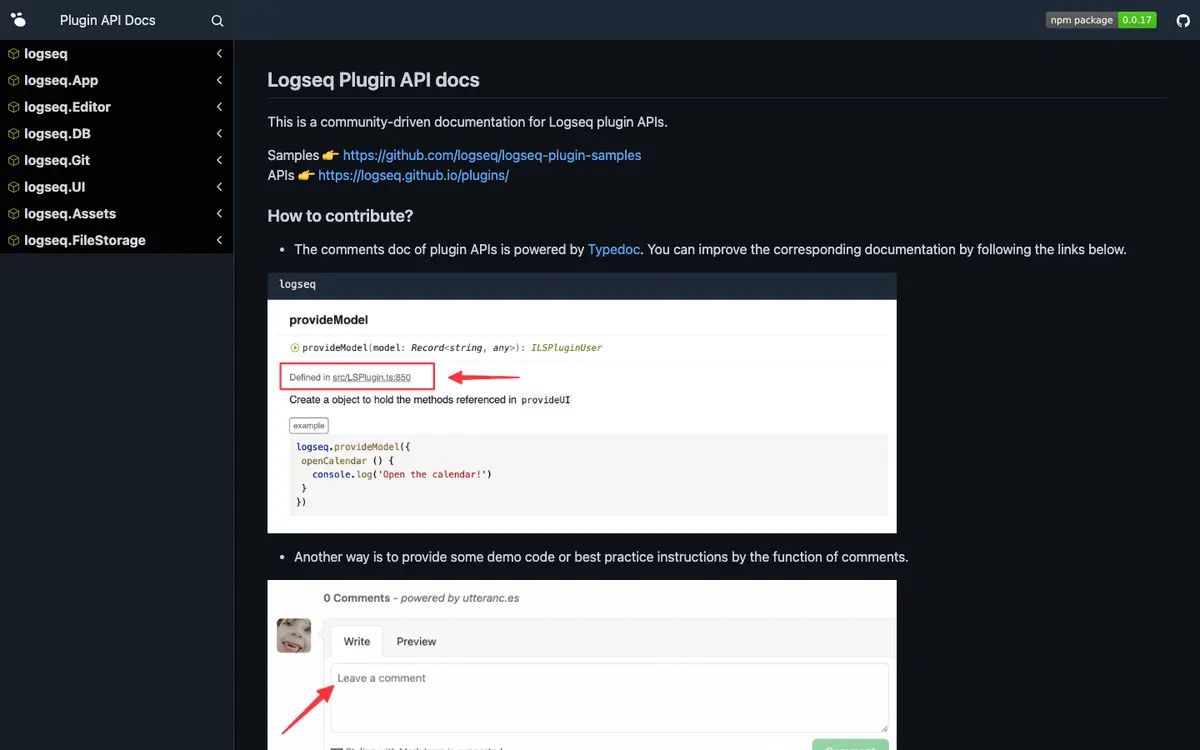
“Community-maintained documentation for building plugins against Logseq's plugin API”
Build my own plugins against a documented extension API/SDK with samples and developer docspartialproof ↗
“A logseq:// URI protocol lets third-party applications invoke actions inside Logseq”
Drive the app from outside — create or open notes via a URI scheme, deep links, or a local endpoint — to wire it into my scripts and workflowsfullproof ↗
“Positioned as a privacy-first, open-source knowledge base”
“Developers can sideload unpacked plugins outside the official marketplace for testing”
Build my own plugins against a documented extension API/SDK with samples and developer docspartialproof ↗
Unverified (4)
“An automatic Journals (daily notes) page is created every day at midnight and is the default landing page”
I get an automatic daily note for each day, pre-filled from a template, as the default landing place for journaling and capturefullproof ↗
“Create/reference pages with [[double-brackets]] and reference individual blocks with ((block refs))”
Reference or transclude an individual block or section of one note inside another and have it stay in syncfullproof ↗
“Run simple structured queries against your notes using the {{query}} macro or /query command”
Query my notes by their structured properties and render live database-style views (tables, boards, lists) from those queriespartialproof ↗
“Publish an entire graph or selected pages as a standalone browsable website (single-page app)”
Publish selected notes as a browsable website — a digital garden with working links — without leaving the appfullproof ↗
Contradicted (4)
“Enable a local HTTP API server to give external tools authorized access to your graph”
My coding agent or assistant can read AND write my notes headlessly — through a documented local API, vendor API, or MCP server — without me touching the GUIdisputedproof ↗
“Export your data in multiple open formats: Markdown, HTML, OPML, PNG, EDN, JSON, text”
Export my entire knowledge base at any time in open formats, so leaving is as easy as arrivingdisputedproof ↗
“Sync up to 10 graphs across Desktop, Android, and iOS apps”
Full-featured iOS and Android apps give me my whole knowledge base — capture, search, and linking — not a stripped-down companionnoneproof ↗
“Graph sync between devices is end-to-end encrypted so the vendor cannot read it”
An official sync service keeps my notes updated across all my devices with end-to-end encryption the vendor can't readdisputedproof ↗
Undersold (13)
Drive the product through a documented public APIpartialproof ↗
Connect external LLMs and AI tools to my notes through first-party connectors or an ecosystem of AI pluginspartialproof ↗
Perform bulk operations across many items at oncepartialproof ↗
Clip web pages, articles, and highlights from my browser straight into my notes with an official clipper or capture flowpartialproof ↗
Explore my knowledge base as an interactive graph of notes and connections, filtered to what I care aboutpartialproof ↗
My notes live in local files or a local-first store that I own and can read without the app, and everything keeps working fully offlinepartialproof ↗
Run the whole system without the vendor's cloud — local-only mode or a self-hosted sync backend I operate myselffullproof ↗
Attach typed properties and tags to notes and use them consistently for organization and retrievalpartialproof ↗
Choose where my data is stored (region/residency)partialproof ↗
Prevent my data from being used to train AI modelspartialproof ↗
Claims outside our story set (2)
Real capability claims found in Logseq’s own materials, but no story in this arena’s taxonomy covers them yet — that’s feedback on the taxonomy, not a mark against the product.
“Whiteboards: place notes, drawings, shapes, embeds, and connectors together on a spatial canvas”
source ↗“Top-level blocks can be converted into a standalone page and back into a block”
source ↗
Business model
Free AGPL-3.0 open-source app on all platforms; the hosted end-to-end-encrypted Logseq Sync service is a beta perk for OpenCollective backers/sponsors while a paid Pro tier is still planned.
pricing ↗Score trend
How this product’s scores have moved as evidence and verdicts are re-derived — a point per change, not per day.
Try Experimental
Run it in the microterminal →Recorded agent sessions — and a live MCP handshake where the vendor ships one.
Flag
⚑ Flag a verdictThink a verdict is wrong? Opens a prefilled GitHub issue — or use the ⚑ next to any verdict above.
For agents