Rank #1 of 5 in Scheduling & Calendar
 vs Calendly
 vs Motion
 vs Reclaim.ai
 vs SavvyCal
Showcase
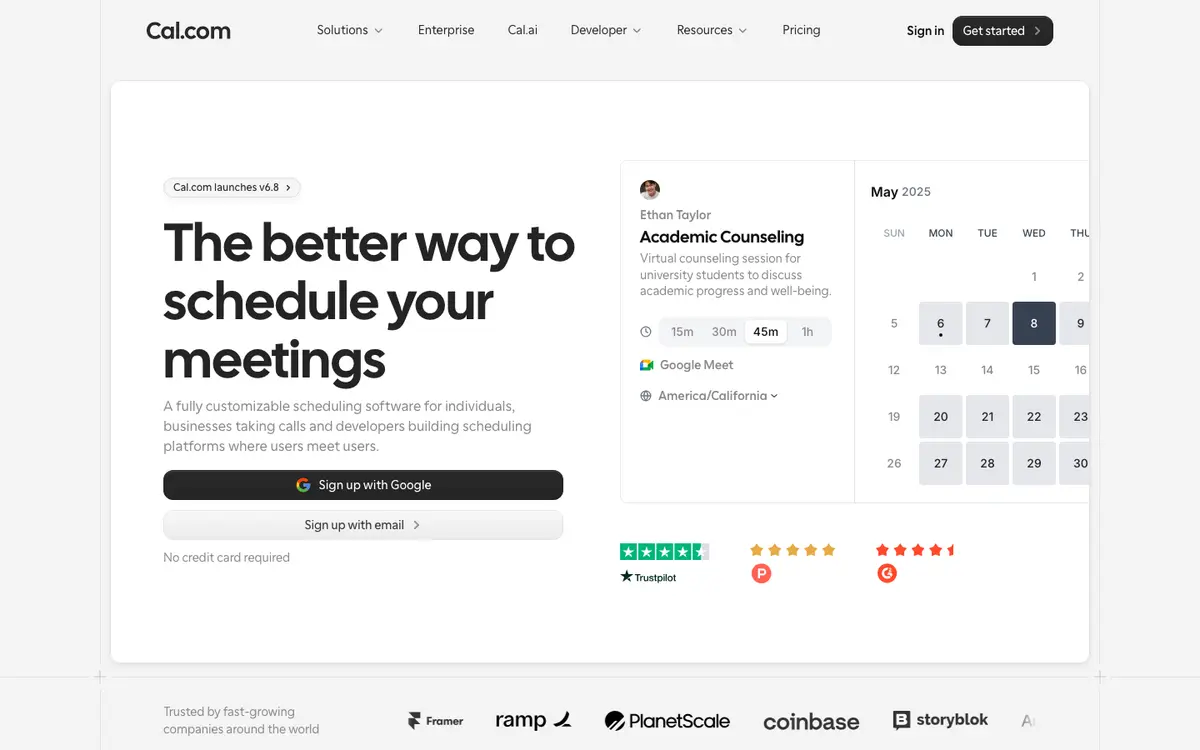
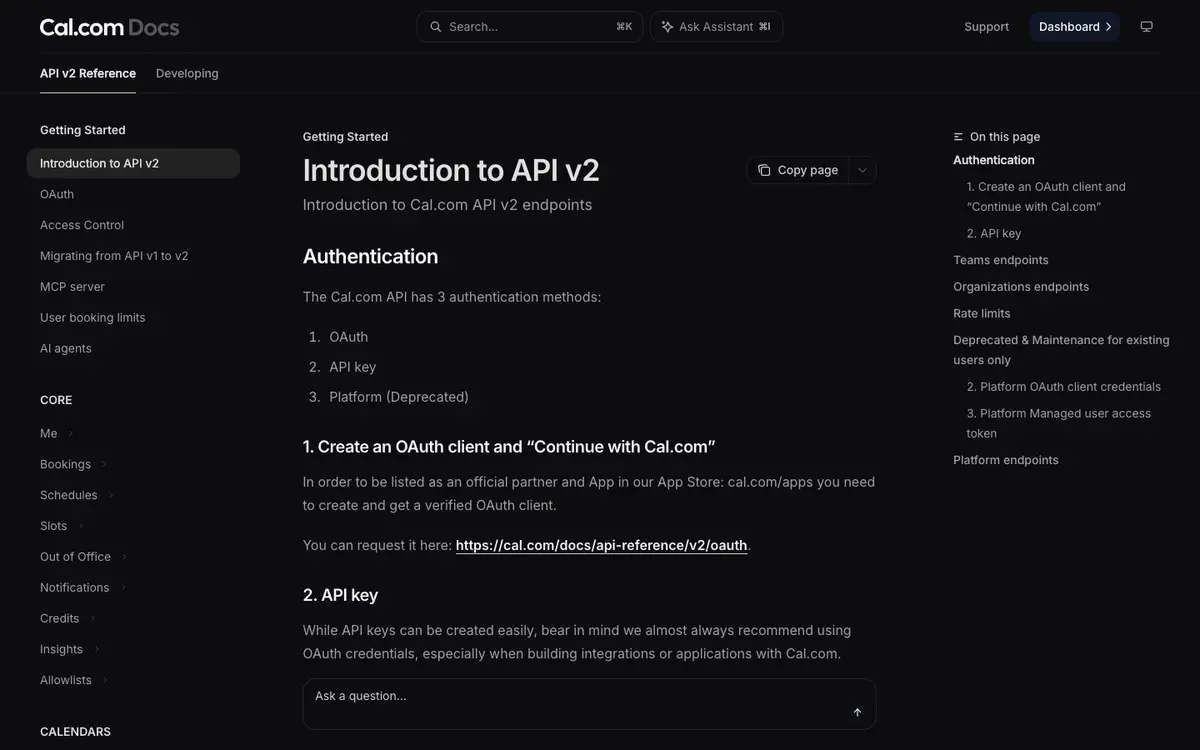
Try itExperimental
See what an agent can do with Cal.com before you ever sign up. Pick a story: recorded sessions replay real probe-harness transcripts; the live MCP handshake runs real requests from our edge, right now — including, where the server allows it, one real read-only tool call (bring your own key for auth-gated servers); sandboxed self-drive sessions are designed and gated (docs/TRY-IT.md).
$curl -si -X POST https://mcp.cal.com/mcp -H 'Content-Type: application/json' -d '<jsonrpc initialize>'recorded session — replayed, not liveVerified integrations
Connections to other tracked products — hover a chip for the verbatim evidence quote behind it.








By theme — the product's score on each story themeBy theme
Agent scheduling — stories about agent scheduling in this arenaAgent schedulingevidence →
Stories about agent scheduling in this arena
Agenticness — how well agents can access and operate the productAgenticnessevidence →
How well agents can access and operate the product
Ai scheduling — stories about ai scheduling in this arenaAi schedulingevidence →
Stories about ai scheduling in this arena
Automation depth — how much of the product can run unattendedAutomation depthevidence →
How much of the product can run unattended
Booking links — stories about booking links in this arenaBooking linksevidence →
Stories about booking links in this arena
Calendar management — stories about calendar management in this arenaCalendar managementevidence →
Stories about calendar management in this arena
Developer platform — stories about developer platform in this arenaDeveloper platformevidence →
Stories about developer platform in this arena
Embeds integrations — stories about embeds integrations in this arenaEmbeds integrationsevidence →
Stories about embeds integrations in this arena
Meeting workflows — stories about meeting workflows in this arenaMeeting workflowsevidence →
Stories about meeting workflows in this arena
Openness — open source, data portability, and self-hosting storiesOpennessevidence →
Open source, data portability, and self-hosting stories
Pricing plans — plan structure and value — what each tier costs and what it unlocksPricing plansevidence →
Plan structure and value — what each tier costs and what it unlocks
Privacy posture — data-handling and privacy storiesPrivacy postureevidence →
Data-handling and privacy stories
Team scheduling — stories about team scheduling in this arenaTeam schedulingevidence →
Stories about team scheduling in this arena
Story verdicts — every judged story with its evidenceStory verdicts
What’s free: 2 free · 1 paid · 0 enterprise · 32 not stated in evidence
Follow the green: where the map greys out is where Cal.com stops today. ✓ full · ~ partial · ! disputed · — none · n/a not applicable.
Agent scheduling — stories about agent scheduling in this arenaAgent scheduling
Stories about agent scheduling in this arena
Agenticness — how well agents can access and operate the productAgenticness
How well agents can access and operate the product
API surface
Drive the product through a documented public API
✓8/10
unlocks → Machine-readable spec · API sandbox · Full data export · Embed the booking experience in my own site — inline, popup, or floating widget — with a documented snippet
Subscribe to events via webhooks
✓8/10
Build against official SDKs
~6/10
Issue scoped/least-privilege API credentials for an agent
~5/10
Connect an agent via an official MCP server
✓8/10
Download a machine-readable API spec (OpenAPI or equivalent)
—0/10
Rely on versioned APIs with a documented deprecation policy
~4/10
Test against a sandbox environment without touching production data
—0/10
Explore an interactive API reference with runnable examples
—0/10
Docs for agents
Point an agent at llms.txt or agent-oriented docs
✓9/10
Agentic features
Delegate tasks to a built-in AI assistant inside the product
—0/10
Operate the product with natural-language commands
✓8/10
Plug MCP servers into this product so it can use their tools
n/an/a
Get AI-generated insights and suggestions from my data inside the product
—0/10
Set up automations that run autonomously in the background
~6/10
Ai scheduling — stories about ai scheduling in this arenaAi scheduling
Stories about ai scheduling in this arena
Automation depth — how much of the product can run unattendedAutomation depth
How much of the product can run unattended
Booking links — stories about booking links in this arenaBooking links
Stories about booking links in this arena
Booking
Booking controls
Calendar management — stories about calendar management in this arenaCalendar management
Stories about calendar management in this arena
Calendars
Developer platform — stories about developer platform in this arenaDeveloper platform
Stories about developer platform in this arena
Platform
Embeds integrations — stories about embeds integrations in this arenaEmbeds integrations
Stories about embeds integrations in this arena
Meeting workflows — stories about meeting workflows in this arenaMeeting workflows
Stories about meeting workflows in this arena
Workflows
Openness — open source, data portability, and self-hosting storiesOpenness
Open source, data portability, and self-hosting stories
Pricing plans — plan structure and value — what each tier costs and what it unlocksPricing plans
Plan structure and value — what each tier costs and what it unlocks
Privacy posture — data-handling and privacy storiesPrivacy posture
Data-handling and privacy stories
Team scheduling — stories about team scheduling in this arenaTeam scheduling
Stories about team scheduling in this arena
Sorted by importance (agentic first) (high → low) · 55/55 stories · click a row’s chevron for the rationale and evidence
Connect an agent via an official MCP server G Agent access | ai-native user | Agenticness — how well agents can access and operate the productAgenticness | 3 | full | 8/10 | Tprobed | |
Drive the product through a documented public API G Agent access | ai-native user | Agenticness — how well agents can access and operate the productAgenticness | 3 | full | 8/10 | Tprobed | |
Delegate tasks to a built-in AI assistant inside the product G Agentic features | ai-native user | Agenticness — how well agents can access and operate the productAgenticness | 3 | none | 0/10 | ||
Plug MCP servers into this product so it can use their tools G Agent access | ai-native user | Agenticness — how well agents can access and operate the productAgenticness | 3 | n/a | 0/10 | ||
Point an agent at llms.txt or agent-oriented docs G Agent access | ai-native user | Agenticness — how well agents can access and operate the productAgenticness | 2 | full | 9/10 | Tprobed | |
Operate the product with natural-language commands G Agentic features | ai-native user | Agenticness — how well agents can access and operate the productAgenticness | 2 | full | 8/10 | Tprobed | |
Subscribe to events via webhooks G Agent access | ai-native user | Agenticness — how well agents can access and operate the productAgenticness | 2 | full | 8/10 | Cclaimed | |
Build against official SDKs G Agent access | ai-native user | Agenticness — how well agents can access and operate the productAgenticness | 2 | partial | 6/10 | Tprobed | |
Run the product headlessly / in CI for automation G Agent access | ai-native user | Agenticness — how well agents can access and operate the productAgenticness | 2 | partial | 6/10 | Xcommunity | |
Set up automations that run autonomously in the background G Agentic features | ai-native user | Agenticness — how well agents can access and operate the productAgenticness | 2 | partial | 6/10 | Tprobed | |
Issue scoped/least-privilege API credentials for an agent G Agent access | ai-native user | Agenticness — how well agents can access and operate the productAgenticness | 2 | partial | 5/10 | Cclaimed | |
Rely on versioned APIs with a documented deprecation policy G Api quality | ai-native user | Agenticness — how well agents can access and operate the productAgenticness | 2 | partial | 4/10 | Tprobed | |
Use an official CLI G Agent access | ai-native user | Agenticness — how well agents can access and operate the productAgenticness | 2 | partial | 4/10 | Cclaimed | |
Download a machine-readable API spec (OpenAPI or equivalent) G Api quality | ai-native user | Agenticness — how well agents can access and operate the productAgenticness | 2 | none | 0/10 | ||
Explore an interactive API reference with runnable examples G Api quality | ai-native user | Agenticness — how well agents can access and operate the productAgenticness | 2 | none | 0/10 | ||
Get AI-generated insights and suggestions from my data inside the product G Agentic features | ai-native user | Agenticness — how well agents can access and operate the productAgenticness | 2 | none | 0/10 | ||
Test against a sandbox environment without touching production data G Api quality | ai-native user | Agenticness — how well agents can access and operate the productAgenticness | 1 | none | 0/10 | ||
A documented REST API lets me manage event types, availability, and bookings programmatically — enough to build scheduling into my own product C Platform | developer | Developer platform — stories about developer platform in this arenaDeveloper platform | 3 | full | 9/10 | Tprobed | |
Share a booking link where invitees pick a time from my live availability — no back-and-forth email C Booking | founder | Booking links — stories about booking links in this arenaBooking links | 3 | full | 9/10 | Xcommunity | |
My agent can check availability, book, reschedule, and cancel meetings end to end through the API or MCP — no dashboard needed C Agent ops | ai-native user | Agent scheduling — stories about agent scheduling in this arenaAgent scheduling | 3 | full | 8/10 | Tprobed | |
Define rules that trigger actions automatically on events G | ai-native user | Automation depth — how much of the product can run unattendedAutomation depth | 3 | partial | 6/10 | Cclaimed | |
Self-host the core product G | ai-native user | Openness — open source, data portability, and self-hosting storiesOpenness | 3 | disputed | 4/10 | Dcontradicted | |
Connect several calendars (Google, Outlook, Apple) and every one is checked for conflicts so I never get double-booked C Calendars | knowledge worker | Calendar management — stories about calendar management in this arenaCalendar management | 3 | partial | 3/10 | Cclaimed | |
Export all of my data in open formats and leave G | ai-native user | Openness — open source, data portability, and self-hosting storiesOpenness | 3 | disputed | 3/10 | Dcontradicted | |
Invitees always see slots in their own time zone — detection, display, and DST handling are automatic C Booking controls | knowledge worker | Booking links — stories about booking links in this arenaBooking links | 3 | none | untested | none yet | |
Prevent my data from being used to train AI models G | ai-native user | Privacy posture — data-handling and privacy storiesPrivacy posture | 3 | n/a | untested | none yet | |
Every booking gets a video conference link automatically (Zoom, Google Meet, Teams, or native video) C Workflows | founder | Meeting workflows — stories about meeting workflows in this arenaMeeting workflows | 2 | full | 9/10 | Cclaimed | |
Offer multiple event types with their own durations, locations, custom questions, and confirmation rules C Booking | founder | Booking links — stories about booking links in this arenaBooking links | 2 | full | 9/10 | Cclaimed | |
Agents can use my scheduling account as a tool — an MCP server or tool-calling surface exposes availability, bookings, and event types C Agent ops | ai-native user | Agent scheduling — stories about agent scheduling in this arenaAgent scheduling | 2 | full | 8/10 | Tprobed | |
Define availability schedules with working hours, date overrides, and out-of-office periods C Calendars | knowledge worker | Calendar management — stories about calendar management in this arenaCalendar management | 2 | full | 8/10 | Cclaimed | |
Inbound meetings distribute across my team round-robin, with weighting or priority so load stays fair C Teams | sales lead | Team scheduling — stories about team scheduling in this arenaTeam scheduling | 2 | full | 8/10 | Cclaimed | |
Invitees can reschedule or cancel from their confirmation, with my policies enforced and calendars updated everywhere C Workflows | founder | Meeting workflows — stories about meeting workflows in this arenaMeeting workflows | 2 | full | 8/10 | Cclaimed | |
Webhooks notify my systems in real time when bookings are created, rescheduled, or canceled C Platform | developer | Developer platform — stories about developer platform in this arenaDeveloper platform | 2 | full | 8/10 | Cclaimed | |
Do everything through the API that I can do in the UI G | ai-native user | Openness — open source, data portability, and self-hosting storiesOpenness | 2 | partialpaid | 7/10 | Tprobed | |
Bookings flow into my CRM and automation stack (Salesforce, HubSpot, Zapier) without manual copying C Embeds | sales lead | Embeds integrations — stories about embeds integrations in this arenaEmbeds integrations | 2 | partial | 6/10 | Cclaimed | |
Offer collective events that only show slots when every required host is free C Teams | sales lead | Team scheduling — stories about team scheduling in this arenaTeam scheduling | 2 | partial | 6/10 | Cclaimed | |
Schedule recurring jobs or workflows G | ai-native user | Automation depth — how much of the product can run unattendedAutomation depth | 2 | partial | 6/10 | Cclaimed | |
The free tier covers real individual scheduling — a usable booking link without a paid plan G Pricing | founder | Pricing plans — plan structure and value — what each tier costs and what it unlocksPricing plans | 2 | partialfree | 6/10 | Xcommunity | |
Read the product's source under an open license G | ai-native user | Openness — open source, data portability, and self-hosting storiesOpenness | 2 | disputedfree | 5/10 | Dcontradicted | |
Choose where my data is stored (region/residency) G | ai-native user | Privacy posture — data-handling and privacy storiesPrivacy posture | 2 | partial | 4/10 | Xcommunity | |
Self-host the full scheduling engine from source or a container image under an open-source license C Platform | developer | Developer platform — stories about developer platform in this arenaDeveloper platform | 2 | disputed | 4/10 | Dcontradicted | |
Automated reminder and follow-up sequences (email/SMS) fire around every booking to cut no-shows C Workflows | sales lead | Meeting workflows — stories about meeting workflows in this arenaMeeting workflows | 2 | partial | 3/10 | Cclaimed | |
Busy blocks sync between my work and personal calendars automatically so all my schedules stay in step C Calendars | knowledge worker | Calendar management — stories about calendar management in this arenaCalendar management | 2 | partial | 3/10 | Cclaimed | |
AI schedules my tasks into real calendar blocks around meetings and deadlines, and re-plans automatically when things change C Ai calendar | knowledge worker | Ai scheduling — stories about ai scheduling in this arenaAi scheduling | 2 | none | 0/10 | ||
Control data retention and deletion G | ai-native user | Privacy posture — data-handling and privacy storiesPrivacy posture | 2 | none | 0/10 | ||
Embed the booking experience in my own site — inline, popup, or floating widget — with a documented snippet C Embeds | developer | Embeds integrations — stories about embeds integrations in this arenaEmbeds integrations | 2 | none | 0/10 | ||
The product auto-defends recurring focus time and habits, flexibly moving them when conflicts appear instead of dropping them C Ai calendar | knowledge worker | Ai scheduling — stories about ai scheduling in this arenaAi scheduling | 2 | none | 0/10 | ||
Opt out of telemetry and usage tracking G | ai-native user | Privacy posture — data-handling and privacy storiesPrivacy posture | 2 | n/a | untested | none yet | |
Perform bulk operations across many items at once G | ai-native user | Automation depth — how much of the product can run unattendedAutomation depth | 2 | none | untested | none yet | |
Protect my calendar with buffers before and after meetings, minimum notice, daily booking caps, and date-range windows C Booking controls | knowledge worker | Booking links — stories about booking links in this arenaBooking links | 2 | none | untested | none yet | |
A routing form qualifies invitees and sends them to the right person or team based on their answers C Teams | sales lead | Team scheduling — stories about team scheduling in this arenaTeam scheduling | 1 | full | 6/10 | Cclaimed | |
Collect payment (e.g. via Stripe) at the moment of booking for paid sessions C Booking controls | founder | Booking links — stories about booking links in this arenaBooking links | 1 | partial | 5/10 | Cclaimed | |
AI finds and continuously optimizes the best meeting time across all attendees' calendars, not just the first open slot C Ai calendar | knowledge worker | Ai scheduling — stories about ai scheduling in this arenaAi scheduling | 1 | partial | 4/10 | Cclaimed | |
Published per-seat pricing tells me exactly what each tier costs and includes before I talk to sales G Pricing | founder | Pricing plans — plan structure and value — what each tier costs and what it unlocksPricing plans | 1 | none | 0/10 | ||
Version, review, and roll back my automations G | ai-native user | Automation depth — how much of the product can run unattendedAutomation depth | 1 | none | untested | none yet |
Opportunities — the stories that would move this product's scores, from its own judged verdictsOpportunitiestop 8 of 32 stories with headroom
What would move Cal.com’s scores — derived from its own judged verdicts, biggest headroom first. Each line quotes what the judge found missing; shipping it (or evidencing it publicly) is the fix.
Agenticness — how well agents can access and operate the productDelegate tasks to a built-in AI assistant inside the product
nonemoves Built-in AIimpact 45
Cal.com's AI-related evidence describes exposing its API/MCP server so external AI agents and clients (e.g., Claude, other MCP clients) can call scheduling functions — it does not describe a built-in AI assistant embedded in the Cal.com product UI that a user can delegate tasks to.
Booking links — stories about booking links in this arenaInvitees always see slots in their own time zone — detection, display, and DST handling are automatic
nonemoves PA Scoreimpact 30
Missing: any docs on invitee timezone detection, timezone conversion display, or DST-safe scheduling logic.
Agenticness — how well agents can access and operate the productGet AI-generated insights and suggestions from my data inside the product
nonemoves Built-in AIimpact 30
Evidence shows Cal.com exposes an API/MCP server so external AI agents can query availability and create bookings, but this is about agents acting as clients on the user's data, not the product itself surfacing AI-generated insights or suggestions to users.
Agenticness — how well agents can access and operate the productExplore an interactive API reference with runnable examples
nonemoves API qualityimpact 30
Missing: an interactive API explorer/sandbox, evidence of runnable code snippets, or a Swagger/OpenAPI-based try-it-now interface.
Agenticness — how well agents can access and operate the productDownload a machine-readable API spec (OpenAPI or equivalent)
nonemoves API qualityimpact 30
A direct probe of common OpenAPI spec paths (openapi.json, swagger.json, etc.) returned 404 on all candidates, and no documentation page or claimed-docs snippet references a downloadable OpenAPI/Swagger spec file—only human-readable API reference pages and llms.txt indices are evidenced.
Calendar management — stories about calendar management in this arenaConnect several calendars (Google, Outlook, Apple) and every one is checked for conflicts so I never get double-booked
partialq3/10moves PA Scoreimpact 21
Missing: explicit documentation of Google/Outlook/Apple calendar integrations, description of two-way sync/conflict-avoidance mechanics, and independent corroboration that double-booking is prevented across multiple connected calendars.
Ai scheduling — stories about ai scheduling in this arenaAI schedules my tasks into real calendar blocks around meetings and deadlines, and re-plans automatically when things change
nonemoves PA Scoreimpact 20
Cal.com's API/MCP lets AI agents check availability, create bookings, and reschedule meetings (cal-com-docs-12, cal-com-docs-24, cal-com-docs-49), but there is no evidence of an AI system that autonomously blocks time for tasks/deadlines around a knowledge worker's existing meetings or automatically re-plans a schedule when things change — it's a booking/meeting API, not a task-time-blocking planner.
Automation depth — how much of the product can run unattendedPerform bulk operations across many items at once
nonemoves PA Scoreimpact 20
The evidence describes single-resource CRUD operations (create one booking, reschedule one booking, create one event type, one webhook) via the API, but no bulk/batch endpoints (e.g., bulk booking creation, bulk cancellation, mass event-type updates) are documented anywhere in the pack.
Showing the top 8 of 32 — every none/partial verdict in the story verdicts table is headroom.
Think a verdict is wrong? Every verdicts-table row has a Flag link — see the methodology.
Coverage map — which docs area, API section, or community source covers which judged storiesCoverage map7 surfaces · 38 covered stories
Where the cited evidence behind each covered verdict came from — the same citations the verdicts table shows, no extra judging.
docs31 stories
- My agent can check availability, book, reschedule, and cancel meetings end to end through the API or MCP — no dashboard needed
- Agents can use my scheduling account as a tool — an MCP server or tool-calling surface exposes availability, bookings, and event types
- Point an agent at llms.txt or agent-oriented docs
- Run the product headlessly / in CI for automation
- Connect an agent via an official MCP server
- Use an official CLI
- Drive the product through a documented public API
- Issue scoped/least-privilege API credentials for an agent
- Build against official SDKs
- Subscribe to events via webhooks
- Set up automations that run autonomously in the background
- Operate the product with natural-language commands
- Rely on versioned APIs with a documented deprecation policy
- AI finds and continuously optimizes the best meeting time across all attendees' calendars, not just the first open slot
- Define rules that trigger actions automatically on events
- Schedule recurring jobs or workflows
- Share a booking link where invitees pick a time from my live availability — no back-and-forth email
- Offer multiple event types with their own durations, locations, custom questions, and confirmation rules
- Collect payment (e.g. via Stripe) at the moment of booking for paid sessions
- Define availability schedules with working hours, date overrides, and out-of-office periods
- Webhooks notify my systems in real time when bookings are created, rescheduled, or canceled
- A documented REST API lets me manage event types, availability, and bookings programmatically — enough to build scheduling into my own product
- Bookings flow into my CRM and automation stack (Salesforce, HubSpot, Zapier) without manual copying
- Automated reminder and follow-up sequences (email/SMS) fire around every booking to cut no-shows
- Invitees can reschedule or cancel from their confirmation, with my policies enforced and calendars updated everywhere
- Every booking gets a video conference link automatically (Zoom, Google Meet, Teams, or native video)
- Do everything through the API that I can do in the UI
- Export all of my data in open formats and leave
- Offer collective events that only show slots when every required host is free
- Inbound meetings distribute across my team round-robin, with weighting or priority so load stays fair
- A routing form qualifies invitees and sends them to the right person or team based on their answers
llms.txt16 stories
- Point an agent at llms.txt or agent-oriented docs
- Schedule recurring jobs or workflows
- Share a booking link where invitees pick a time from my live availability — no back-and-forth email
- Collect payment (e.g. via Stripe) at the moment of booking for paid sessions
- Busy blocks sync between my work and personal calendars automatically so all my schedules stay in step
- Connect several calendars (Google, Outlook, Apple) and every one is checked for conflicts so I never get double-booked
- Define availability schedules with working hours, date overrides, and out-of-office periods
- Bookings flow into my CRM and automation stack (Salesforce, HubSpot, Zapier) without manual copying
- Automated reminder and follow-up sequences (email/SMS) fire around every booking to cut no-shows
- Every booking gets a video conference link automatically (Zoom, Google Meet, Teams, or native video)
- Read the product's source under an open license
- The free tier covers real individual scheduling — a usable booking link without a paid plan
- Choose where my data is stored (region/residency)
- Offer collective events that only show slots when every required host is free
- Inbound meetings distribute across my team round-robin, with weighting or priority so load stays fair
- A routing form qualifies invitees and sends them to the right person or team based on their answers
Hacker News10 stories
- Run the product headlessly / in CI for automation
- Drive the product through a documented public API
- Build against official SDKs
- Share a booking link where invitees pick a time from my live availability — no back-and-forth email
- Self-host the full scheduling engine from source or a container image under an open-source license
- Export all of my data in open formats and leave
- Read the product's source under an open license
- Self-host the core product
- The free tier covers real individual scheduling — a usable booking link without a paid plan
- Choose where my data is stored (region/residency)
GitHub README5 stories
OpenAPI spec4 stories
Apps docs3 stories
Probe proofs — replayable recordings from the probe harnessProbe proofs
Replayable recordings from our probe harness — see the Prove-It protocol to submit one.
$curl -si -X POST https://mcp.cal.com/mcp -H 'Content-Type: application/json' -d '<jsonrpc initialize>'reproduced$ curl -si -X POST https://mcp.cal.com/mcp -H 'Content-Type: application/json' -d '<jsonrpc initialize>'
HTTP/2 401
access-control-allow-credentials: true
access-control-allow-headers: Content-Type, Authorization, Mcp-Session-Id, mcp-protocol-version, last-event-id
access-control-allow-methods: GET, POST, DELETE, OPTIONS
access-control-allow-origin: https://mcp.cal.com
access-control-expose-headers: Mcp-Session-Id
cache-control: public, max-age=0, must-revalidate
content-type: application/json
date: Sun, 06 Sep 2026 23:41:25 GMT
server: Vercel
strict-transport-security: max-age=63072000
vary: Origin
www-authenticate: Bearer resource_metadata="https://mcp.cal.com/.well-known/oauth-protected-resource/mcp"
x-vercel-cache: MISS
x-vercel-id: sfo1::iad1::nbnqs-1788738085459-6848c9b253dd
{"error":"unauthorized","error_description":"Bearer [redacted] required"}
$docker run calcom/cal.com:v6.2.0-arm (+ throwaway postgres:16) # boot the vendor self-host image, poll /auth/login, print the page titlereproduced$ docker run calcom/cal.com:v6.2.0-arm (+ throwaway postgres:16) # boot the vendor self-host image, poll /auth/login, print the page title login page HTTP 200 <title>Setup | Cal.com</title>
Claims vs evidence — vendor claims reconciled against independent verdictsClaims vs evidence
8 of 21 testable claims verified · 4 contradicted → integrity 0/100
32 distinct capability claims found in Cal.com’s own claimed-docs/GitHub materials, reconciled against our judge’s independent verdicts.
8
Verified
9
Unverified
4
Contradicted
17
Undersold
Verified (16)
“Invitees can pick a time from a shared booking link, eliminating back-and-forth scheduling emails”
Share a booking link where invitees pick a time from my live availability — no back-and-forth emailfullproof ↗
“Available slots for an event type can be queried four different ways (by event type id, by username+slug, by usernames only for dynamic events, etc.)”
A documented REST API lets me manage event types, availability, and bookings programmatically — enough to build scheduling into my own productfullproof ↗
“Available slots can be queried using just username and event slug, without first looking up IDs”
A documented REST API lets me manage event types, availability, and bookings programmatically — enough to build scheduling into my own productfullproof ↗
“A single bookings endpoint supports creating regular, recurring, and instant bookings”
My agent can check availability, book, reschedule, and cancel meetings end to end through the API or MCP — no dashboard neededfullproof ↗
“A hosted MCP server at mcp.cal.com (or a self-run instance) lets AI clients connect to Cal.com scheduling”
“API v2 lets AI agents check availability, create bookings, and manage event types on users' behalf”
My agent can check availability, book, reschedule, and cancel meetings end to end through the API or MCP — no dashboard neededfullproof ↗
“API v2 lets AI agents check availability, create bookings, and manage event types on users' behalf”
Agents can use my scheduling account as a tool — an MCP server or tool-calling surface exposes availability, bookings, and event typesfullproof ↗
“API supports three authentication methods: OAuth, API key, and (deprecated) platform auth”
Drive the product through a documented public APIfullproof ↗
“OAuth clients can be created to let users 'Continue with Cal.com' for third-party integrations”
Drive the product through a documented public APIfullproof ↗
“API authentication is performed via a standard Authorization header”
Drive the product through a documented public APIfullproof ↗
“MCP integration lets users manage bookings, event types and schedules through natural language in any MCP-compatible client”
Operate the product with natural-language commandsfullproof ↗
“MCP integration lets users manage bookings, event types and schedules through natural language in any MCP-compatible client”
“Event types can be created programmatically via the API”
A documented REST API lets me manage event types, availability, and bookings programmatically — enough to build scheduling into my own productfullproof ↗
“Key differentiators include a self-hostable MIT edition, API-first architecture, regulated-industry compliance, org-scale governance and a generous free tier”
The free tier covers real individual scheduling — a usable booking link without a paid planpartialproof ↗
“The booking creation endpoint is public and requires no authentication, allowing agents to book on behalf of external users”
Drive the product through a documented public APIfullproof ↗
“Slot/availability lookups accept eventTypeSlug and username (plus optional organizationSlug for org members) as parameters”
A documented REST API lets me manage event types, availability, and bookings programmatically — enough to build scheduling into my own productfullproof ↗
Unverified (14)
“Event types can offer multiple selectable durations for the same event”
Offer multiple event types with their own durations, locations, custom questions, and confirmation rulesfullproof ↗
“Custom fields beyond name/email can be added to the booking form”
Offer multiple event types with their own durations, locations, custom questions, and confirmation rulesfullproof ↗
“Every booking gets a video location automatically, defaulting to Cal Video or a connected Zoom/Teams/Meet account”
Every booking gets a video conference link automatically (Zoom, Google Meet, Teams, or native video)fullproof ↗
“Zoom, Microsoft Teams or Google Meet can be connected at the user or team level”
Every booking gets a video conference link automatically (Zoom, Google Meet, Teams, or native video)fullproof ↗
“Bookings (including seated bookings) can be rescheduled, with defined reschedulable statuses like accepted/pending”
Invitees can reschedule or cancel from their confirmation, with my policies enforced and calendars updated everywherefullproof ↗
“Schedules can be created via API for the authenticated user so event types are available at specific times”
Define availability schedules with working hours, date overrides, and out-of-office periodsfullproof ↗
“Webhooks can be triggered on booking lifecycle events (created, payment initiated, paid, rescheduled, requested, cancelled)”
Webhooks notify my systems in real time when bookings are created, rescheduled, or canceledfullproof ↗
“Round-robin events support host priority, weight, group assignment, and advanced settings like no-show calc and CRM fallback”
Inbound meetings distribute across my team round-robin, with weighting or priority so load stays fairfullproof ↗
“A booking's full routing trace (routing forms, CRM lookups, host selection logic) can be retrieved by booking UID”
A routing form qualifies invitees and sends them to the right person or team based on their answersfullproof ↗
“API keys can be created and managed from the account security settings page”
Issue scoped/least-privilege API credentials for an agentpartialproof ↗
“Product powers one-on-one, group, round-robin and collective scheduling with routing forms, workflows, payments, native video, and an app store”
Offer multiple event types with their own durations, locations, custom questions, and confirmation rulesfullproof ↗
“Event types can be created programmatically via the API”
Offer multiple event types with their own durations, locations, custom questions, and confirmation rulesfullproof ↗
“The scheduling configuration for a team event type can be retrieved via API”
Inbound meetings distribute across my team round-robin, with weighting or priority so load stays fairfullproof ↗
“An official Cal.com CLI is recommended for agents that can execute commands on a machine, instead of calling the API directly”
Contradicted (4)
“React 'atoms' let developers embed scheduling UI directly into their own product”
Embed the booking experience in my own site — inline, popup, or floating widget — with a documented snippetnoneproof ↗
“Cal.diy is a 100% MIT-licensed fork of Cal.com with all enterprise/commercial code removed, for self-hosters”
“Cal.diy is a 100% MIT-licensed fork of Cal.com with all enterprise/commercial code removed, for self-hosters”
Read the product's source under an open licensedisputedproof ↗
“Cal.diy is a 100% MIT-licensed fork of Cal.com with all enterprise/commercial code removed, for self-hosters”
Self-host the full scheduling engine from source or a container image under an open-source licensedisputedproof ↗
Undersold (17)
Point an agent at llms.txt or agent-oriented docsfullproof ↗
Run the product headlessly / in CI for automationpartialproof ↗
Set up automations that run autonomously in the backgroundpartialproof ↗
Rely on versioned APIs with a documented deprecation policypartialproof ↗
AI finds and continuously optimizes the best meeting time across all attendees' calendars, not just the first open slotpartialproof ↗
Define rules that trigger actions automatically on eventspartialproof ↗
Collect payment (e.g. via Stripe) at the moment of booking for paid sessionspartialproof ↗
Busy blocks sync between my work and personal calendars automatically so all my schedules stay in steppartialproof ↗
Connect several calendars (Google, Outlook, Apple) and every one is checked for conflicts so I never get double-bookedpartialproof ↗
Bookings flow into my CRM and automation stack (Salesforce, HubSpot, Zapier) without manual copyingpartialproof ↗
Automated reminder and follow-up sequences (email/SMS) fire around every booking to cut no-showspartialproof ↗
Do everything through the API that I can do in the UIpartialproof ↗
Choose where my data is stored (region/residency)partialproof ↗
Offer collective events that only show slots when every required host is freepartialproof ↗
Claims outside our story set (3)
Real capability claims found in Cal.com’s own materials, but no story in this arena’s taxonomy covers them yet — that’s feedback on the taxonomy, not a mark against the product.
“Team event types can be flagged as instant meetings via an 'instant' flag in the request body”
source ↗“Managed users can be created via API that are fully independent of a Cal.com web account, so end users never need to register”
source ↗“Product supports HIPAA (with BAA), SOC 2, ISO 27001, GDPR and CCPA compliance”
source ↗
Business model
Free individual plan, then per-seat Teams/Organizations and custom enterprise contracts; the commercial product went closed source in April 2026 — the MIT-licensed, self-hostable community edition is the separate Cal.diy project.
pricing ↗Score trend
How this product’s scores have moved as evidence and verdicts are re-derived — a point per change, not per day.
Try Experimental
Run it in the microterminal →Recorded agent sessions — and a live MCP handshake where the vendor ships one.
Flag
⚑ Flag a verdictThink a verdict is wrong? Opens a prefilled GitHub issue — or use the ⚑ next to any verdict above.
For agents
Agent surface uptime MCP 100% · llms.txt 100% (30d, checked every 6h since Sep 8 '26)