Rank #7 of 9 in Agent Frameworks & SDKs

Access
Install
npm create mastra@latest vs LangGraph
 vs OpenAI Agents SDK
 vs Claude Agent SDK
 vs CrewAI
 vs Pydantic AI
 vs Google ADK
 vs AutoGen
 vs smolagents
Showcase
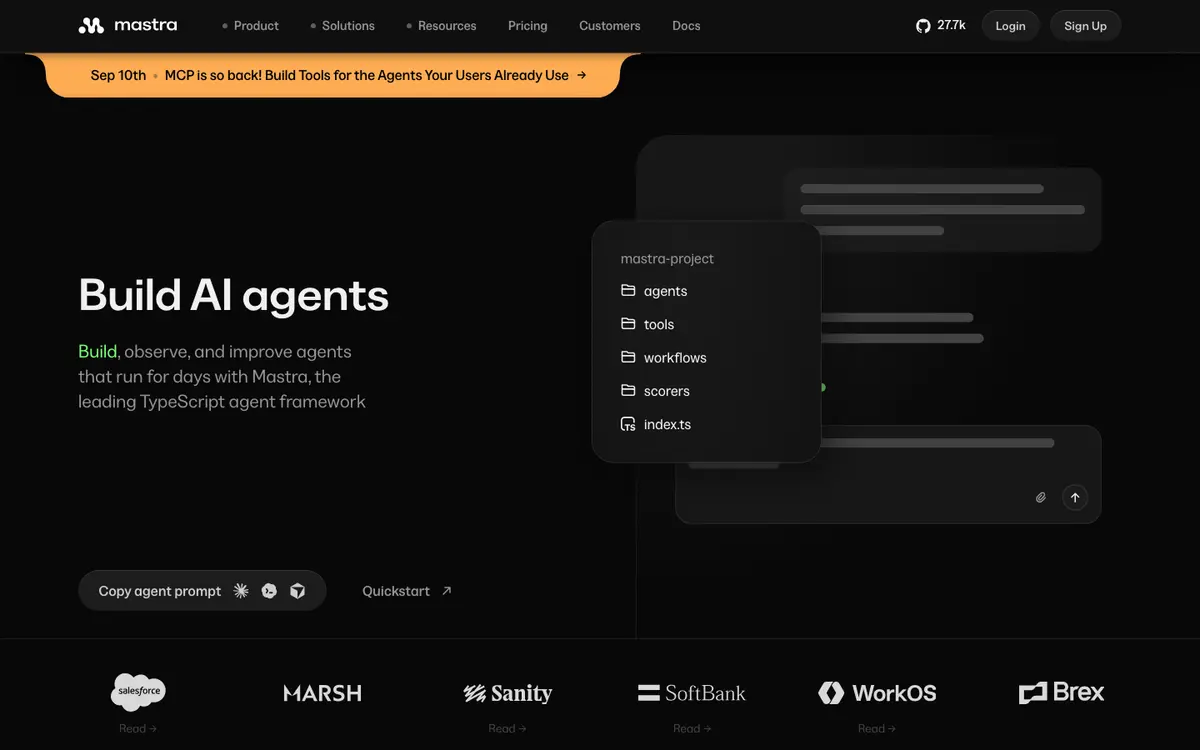
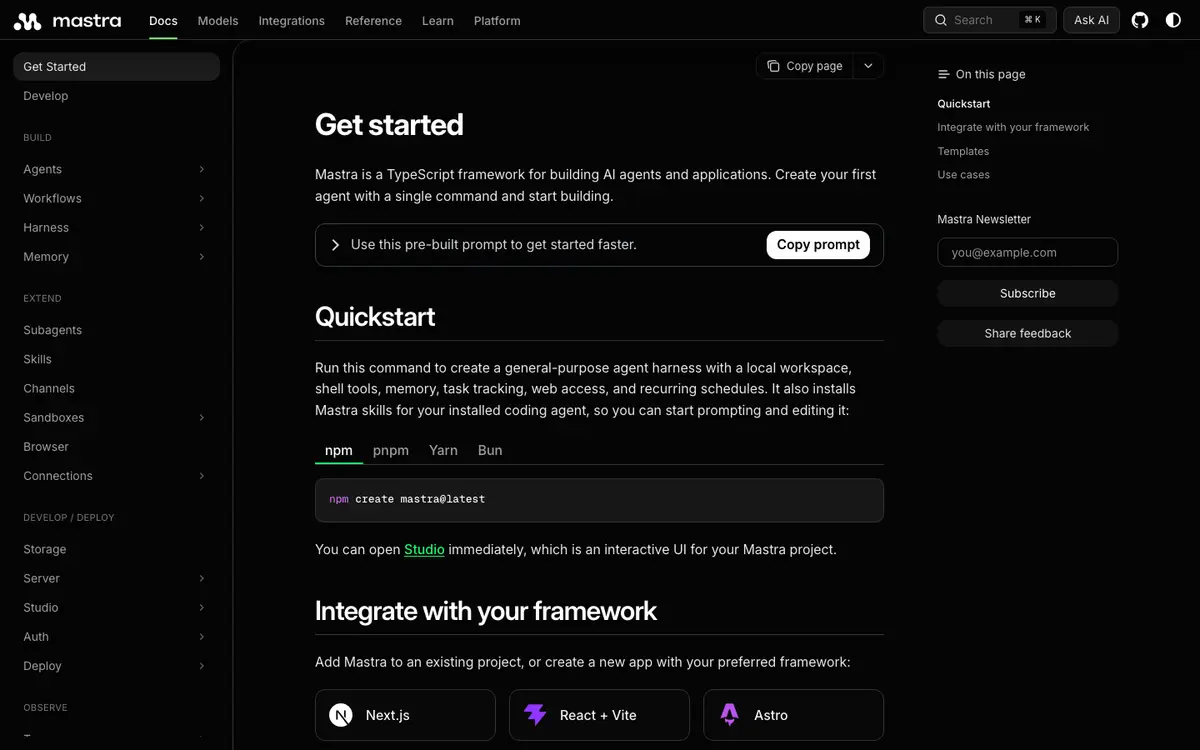
Verified integrations
Connections to other tracked products — hover a chip for the verbatim evidence quote behind it.







By theme — the product's score on each story themeBy theme
Agenticness — how well agents can access and operate the productAgenticnessevidence →
How well agents can access and operate the product
Agents tools — stories about agents tools in this arenaAgents toolsevidence →
Stories about agents tools in this arena
Automation depth — how much of the product can run unattendedAutomation depthevidence →
How much of the product can run unattended
Deployment portability — stories about deployment portability in this arenaDeployment portabilityevidence →
Stories about deployment portability in this arena
Evals observability — stories about evals observability in this arenaEvals observabilityevidence →
Stories about evals observability in this arena
Guardrails safety — stories about guardrails safety in this arenaGuardrails safetyevidence →
Stories about guardrails safety in this arena
Human in the loop — stories about human in the loop in this arenaHuman in the loopevidence →
Stories about human in the loop in this arena
Memory context — stories about memory context in this arenaMemory contextevidence →
Stories about memory context in this arena
Openness — open source, data portability, and self-hosting storiesOpennessevidence →
Open source, data portability, and self-hosting stories
Orchestration multi agent — stories about orchestration multi agent in this arenaOrchestration multi agentevidence →
Stories about orchestration multi agent in this arena
Privacy posture — data-handling and privacy storiesPrivacy postureevidence →
Data-handling and privacy stories
State durability — stories about state durability in this arenaState durabilityevidence →
Stories about state durability in this arena
Streaming output — stories about streaming output in this arenaStreaming outputevidence →
Stories about streaming output in this arena
Story verdicts — every judged story with its evidenceStory verdicts
What’s free: 6 free · 0 paid · 0 enterprise · 22 not stated in evidence
Follow the green: where the map greys out is where Mastra stops today. ✓ full · ~ partial · ! disputed · — none · n/a not applicable.
Agenticness — how well agents can access and operate the productAgenticness
How well agents can access and operate the product
API surface
Drive the product through a documented public API
~6/10
unlocks → Webhooks · Scoped API keys · Machine-readable spec · Versioning policy · Full data export · Run the framework's example agents headlessly from a terminal so an agent can verify what it just built
Subscribe to events via webhooks
—0/10
Build against official SDKs
✓8/10
Issue scoped/least-privilege API credentials for an agent
—0/10
Connect an agent via an official MCP server
✓8/10
Download a machine-readable API spec (OpenAPI or equivalent)
—0/10
Rely on versioned APIs with a documented deprecation policy
—0/10
Test against a sandbox environment without touching production data
~4/10
Explore an interactive API reference with runnable examples
—0/10
Agentic features
Delegate tasks to a built-in AI assistant inside the product
n/an/a
Operate the product with natural-language commands
~4/10
Plug MCP servers into this product so it can use their tools
✓8/10
Get AI-generated insights and suggestions from my data inside the product
n/an/a
Set up automations that run autonomously in the background
✓8/10
Agents tools — stories about agents tools in this arenaAgents tools
Stories about agents tools in this arena
Automation depth — how much of the product can run unattendedAutomation depth
How much of the product can run unattended
Deployment portability — stories about deployment portability in this arenaDeployment portability
Stories about deployment portability in this arena
Evals observability — stories about evals observability in this arenaEvals observability
Stories about evals observability in this arena
Guardrails safety — stories about guardrails safety in this arenaGuardrails safety
Stories about guardrails safety in this arena
Human in the loop — stories about human in the loop in this arenaHuman in the loop
Stories about human in the loop in this arena
Memory context — stories about memory context in this arenaMemory context
Stories about memory context in this arena
Openness — open source, data portability, and self-hosting storiesOpenness
Open source, data portability, and self-hosting stories
Orchestration multi agent — stories about orchestration multi agent in this arenaOrchestration multi agent
Stories about orchestration multi agent in this arena
Privacy posture — data-handling and privacy storiesPrivacy posture
Data-handling and privacy stories
State durability — stories about state durability in this arenaState durability
Stories about state durability in this arena
Streaming output — stories about streaming output in this arenaStreaming output
Stories about streaming output in this arena
Sorted by importance (agentic first) (high → low) · 51/51 stories · click a row’s chevron for the rationale and evidence
Connect an agent via an official MCP server G Agent access | ai-native user | Agenticness — how well agents can access and operate the productAgenticness | 3 | full | 8/10 | Tprobed | |
Plug MCP servers into this product so it can use their tools G Agent access | ai-native user | Agenticness — how well agents can access and operate the productAgenticness | 3 | full | 8/10 | Cclaimed | |
Drive the product through a documented public API G Agent access | ai-native user | Agenticness — how well agents can access and operate the productAgenticness | 3 | partial | 6/10 | Tprobed | |
Delegate tasks to a built-in AI assistant inside the product G Agentic features | ai-native user | Agenticness — how well agents can access and operate the productAgenticness | 3 | n/a | untested | none yet | |
Point an agent at llms.txt or agent-oriented docs G Agent access | ai-native user | Agenticness — how well agents can access and operate the productAgenticness | 2 | full | 9/10 | Tprobed | |
Build against official SDKs G Agent access | ai-native user | Agenticness — how well agents can access and operate the productAgenticness | 2 | full | 8/10 | Tprobed | |
Set up automations that run autonomously in the background G Agentic features | ai-native user | Agenticness — how well agents can access and operate the productAgenticness | 2 | fullfree | 8/10 | Cclaimed | |
Run the product headlessly / in CI for automation G Agent access | ai-native user | Agenticness — how well agents can access and operate the productAgenticness | 2 | partialfree | 6/10 | Cclaimed | |
Use an official CLI G Agent access | ai-native user | Agenticness — how well agents can access and operate the productAgenticness | 2 | partial | 6/10 | Cclaimed | |
Operate the product with natural-language commands G Agentic features | ai-native user | Agenticness — how well agents can access and operate the productAgenticness | 2 | partial | 4/10 | Tprobed | |
Download a machine-readable API spec (OpenAPI or equivalent) G Api quality | ai-native user | Agenticness — how well agents can access and operate the productAgenticness | 2 | none | 0/10 | ||
Explore an interactive API reference with runnable examples G Api quality | ai-native user | Agenticness — how well agents can access and operate the productAgenticness | 2 | none | 0/10 | ||
Issue scoped/least-privilege API credentials for an agent G Agent access | ai-native user | Agenticness — how well agents can access and operate the productAgenticness | 2 | none | 0/10 | ||
Rely on versioned APIs with a documented deprecation policy G Api quality | ai-native user | Agenticness — how well agents can access and operate the productAgenticness | 2 | none | 0/10 | ||
Subscribe to events via webhooks G Agent access | ai-native user | Agenticness — how well agents can access and operate the productAgenticness | 2 | none | 0/10 | ||
Get AI-generated insights and suggestions from my data inside the product G Agentic features | ai-native user | Agenticness — how well agents can access and operate the productAgenticness | 2 | n/a | untested | none yet | |
Test against a sandbox environment without touching production data G Api quality | ai-native user | Agenticness — how well agents can access and operate the productAgenticness | 1 | partial | 4/10 | Cclaimed | |
Define an agent with typed custom tools in a few lines of code C Agent authoring | developer | Agents tools — stories about agents tools in this arenaAgents tools | 3 | full | 9/10 | Cclaimed | |
Checkpoint agent state so a run can resume exactly where it left off after a crash or restart C Durable state | developer | State durability — stories about state durability in this arenaState durability | 3 | full | 8/10 | Cclaimed | |
Pause an agent mid-run for human input or approval and resume with the human's decision C Approval flows | developer | Human in the loop — stories about human in the loop in this arenaHuman in the loop | 3 | full | 8/10 | Cclaimed | |
Stream tokens and intermediate agent events (tool calls, steps) to my UI in real time C Streaming | developer | Streaming output — stories about streaming output in this arenaStreaming output | 3 | full | 8/10 | Cclaimed | |
Swap the underlying LLM provider or model without rewriting my agent C Portability | developer | Deployment portability — stories about deployment portability in this arenaDeployment portability | 3 | full | 8/10 | Cclaimed | |
Trace every LLM call and tool invocation of an agent run in an observability UI C Tracing | developer | Evals observability — stories about evals observability in this arenaEvals observability | 3 | full | 8/10 | Cclaimed | |
Attach input/output guardrails that validate, transform, or block unsafe content C Guardrails | developer | Guardrails safety — stories about guardrails safety in this arenaGuardrails safety | 3 | full | 7/10 | Cclaimed | |
Orchestrate multiple agents — handoffs, subagents, or crews — inside one workflow C Multi agent | developer | Orchestration multi agent — stories about orchestration multi agent in this arenaOrchestration multi agent | 3 | full | 7/10 | Xcommunity | |
Define rules that trigger actions automatically on events G | ai-native user | Automation depth — how much of the product can run unattendedAutomation depth | 3 | partial | 6/10 | Cclaimed | |
Get schema-validated structured output from an agent, with automatic retries when validation fails C Structured output | developer | Streaming output — stories about streaming output in this arenaStreaming output | 3 | partial | 5/10 | Cclaimed | |
Self-host the core product G | ai-native user | Openness — open source, data portability, and self-hosting storiesOpenness | 3 | disputedfree | 5/10 | Dcontradicted | |
Export all of my data in open formats and leave G | ai-native user | Openness — open source, data portability, and self-hosting storiesOpenness | 3 | none | 0/10 | ||
Prevent my data from being used to train AI models G | ai-native user | Privacy posture — data-handling and privacy storiesPrivacy posture | 3 | n/a | 0/10 | ||
Give agents long-term memory that persists across sessions and threads C Memory | developer | Memory context — stories about memory context in this arenaMemory context | 2 | full | 8/10 | Cclaimed | |
Require human approval before specific sensitive tool calls execute C Approval flows | engineering-lead | Human in the loop — stories about human in the loop in this arenaHuman in the loop | 2 | full | 8/10 | Cclaimed | |
Run my agents entirely on my own infrastructure with no dependence on the vendor's platform C Deployment | engineering-lead | Deployment portability — stories about deployment portability in this arenaDeployment portability | 2 | fullfree | 8/10 | Xcommunity | |
Compose agents into an explicit graph or workflow with branching, loops, and parallel steps C Workflow control | developer | Orchestration multi agent — stories about orchestration multi agent in this arenaOrchestration multi agent | 2 | partial | 7/10 | Xcommunity | |
Restrict what an agent may do with fine-grained tool permissions and sandboxed execution C Guardrails | engineering-lead | Guardrails safety — stories about guardrails safety in this arenaGuardrails safety | 2 | full | 7/10 | Cclaimed | |
Run long-lived agents durably across process restarts and deploys, natively or via durable-execution integrations C Durable state | engineering-lead | State durability — stories about state durability in this arenaState durability | 2 | full | 7/10 | Cclaimed | |
Schedule recurring jobs or workflows G | ai-native user | Automation depth — how much of the product can run unattendedAutomation depth | 2 | full | 7/10 | Cclaimed | |
Deploy an agent to a managed runtime and call it as an API endpoint C Deployment | engineering-lead | Deployment portability — stories about deployment portability in this arenaDeployment portability | 2 | partialfree | 6/10 | Tprobed | |
Have a coding agent scaffold a new agent project from an official CLI or template in one command C Ai buildability | ai-native user | Agents tools — stories about agents tools in this arenaAgents tools | 2 | partial | 6/10 | Cclaimed | |
Rely on strict typing and schema validation so a coding agent catches its own mistakes at build time C Ai buildability | ai-native user | Agents tools — stories about agents tools in this arenaAgents tools | 2 | full | 6/10 | Cclaimed | |
Score agent quality with built-in evals and run them as part of CI C Evals | engineering-lead | Evals observability — stories about evals observability in this arenaEvals observability | 2 | partial | 5/10 | Cclaimed | |
Choose where my data is stored (region/residency) G | ai-native user | Privacy posture — data-handling and privacy storiesPrivacy posture | 2 | partialfree | 4/10 | Cclaimed | |
Do everything through the API that I can do in the UI G | ai-native user | Openness — open source, data portability, and self-hosting storiesOpenness | 2 | partial | 4/10 | Tprobed | |
Perform bulk operations across many items at once G | ai-native user | Automation depth — how much of the product can run unattendedAutomation depth | 2 | partial | 4/10 | Cclaimed | |
Read the product's source under an open license G | ai-native user | Openness — open source, data portability, and self-hosting storiesOpenness | 2 | disputed | 4/10 | Dcontradicted | |
Control data retention and deletion G | ai-native user | Privacy posture — data-handling and privacy storiesPrivacy posture | 2 | none | 0/10 | ||
Run the framework's example agents headlessly from a terminal so an agent can verify what it just built C Ai buildability | ai-native user | Agents tools — stories about agents tools in this arenaAgents tools | 2 | none | 0/10 | ||
Trim, summarize, or filter conversation history to keep an agent inside its context window C Memory | developer | Memory context — stories about memory context in this arenaMemory context | 2 | none | 0/10 | ||
Opt out of telemetry and usage tracking G | ai-native user | Privacy posture — data-handling and privacy storiesPrivacy posture | 2 | none | untested | none yet | |
Unit-test agents with mocked models and tools C Testing | developer | Evals observability — stories about evals observability in this arenaEvals observability | 2 | none | untested | none yet | |
Version, review, and roll back my automations G | ai-native user | Automation depth — how much of the product can run unattendedAutomation depth | 1 | none | 0/10 |
Opportunities — the stories that would move this product's scores, from its own judged verdictsOpportunitiestop 8 of 26 stories with headroom
What would move Mastra’s scores — derived from its own judged verdicts, biggest headroom first. Each line quotes what the judge found missing; shipping it (or evidencing it publicly) is the fix.
Openness — open source, data portability, and self-hosting storiesExport all of my data in open formats and leave
nonemoves PA Scoreimpact 30
Missing: any documented export/migration tooling, data format specs, or explicit portability guarantees.
Agenticness — how well agents can access and operate the productIssue scoped/least-privilege API credentials for an agent
nonemoves agent-readyimpact 30
Missing: any documentation of per-agent credential scoping, secrets vault integration, or least-privilege API key issuance.
Agenticness — how well agents can access and operate the productSubscribe to events via webhooks
nonemoves agent-readyimpact 30
Missing: any explicit webhook registration/subscription API, incoming webhook trigger docs, or example of an agent/workflow subscribing to external webhook events.
Agenticness — how well agents can access and operate the productExplore an interactive API reference with runnable examples
nonemoves API qualityimpact 30
Evidence shows Mastra has markdown-based docs (docs.md, llms.txt) and a local dev Studio for testing agents, but no interactive API reference with runnable/embedded examples (e.g., a Swagger/OpenAPI-style playground) is documented, and probes for OpenAPI specs all 404'd.
Agenticness — how well agents can access and operate the productDownload a machine-readable API spec (OpenAPI or equivalent)
nonemoves API qualityimpact 30
Mastra deploys servers/agents but explicit probes for OpenAPI/swagger endpoints all returned 404, and no docs mention a downloadable machine-readable API spec.
Agenticness — how well agents can access and operate the productRely on versioned APIs with a documented deprecation policy
nonemoves API qualityimpact 30
No evidence of a versioned API scheme or documented deprecation policy; OpenAPI spec probes all 404 and no docs reference API versioning or deprecation practices.
Agents tools — stories about agents tools in this arenaRun the framework's example agents headlessly from a terminal so an agent can verify what it just built
nonemoves PA Scoreimpact 20
Missing: a documented CLI command to run/test agents non-interactively, evidence of scripted/headless agent execution, and confirmation this works without the Studio UI.
Memory context — stories about memory context in this arenaTrim, summarize, or filter conversation history to keep an agent inside its context window
nonemoves PA Scoreimpact 20
The evidence describes Mastra's Memory system only in general terms (remembering messages/tool results, multi-user threads) but never mentions any mechanism for trimming, summarizing, or filtering conversation history to manage context window size.
Showing the top 8 of 26 — every none/partial verdict in the story verdicts table is headroom.
Think a verdict is wrong? Every verdicts-table row has a Flag link — see the methodology.
Coverage map — which docs area, API section, or community source covers which judged storiesCoverage map8 surfaces · 36 covered stories
Where the cited evidence behind each covered verdict came from — the same citations the verdicts table shows, no extra judging.
docs30 stories
- Point an agent at llms.txt or agent-oriented docs
- Run the product headlessly / in CI for automation
- Plug MCP servers into this product so it can use their tools
- Connect an agent via an official MCP server
- Use an official CLI
- Drive the product through a documented public API
- Build against official SDKs
- Set up automations that run autonomously in the background
- Test against a sandbox environment without touching production data
- Define an agent with typed custom tools in a few lines of code
- Have a coding agent scaffold a new agent project from an official CLI or template in one command
- Rely on strict typing and schema validation so a coding agent catches its own mistakes at build time
- Perform bulk operations across many items at once
- Schedule recurring jobs or workflows
- Deploy an agent to a managed runtime and call it as an API endpoint
- Run my agents entirely on my own infrastructure with no dependence on the vendor's platform
- Swap the underlying LLM provider or model without rewriting my agent
- Score agent quality with built-in evals and run them as part of CI
- Trace every LLM call and tool invocation of an agent run in an observability UI
- Pause an agent mid-run for human input or approval and resume with the human's decision
- Require human approval before specific sensitive tool calls execute
- Give agents long-term memory that persists across sessions and threads
- Do everything through the API that I can do in the UI
- Self-host the core product
- Orchestrate multiple agents — handoffs, subagents, or crews — inside one workflow
- Compose agents into an explicit graph or workflow with branching, loops, and parallel steps
- Choose where my data is stored (region/residency)
- Checkpoint agent state so a run can resume exactly where it left off after a crash or restart
- Run long-lived agents durably across process restarts and deploys, natively or via durable-execution integrations
- Stream tokens and intermediate agent events (tool calls, steps) to my UI in real time
mastra.ai23 stories
- Run the product headlessly / in CI for automation
- Use an official CLI
- Set up automations that run autonomously in the background
- Operate the product with natural-language commands
- Test against a sandbox environment without touching production data
- Rely on strict typing and schema validation so a coding agent catches its own mistakes at build time
- Perform bulk operations across many items at once
- Define rules that trigger actions automatically on events
- Schedule recurring jobs or workflows
- Deploy an agent to a managed runtime and call it as an API endpoint
- Trace every LLM call and tool invocation of an agent run in an observability UI
- Attach input/output guardrails that validate, transform, or block unsafe content
- Restrict what an agent may do with fine-grained tool permissions and sandboxed execution
- Pause an agent mid-run for human input or approval and resume with the human's decision
- Require human approval before specific sensitive tool calls execute
- Give agents long-term memory that persists across sessions and threads
- Do everything through the API that I can do in the UI
- Orchestrate multiple agents — handoffs, subagents, or crews — inside one workflow
- Compose agents into an explicit graph or workflow with branching, loops, and parallel steps
- Checkpoint agent state so a run can resume exactly where it left off after a crash or restart
- Run long-lived agents durably across process restarts and deploys, natively or via durable-execution integrations
- Stream tokens and intermediate agent events (tool calls, steps) to my UI in real time
- Get schema-validated structured output from an agent, with automatic retries when validation fails
GitHub README13 stories
- Plug MCP servers into this product so it can use their tools
- Connect an agent via an official MCP server
- Build against official SDKs
- Set up automations that run autonomously in the background
- Perform bulk operations across many items at once
- Schedule recurring jobs or workflows
- Swap the underlying LLM provider or model without rewriting my agent
- Pause an agent mid-run for human input or approval and resume with the human's decision
- Require human approval before specific sensitive tool calls execute
- Orchestrate multiple agents — handoffs, subagents, or crews — inside one workflow
- Compose agents into an explicit graph or workflow with branching, loops, and parallel steps
- Checkpoint agent state so a run can resume exactly where it left off after a crash or restart
- Run long-lived agents durably across process restarts and deploys, natively or via durable-execution integrations
Pricing docs9 stories
- Run the product headlessly / in CI for automation
- Set up automations that run autonomously in the background
- Test against a sandbox environment without touching production data
- Deploy an agent to a managed runtime and call it as an API endpoint
- Run my agents entirely on my own infrastructure with no dependence on the vendor's platform
- Restrict what an agent may do with fine-grained tool permissions and sandboxed execution
- Read the product's source under an open license
- Self-host the core product
- Choose where my data is stored (region/residency)
Hacker News6 stories
- Build against official SDKs
- Run my agents entirely on my own infrastructure with no dependence on the vendor's platform
- Read the product's source under an open license
- Self-host the core product
- Orchestrate multiple agents — handoffs, subagents, or crews — inside one workflow
- Compose agents into an explicit graph or workflow with branching, loops, and parallel steps
API reference5 stories
OpenAPI spec4 stories
Claims vs evidence — vendor claims reconciled against independent verdictsClaims vs evidence
6 of 20 testable claims verified · 2 contradicted → integrity 10/100
25 distinct capability claims found in Mastra’s own claimed-docs/GitHub materials, reconciled against our judge’s independent verdicts.
6
Verified
12
Unverified
2
Contradicted
16
Undersold
Verified (11)
“Graph-based workflow engine with .then/.branch/.parallel control flow for multi-step processes”
Compose agents into an explicit graph or workflow with branching, loops, and parallel stepspartialproof ↗
“Runs on Node.js, Bun, Deno, and Cloudflare runtime environments”
Run my agents entirely on my own infrastructure with no dependence on the vendor's platformfullproof ↗
“Official MCP docs server package gives AI coding tools direct local access to Mastra's documentation”
“Official MCP docs server package gives AI coding tools direct local access to Mastra's documentation”
Point an agent at llms.txt or agent-oriented docsfullproof ↗
“Workflows let you define structured multi-step task sequences instead of relying on agent reasoning alone”
Compose agents into an explicit graph or workflow with branching, loops, and parallel stepspartialproof ↗
“Deploy Mastra applications to any Node.js-compatible environment, self-hosted or as a server”
Run my agents entirely on my own infrastructure with no dependence on the vendor's platformfullproof ↗
“Deploy Mastra applications to any Node.js-compatible environment, self-hosted or as a server”
Deploy an agent to a managed runtime and call it as an API endpointpartialproof ↗
“Author Model Context Protocol servers exposing agents, tools, and resources via MCP”
“Compose workflow steps with createWorkflow to define execution flow”
Compose agents into an explicit graph or workflow with branching, loops, and parallel stepspartialproof ↗
“Convert Mastra streams and stored messages to AI SDK-compatible formats via toAISdkStream/toAISdkMessages”
“Mastra packages ship embedded docs in dist/docs so an AI agent can read package APIs directly from node_modules”
Point an agent at llms.txt or agent-oriented docsfullproof ↗
Unverified (15)
“Scaffold a new agent project with a single CLI command”
Have a coding agent scaffold a new agent project from an official CLI or template in one commandpartialproof ↗
“Route requests to 40+ model providers (OpenAI, Anthropic, Gemini, etc.) through one interface”
Swap the underlying LLM provider or model without rewriting my agentfullproof ↗
“Suspend an agent or workflow and resume later from persisted execution state after user input/approval”
Pause an agent mid-run for human input or approval and resume with the human's decisionfullproof ↗
“Suspend an agent or workflow and resume later from persisted execution state after user input/approval”
Checkpoint agent state so a run can resume exactly where it left off after a crash or restartfullproof ↗
“Define custom tools with createTool using id, description, input/output zod schemas, and execute function”
Define an agent with typed custom tools in a few lines of codefullproof ↗
“Define custom tools with createTool using id, description, input/output zod schemas, and execute function”
Rely on strict typing and schema validation so a coding agent catches its own mistakes at build timefullproof ↗
“Load tools from remote MCP servers to extend an agent's capabilities”
Plug MCP servers into this product so it can use their toolsfullproof ↗
“Agent memory persists user messages, replies, and tool results across interactions”
Give agents long-term memory that persists across sessions and threadsfullproof ↗
“Stream real-time, incremental output from agents and workflows as it's generated”
Stream tokens and intermediate agent events (tool calls, steps) to my UI in real timefullproof ↗
“Live evaluations automatically score agent/workflow outputs in real time”
Score agent quality with built-in evals and run them as part of CIpartialproof ↗
“Observability system provides visibility into every agent run, workflow step, tool call, and model interaction”
Trace every LLM call and tool invocation of an agent run in an observability UIfullproof ↗
“Pause a workflow at any step to collect data, wait on API callbacks, throttle costly ops, or get human-in-the-loop input”
Pause an agent mid-run for human input or approval and resume with the human's decisionfullproof ↗
“Pause a workflow at any step to collect data, wait on API callbacks, throttle costly ops, or get human-in-the-loop input”
Require human approval before specific sensitive tool calls executefullproof ↗
“Tools must be defined via createTool with typed schema and execute function, enforcing type safety”
Rely on strict typing and schema validation so a coding agent catches its own mistakes at build timefullproof ↗
“Scorers provide quantifiable metrics for measuring agent quality”
Score agent quality with built-in evals and run them as part of CIpartialproof ↗
Contradicted (2)
“Self-host Mastra projects for free under Apache 2.0 license”
“Self-host Mastra projects for free under Apache 2.0 license”
Read the product's source under an open licensedisputedproof ↗
Undersold (16)
Run the product headlessly / in CI for automationpartialproof ↗
Drive the product through a documented public APIpartialproof ↗
Set up automations that run autonomously in the backgroundfullproof ↗
Operate the product with natural-language commandspartialproof ↗
Test against a sandbox environment without touching production datapartialproof ↗
Perform bulk operations across many items at oncepartialproof ↗
Define rules that trigger actions automatically on eventspartialproof ↗
Attach input/output guardrails that validate, transform, or block unsafe contentfullproof ↗
Restrict what an agent may do with fine-grained tool permissions and sandboxed executionfullproof ↗
Do everything through the API that I can do in the UIpartialproof ↗
Orchestrate multiple agents — handoffs, subagents, or crews — inside one workflowfullproof ↗
Choose where my data is stored (region/residency)partialproof ↗
Run long-lived agents durably across process restarts and deploys, natively or via durable-execution integrationsfullproof ↗
Get schema-validated structured output from an agent, with automatic retries when validation failspartialproof ↗
Claims outside our story set (3)
Real capability claims found in Mastra’s own materials, but no story in this arena’s taxonomy covers them yet — that’s feedback on the taxonomy, not a mark against the product.
“Build autonomous agents that reason about goals, choose tools, and iterate to a final answer”
source ↗“Share a single conversation thread across multiple users”
source ↗“Enterprise access controls including RBAC, SSO, IAM, and network policy integration”
source ↗
Business model
The Mastra framework is open source (Apache-2.0 core with source-available ee/ modules); Mastra Cloud deployment has a free tier then usage-based paid plans.
pricing ↗Score trend
How this product’s scores have moved as evidence and verdicts are re-derived — a point per change, not per day.
Flag
⚑ Flag a verdictThink a verdict is wrong? Opens a prefilled GitHub issue — or use the ⚑ next to any verdict above.
For agents
Agent surface uptime llms.txt 100% (30d, checked every 6h since Sep 8 '26)