Rank #3 of 13 in AI Coding Agents

Access
Install
npm install -g cline vs Codex
 vs Claude Code
 vs Cursor
 vs GitHub Copilot
 vs Gemini CLI
 vs OpenCode
 vs Devin
 vs cubic
 vs Google Antigravity
 vs Slate
 vs Conductor
Showcase
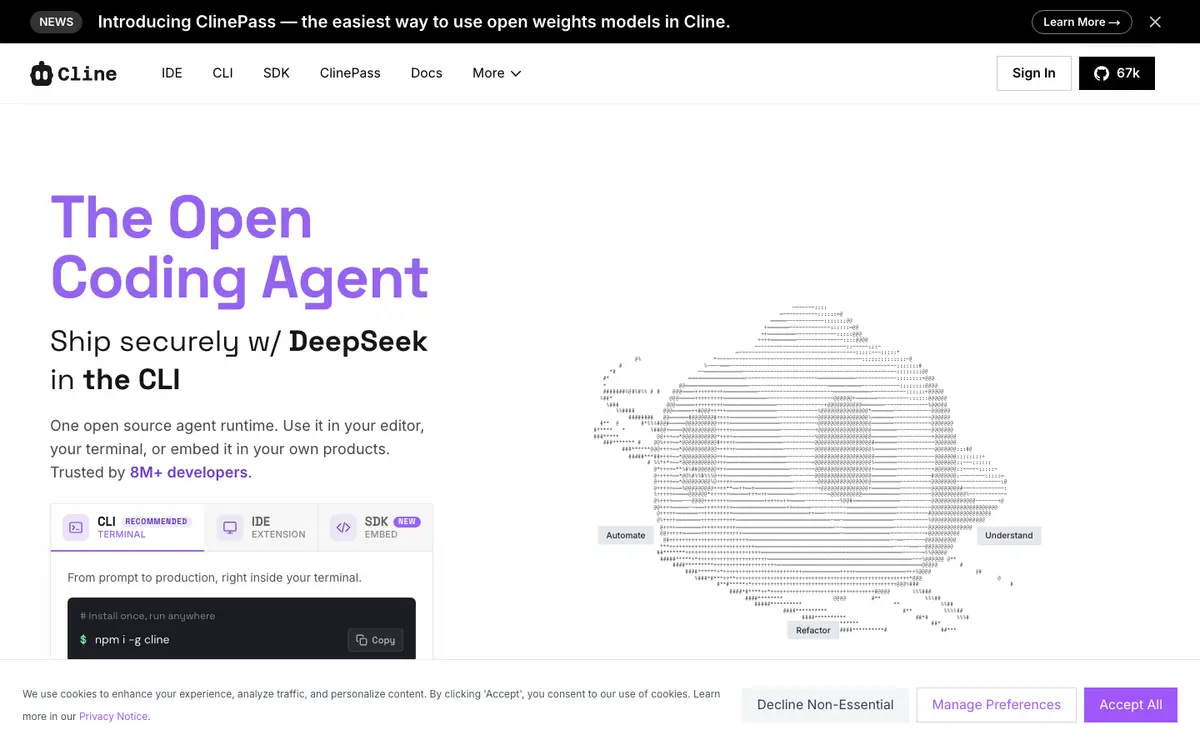
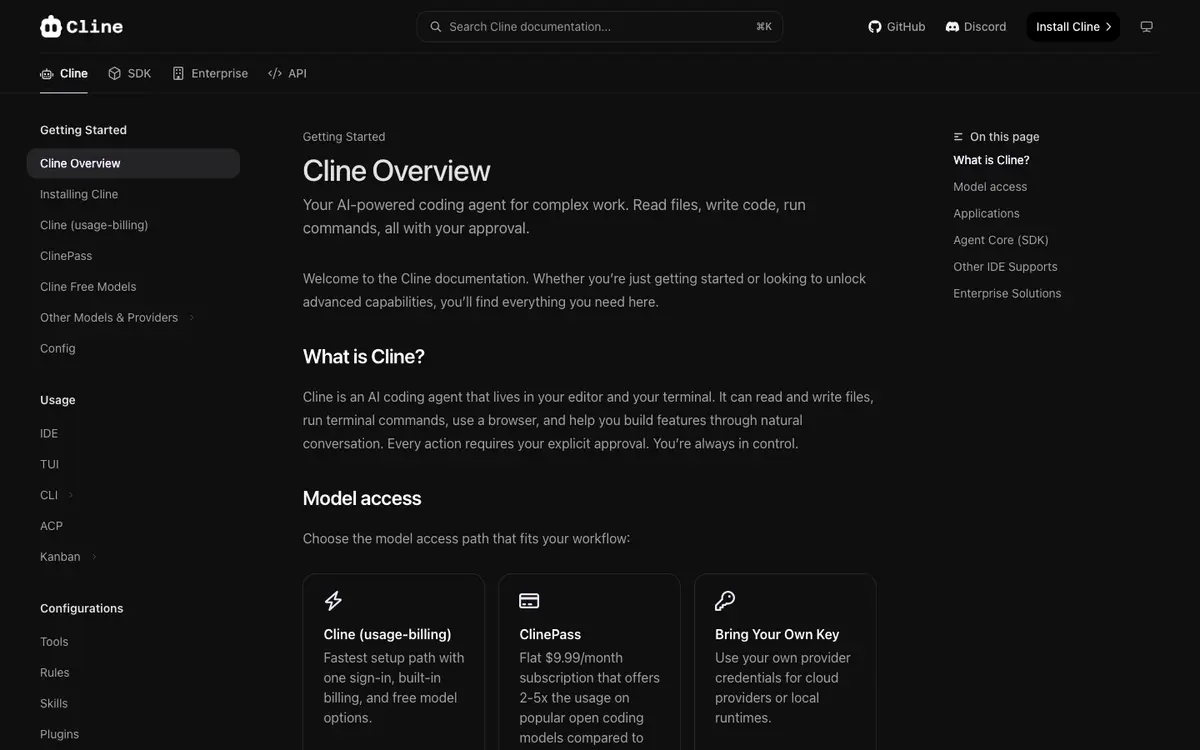
Verified integrations
Connections to other tracked products — hover a chip for the verbatim evidence quote behind it.









By theme — the product's score on each story themeBy theme
Agenticness — how well agents can access and operate the productAgenticnessevidence →
How well agents can access and operate the product
Automation depth — how much of the product can run unattendedAutomation depthevidence →
How much of the product can run unattended
Autonomy agents — stories about autonomy agents in this arenaAutonomy agentsevidence →
Stories about autonomy agents in this arena
Code generation — quality of generated code — correctness, style, fit to the codebaseCode generationevidence →
Quality of generated code — correctness, style, fit to the codebase
Codebase understanding — how deeply the tool maps your repo — cross-file context, architecture awareness, historyCodebase understandingevidence →
How deeply the tool maps your repo — cross-file context, architecture awareness, history
Ecosystem — integrations, plugins, and third-party ecosystem storiesEcosystemevidence →
Integrations, plugins, and third-party ecosystem stories
Ide terminal integration — meeting you in the IDE and terminal — extensions, inline flows, contextIde terminal integrationevidence →
Meeting you in the IDE and terminal — extensions, inline flows, context
Openness — open source, data portability, and self-hosting storiesOpennessevidence →
Open source, data portability, and self-hosting stories
Pricing limits — free-tier ceilings, usage caps, and rate limits before you have to payPricing limitsevidence →
Free-tier ceilings, usage caps, and rate limits before you have to pay
Privacy posture — data-handling and privacy storiesPrivacy postureevidence →
Data-handling and privacy stories
Review safety — keeping generated changes safe — diffs, approvals, guardrailsReview safetyevidence →
Keeping generated changes safe — diffs, approvals, guardrails
Story verdicts — every judged story with its evidenceStory verdicts
What’s free: 1 free · 0 paid · 0 enterprise · 45 not stated in evidence
Follow the green: where the map greys out is where Cline stops today. ✓ full · ~ partial · ! disputed · — none · n/a not applicable.
Agenticness — how well agents can access and operate the productAgenticness
How well agents can access and operate the product
API surface
Drive the product through a documented public API
~6/10
unlocks → Webhooks · Scoped API keys · Machine-readable spec · Versioning policy · Configure a reproducible cloud environment with the dependencies and setup steps my repository needs
Subscribe to events via webhooks
—0/10
Build against official SDKs
~3/10
Issue scoped/least-privilege API credentials for an agent
—0/10
Connect an agent via an official MCP server
n/an/a
Download a machine-readable API spec (OpenAPI or equivalent)
—0/10
Rely on versioned APIs with a documented deprecation policy
—0/10
Test against a sandbox environment without touching production data
n/an/a
Explore an interactive API reference with runnable examples
n/an/a
Agentic features
Delegate tasks to a built-in AI assistant inside the product
✓9/10
Operate the product with natural-language commands
✓9/10
Plug MCP servers into this product so it can use their tools
✓9/10
Get AI-generated insights and suggestions from my data inside the product
~5/10
Set up automations that run autonomously in the background
✓8/10
Automation depth — how much of the product can run unattendedAutomation depth
How much of the product can run unattended
Autonomy agents — stories about autonomy agents in this arenaAutonomy agents
Stories about autonomy agents in this arena
Background execution
Parallel agents
Set up always-on agents that run on schedules or triggers to maintain and fix my software autonomously
✓8/10
Code generation — quality of generated code — correctness, style, fit to the codebaseCode generation
Quality of generated code — correctness, style, fit to the codebase
Codebase understanding — how deeply the tool maps your repo — cross-file context, architecture awareness, historyCodebase understanding
How deeply the tool maps your repo — cross-file context, architecture awareness, history
Ecosystem — integrations, plugins, and third-party ecosystem storiesEcosystem
Integrations, plugins, and third-party ecosystem stories
Ide terminal integration — meeting you in the IDE and terminal — extensions, inline flows, contextIde terminal integration
Meeting you in the IDE and terminal — extensions, inline flows, context
Start a task on one device and continue it later from another device or browser
~5/10
Ide integration
Session management
Openness — open source, data portability, and self-hosting storiesOpenness
Open source, data portability, and self-hosting stories
Pricing limits — free-tier ceilings, usage caps, and rate limits before you have to payPricing limits
Free-tier ceilings, usage caps, and rate limits before you have to pay
Privacy posture — data-handling and privacy storiesPrivacy posture
Data-handling and privacy stories
Review safety — keeping generated changes safe — diffs, approvals, guardrailsReview safety
Keeping generated changes safe — diffs, approvals, guardrails
Sorted by importance (agentic first) (high → low) · 74/74 stories · click a row’s chevron for the rationale and evidence
Delegate tasks to a built-in AI assistant inside the product G Agentic features | ai-native user | Agenticness — how well agents can access and operate the productAgenticness | 3 | full | 9/10 | Xcommunity | |
Plug MCP servers into this product so it can use their tools G Agent access | ai-native user | Agenticness — how well agents can access and operate the productAgenticness | 3 | full | 9/10 | Cclaimed | |
Drive the product through a documented public API G Agent access | ai-native user | Agenticness — how well agents can access and operate the productAgenticness | 3 | partial | 6/10 | Tprobed | |
Connect an agent via an official MCP server G Agent access | ai-native user | Agenticness — how well agents can access and operate the productAgenticness | 3 | n/a | 0/10 | ||
Operate the product with natural-language commands G Agentic features | ai-native user | Agenticness — how well agents can access and operate the productAgenticness | 2 | full | 9/10 | Xcommunity | |
Run the product headlessly / in CI for automation G Agent access | ai-native user | Agenticness — how well agents can access and operate the productAgenticness | 2 | full | 9/10 | Cclaimed | |
Use an official CLI G Agent access | ai-native user | Agenticness — how well agents can access and operate the productAgenticness | 2 | full | 9/10 | Tprobed | |
Set up automations that run autonomously in the background G Agentic features | ai-native user | Agenticness — how well agents can access and operate the productAgenticness | 2 | full | 8/10 | Cclaimed | |
Point an agent at llms.txt or agent-oriented docs G Agent access | ai-native user | Agenticness — how well agents can access and operate the productAgenticness | 2 | partial | 6/10 | Tprobed | |
Get AI-generated insights and suggestions from my data inside the product G Agentic features | ai-native user | Agenticness — how well agents can access and operate the productAgenticness | 2 | partial | 5/10 | Cclaimed | |
Build against official SDKs G Agent access | ai-native user | Agenticness — how well agents can access and operate the productAgenticness | 2 | partial | 3/10 | Tprobed | |
Download a machine-readable API spec (OpenAPI or equivalent) G Api quality | ai-native user | Agenticness — how well agents can access and operate the productAgenticness | 2 | none | 0/10 | ||
Explore an interactive API reference with runnable examples G Api quality | ai-native user | Agenticness — how well agents can access and operate the productAgenticness | 2 | n/a | 0/10 | ||
Issue scoped/least-privilege API credentials for an agent G Agent access | ai-native user | Agenticness — how well agents can access and operate the productAgenticness | 2 | none | 0/10 | ||
Rely on versioned APIs with a documented deprecation policy G Api quality | ai-native user | Agenticness — how well agents can access and operate the productAgenticness | 2 | none | 0/10 | ||
Subscribe to events via webhooks G Agent access | ai-native user | Agenticness — how well agents can access and operate the productAgenticness | 2 | none | 0/10 | ||
Test against a sandbox environment without touching production data G Api quality | ai-native user | Agenticness — how well agents can access and operate the productAgenticness | 1 | n/a | untested | none yet | |
Chat with the coding assistant directly inside my IDE for contextual help C Ide integration | developer | Ide terminal integration — meeting you in the IDE and terminal — extensions, inline flows, contextIde terminal integration | 3 | full | 9/10 | Xcommunity | |
Run a coding agent locally from my terminal C Terminal workflow | developer | Ide terminal integration — meeting you in the IDE and terminal — extensions, inline flows, contextIde terminal integration | 3 | full | 9/10 | Xcommunity | |
Describe a feature or bug in plain language and have the agent implement or fix it across multiple files C Feature implementation | developer | Code generation — quality of generated code — correctness, style, fit to the codebaseCode generation | 3 | full | 8/10 | Xcommunity | |
Inspect diffs and run checks to catch problems before merging C Pr review | developer | Review safety — keeping generated changes safe — diffs, approvals, guardrailsReview safety | 3 | full | 8/10 | Cclaimed | |
Define rules that trigger actions automatically on events G | ai-native user | Automation depth — how much of the product can run unattendedAutomation depth | 3 | partial | 7/10 | Cclaimed | |
Have the agent write tests, fix lint errors, resolve merge conflicts, and update dependencies for me C Maintenance automation | developer | Code generation — quality of generated code — correctness, style, fit to the codebaseCode generation | 3 | full | 7/10 | Xcommunity | |
Reproduce issues, narrow down root causes, and verify fixes C Issue diagnosis | developer | Codebase understanding — how deeply the tool maps your repo — cross-file context, architecture awareness, historyCodebase understanding | 3 | partial | 7/10 | Xcommunity | |
Connect the agent to workflow tools like Jira, Slack, and Google Drive to extend its context C Tool integration | developer | Ecosystem — integrations, plugins, and third-party ecosystem storiesEcosystem | 3 | partial | 6/10 | Cclaimed | |
Self-host the core product G | ai-native user | Openness — open source, data portability, and self-hosting storiesOpenness | 3 | partialfree | 6/10 | Cclaimed | |
Understand how a codebase fits together to find where to start making changes C Codebase mapping | developer | Codebase understanding — how deeply the tool maps your repo — cross-file context, architecture awareness, historyCodebase understanding | 3 | partial | 6/10 | Xcommunity | |
Have the agent map and explain an entire unfamiliar codebase without manually selecting context files C Codebase mapping | developer | Codebase understanding — how deeply the tool maps your repo — cross-file context, architecture awareness, historyCodebase understanding | 3 | disputed | 5/10 | Dcontradicted | |
Have the agent stage changes, write commit messages, create branches, and open pull requests C Pr review | developer | Review safety — keeping generated changes safe — diffs, approvals, guardrailsReview safety | 3 | partial | 5/10 | Cclaimed | |
Delegate longer-running coding tasks to run in the background in an isolated cloud environment C Background execution | developer | Autonomy agents — stories about autonomy agents in this arenaAutonomy agents | 3 | partial | 4/10 | Cclaimed | |
Export all of my data in open formats and leave G | ai-native user | Openness — open source, data portability, and self-hosting storiesOpenness | 3 | partial | 4/10 | Cclaimed | |
Get automatic code review with contextual feedback on every pull request C Pr review | developer | Review safety — keeping generated changes safe — diffs, approvals, guardrailsReview safety | 3 | partial | 4/10 | Cclaimed | |
Turn a tracked issue into a complete pull request end-to-end C Feature implementation | developer | Code generation — quality of generated code — correctness, style, fit to the codebaseCode generation | 3 | partial | 4/10 | Cclaimed | |
Add a project instructions file to set coding standards and conventions the agent follows C Context management | developer | Codebase understanding — how deeply the tool maps your repo — cross-file context, architecture awareness, historyCodebase understanding | 3 | partial | 3/10 | Cclaimed | |
Receive inline code completions and next-edit suggestions as I type C Code completion | developer | Code generation — quality of generated code — correctness, style, fit to the codebaseCode generation | 3 | none | 0/10 | ||
Prevent my data from being used to train AI models G | ai-native user | Privacy posture — data-handling and privacy storiesPrivacy posture | 3 | none | untested | none yet | |
Choose which underlying AI model powers my session from multiple providers C Model choice | developer | Pricing limits — free-tier ceilings, usage caps, and rate limits before you have to payPricing limits | 2 | full | 9/10 | Xcommunity | |
Run the agent non-interactively in scripts for workflow automation C Terminal workflow | developer | Ide terminal integration — meeting you in the IDE and terminal — extensions, inline flows, contextIde terminal integration | 2 | full | 9/10 | Cclaimed | |
Authenticate with an API key instead of an account login G Authentication | developer | Pricing limits — free-tier ceilings, usage caps, and rate limits before you have to payPricing limits | 2 | full | 8/10 | Cclaimed | |
Launch fleets of autonomous agents that work in parallel on different tasks for hours or days C Parallel agents | ai-native user | Autonomy agents — stories about autonomy agents in this arenaAutonomy agents | 2 | full | 8/10 | Cclaimed | |
Review diffs visually and run multiple sessions side by side in a desktop app C Session management | developer | Ide terminal integration — meeting you in the IDE and terminal — extensions, inline flows, contextIde terminal integration | 2 | full | 8/10 | Cclaimed | |
Set up always-on agents that run on schedules or triggers to maintain and fix my software autonomously C Scheduled automation | ai-native user | Autonomy agents — stories about autonomy agents in this arenaAutonomy agents | 2 | full | 8/10 | Cclaimed | |
Control which external tools and integrations the agent is allowed to access C Safe execution | engineering-lead | Review safety — keeping generated changes safe — diffs, approvals, guardrailsReview safety | 2 | partial | 7/10 | Cclaimed | |
Debug issues and troubleshoot using natural-language queries C Debugging | developer | Code generation — quality of generated code — correctness, style, fit to the codebaseCode generation | 2 | full | 7/10 | Xcommunity | |
Manage multiple agent-driven coding sessions from one unified workspace C Session management | engineering-lead | Ide terminal integration — meeting you in the IDE and terminal — extensions, inline flows, contextIde terminal integration | 2 | full | 7/10 | Cclaimed | |
Perform bulk operations across many items at once G | ai-native user | Automation depth — how much of the product can run unattendedAutomation depth | 2 | full | 7/10 | Cclaimed | |
Schedule recurring jobs or workflows G | ai-native user | Automation depth — how much of the product can run unattendedAutomation depth | 2 | full | 7/10 | Cclaimed | |
Do everything through the API that I can do in the UI G | ai-native user | Openness — open source, data portability, and self-hosting storiesOpenness | 2 | partial | 6/10 | Tprobed | |
Have a cloud agent build, test, and demo a feature end-to-end for my review C Background execution | ai-native user | Autonomy agents — stories about autonomy agents in this arenaAutonomy agents | 2 | partial | 6/10 | Cclaimed | |
Kick off agent tasks directly from GitHub, GitLab, Linear, or Slack C Tool integration | developer | Ecosystem — integrations, plugins, and third-party ecosystem storiesEcosystem | 2 | partial | 6/10 | Cclaimed | |
Read the product's source under an open license G | ai-native user | Openness — open source, data portability, and self-hosting storiesOpenness | 2 | partial | 5/10 | Cclaimed | |
Start a task on one device and continue it later from another device or browser C Cross device continuity | developer | Ide terminal integration — meeting you in the IDE and terminal — extensions, inline flows, contextIde terminal integration | 2 | partial | 5/10 | Cclaimed | |
Generate a working app from a sketch, image, or PDF design C Multimodal generation | ai-native user | Code generation — quality of generated code — correctness, style, fit to the codebaseCode generation | 2 | partial | 3/10 | Cclaimed | |
Authenticate through an enterprise identity or cloud platform for compliance and scalability G Authentication | engineering-lead | Pricing limits — free-tier ceilings, usage caps, and rate limits before you have to payPricing limits | 2 | none | 0/10 | ||
Choose where my data is stored (region/residency) G | ai-native user | Privacy posture — data-handling and privacy storiesPrivacy posture | 2 | none | 0/10 | ||
Have the agent build and recall memory automatically across sessions C Context management | developer | Codebase understanding — how deeply the tool maps your repo — cross-file context, architecture awareness, historyCodebase understanding | 2 | none | 0/10 | ||
Have the agent operate inside a sandbox when interacting with code, tools, and network resources C Safe execution | engineering-lead | Review safety — keeping generated changes safe — diffs, approvals, guardrailsReview safety | 2 | none | 0/10 | ||
Include multiple project directories in a single session for broader context C Context management | developer | Codebase understanding — how deeply the tool maps your repo — cross-file context, architecture awareness, historyCodebase understanding | 2 | none | 0/10 | ||
Sign in with my existing product subscription plan to use the coding agent C Authentication | developer | Pricing limits — free-tier ceilings, usage caps, and rate limits before you have to payPricing limits | 2 | none | 0/10 | ||
Configure a reproducible cloud environment with the dependencies and setup steps my repository needs C Background execution | developer | Autonomy agents — stories about autonomy agents in this arenaAutonomy agents | 2 | none | untested | none yet | |
Control data retention and deletion G | ai-native user | Privacy posture — data-handling and privacy storiesPrivacy posture | 2 | none | untested | none yet | |
Get contextual explanations and automatic fixes for security vulnerabilities C Security checks | developer | Review safety — keeping generated changes safe — diffs, approvals, guardrailsReview safety | 2 | none | untested | none yet | |
Opt out of telemetry and usage tracking G | ai-native user | Privacy posture — data-handling and privacy storiesPrivacy posture | 2 | none | untested | none yet | |
Equip the agent with custom skills to perform specialized tasks C Marketplace | developer | Ecosystem — integrations, plugins, and third-party ecosystem storiesEcosystem | 1 | full | 8/10 | Cclaimed | |
Run several task attempts in parallel and compare results before choosing one C Parallel agents | developer | Autonomy agents — stories about autonomy agents in this arenaAutonomy agents | 1 | full | 8/10 | Cclaimed | |
Sign in with a personal account to get free-tier access without managing API keys G Authentication | developer | Pricing limits — free-tier ceilings, usage caps, and rate limits before you have to payPricing limits | 1 | partial | 6/10 | Cclaimed | |
Version, review, and roll back my automations G | ai-native user | Automation depth — how much of the product can run unattendedAutomation depth | 1 | partial | 6/10 | Cclaimed | |
View interactive diffs and share selected code as context from within my JetBrains IDE C Ide integration | developer | Ide terminal integration — meeting you in the IDE and terminal — extensions, inline flows, contextIde terminal integration | 1 | partial | 6/10 | Cclaimed | |
Debug a live running web application directly from my coding assistant C Debugging | developer | Code generation — quality of generated code — correctness, style, fit to the codebaseCode generation | 1 | partial | 5/10 | Cclaimed | |
Integrate third-party partner-built agent apps into my workflows C Marketplace | engineering-lead | Ecosystem — integrations, plugins, and third-party ecosystem storiesEcosystem | 1 | partial | 5/10 | Cclaimed | |
Create a shared workspace from my docs and repos as a common source of truth for the team C Team knowledge | engineering-lead | Ecosystem — integrations, plugins, and third-party ecosystem storiesEcosystem | 1 | none | 0/10 | ||
Let the tool automatically pick the best model for each task C Model choice | developer | Pricing limits — free-tier ceilings, usage caps, and rate limits before you have to payPricing limits | 1 | none | 0/10 | ||
Opt out of having my code and prompts used for AI model training C Data governance | engineering-lead | Review safety — keeping generated changes safe — diffs, approvals, guardrailsReview safety | 1 | none | untested | none yet | |
See license and public-code matching references for AI-suggested code C Security checks | engineering-lead | Review safety — keeping generated changes safe — diffs, approvals, guardrailsReview safety | 1 | none | untested | none yet |
Opportunities — the stories that would move this product's scores, from its own judged verdictsOpportunitiestop 8 of 47 stories with headroom
What would move Cline’s scores — derived from its own judged verdicts, biggest headroom first. Each line quotes what the judge found missing; shipping it (or evidencing it publicly) is the fix.
Code generation — quality of generated code — correctness, style, fit to the codebaseReceive inline code completions and next-edit suggestions as I type
nonemoves PA Scoreimpact 30
Evidence describes Cline as a chat-driven, task-based agentic coding assistant that edits files via reviewable diffs and terminal actions, not an inline ghost-text/next-edit-suggestion tool that activates as you type.
Privacy posture — data-handling and privacy storiesPrevent my data from being used to train AI models
nonemoves PA Scoreimpact 30
No evidence in the pack addresses data usage for AI model training, opt-out policies, zero-retention agreements, or any privacy/data-training controls for Cline.
Agenticness — how well agents can access and operate the productIssue scoped/least-privilege API credentials for an agent
nonemoves agent-readyimpact 30
Evidence shows Cline supports Bring-Your-Own-Key (BYOK) for various providers and its own sign-in credit system, but there is no mention of issuing scoped, permission-limited, or least-privilege API credentials/tokens for the agent — only full provider keys and coarse action-approval settings (auto-approve, plan/act mode) which govern actions, not credential scope.
Agenticness — how well agents can access and operate the productSubscribe to events via webhooks
nonemoves agent-readyimpact 30
No evidence of webhook subscription capability; Cline's integrations (Slack, Discord, Telegram, Linear, CI/CD pipelines) are described as chat/automation surfaces, not an event/webhook subscription API, and the openapi probe returned all 404s suggesting no public API surface for such events.
Agenticness — how well agents can access and operate the productDownload a machine-readable API spec (OpenAPI or equivalent)
nonemoves API qualityimpact 30
A direct probe for OpenAPI/swagger specs returned 404 on all candidate paths, and no documentation elsewhere references a downloadable machine-readable API spec.
Agenticness — how well agents can access and operate the productRely on versioned APIs with a documented deprecation policy
nonemoves API qualityimpact 30
No evidence of versioned APIs or a documented deprecation policy; the OpenAPI probe found no API spec at any candidate path, and no docs mention API versioning or deprecation practices.
Codebase understanding — how deeply the tool maps your repo — cross-file context, architecture awareness, historyAdd a project instructions file to set coding standards and conventions the agent follows
partialq3/10moves PA Scoreimpact 21
Missing: explicit documentation of a project-level instructions/rules file (e.g. a .clinerules-style config), guidance on setting coding standards/conventions, and any community corroboration of this specific feature.
Agenticness — how well agents can access and operate the productBuild against official SDKs
partialq3/10moves agent-readyimpact 21
Missing: published SDK package/reference docs, code samples for building against the engine, independent evidence of third-party integrations built with it.
Showing the top 8 of 47 — every none/partial verdict in the story verdicts table is headroom.
Think a verdict is wrong? Every verdicts-table row has a Flag link — see the methodology.
Coverage map — which docs area, API section, or community source covers which judged storiesCoverage map15 surfaces · 51 covered stories
Where the cited evidence behind each covered verdict came from — the same citations the verdicts table shows, no extra judging.
Usage docs33 stories
- Run the product headlessly / in CI for automation
- Use an official CLI
- Drive the product through a documented public API
- Set up automations that run autonomously in the background
- Operate the product with natural-language commands
- Perform bulk operations across many items at once
- Define rules that trigger actions automatically on events
- Schedule recurring jobs or workflows
- Version, review, and roll back my automations
- Have a cloud agent build, test, and demo a feature end-to-end for my review
- Delegate longer-running coding tasks to run in the background in an isolated cloud environment
- Launch fleets of autonomous agents that work in parallel on different tasks for hours or days
- Run several task attempts in parallel and compare results before choosing one
- Set up always-on agents that run on schedules or triggers to maintain and fix my software autonomously
- Debug a live running web application directly from my coding assistant
- Debug issues and troubleshoot using natural-language queries
- Turn a tracked issue into a complete pull request end-to-end
- Describe a feature or bug in plain language and have the agent implement or fix it across multiple files
- Have the agent write tests, fix lint errors, resolve merge conflicts, and update dependencies for me
- Generate a working app from a sketch, image, or PDF design
- Reproduce issues, narrow down root causes, and verify fixes
- Integrate third-party partner-built agent apps into my workflows
- Start a task on one device and continue it later from another device or browser
- Review diffs visually and run multiple sessions side by side in a desktop app
- Manage multiple agent-driven coding sessions from one unified workspace
- Run a coding agent locally from my terminal
- Run the agent non-interactively in scripts for workflow automation
- Do everything through the API that I can do in the UI
- Self-host the core product
- Have the agent stage changes, write commit messages, create branches, and open pull requests
- Get automatic code review with contextual feedback on every pull request
- Inspect diffs and run checks to catch problems before merging
- Control which external tools and integrations the agent is allowed to access
Cline overview docs25 stories
- Point an agent at llms.txt or agent-oriented docs
- Run the product headlessly / in CI for automation
- Use an official CLI
- Drive the product through a documented public API
- Build against official SDKs
- Delegate tasks to a built-in AI assistant inside the product
- Operate the product with natural-language commands
- Perform bulk operations across many items at once
- Define rules that trigger actions automatically on events
- Have a cloud agent build, test, and demo a feature end-to-end for my review
- Launch fleets of autonomous agents that work in parallel on different tasks for hours or days
- Run several task attempts in parallel and compare results before choosing one
- Debug a live running web application directly from my coding assistant
- Debug issues and troubleshoot using natural-language queries
- Describe a feature or bug in plain language and have the agent implement or fix it across multiple files
- Have the agent write tests, fix lint errors, resolve merge conflicts, and update dependencies for me
- Generate a working app from a sketch, image, or PDF design
- Start a task on one device and continue it later from another device or browser
- View interactive diffs and share selected code as context from within my JetBrains IDE
- Chat with the coding assistant directly inside my IDE for contextual help
- Review diffs visually and run multiple sessions side by side in a desktop app
- Manage multiple agent-driven coding sessions from one unified workspace
- Run a coding agent locally from my terminal
- Run the agent non-interactively in scripts for workflow automation
- Have the agent stage changes, write commit messages, create branches, and open pull requests
cline.bot23 stories
- Run the product headlessly / in CI for automation
- Get AI-generated insights and suggestions from my data inside the product
- Set up automations that run autonomously in the background
- Operate the product with natural-language commands
- Define rules that trigger actions automatically on events
- Version, review, and roll back my automations
- Have a cloud agent build, test, and demo a feature end-to-end for my review
- Delegate longer-running coding tasks to run in the background in an isolated cloud environment
- Set up always-on agents that run on schedules or triggers to maintain and fix my software autonomously
- Debug a live running web application directly from my coding assistant
- Debug issues and troubleshoot using natural-language queries
- Turn a tracked issue into a complete pull request end-to-end
- Describe a feature or bug in plain language and have the agent implement or fix it across multiple files
- Have the agent write tests, fix lint errors, resolve merge conflicts, and update dependencies for me
- Reproduce issues, narrow down root causes, and verify fixes
- Integrate third-party partner-built agent apps into my workflows
- Connect the agent to workflow tools like Jira, Slack, and Google Drive to extend its context
- Kick off agent tasks directly from GitHub, GitLab, Linear, or Slack
- Run a coding agent locally from my terminal
- Run the agent non-interactively in scripts for workflow automation
- Have the agent stage changes, write commit messages, create branches, and open pull requests
- Get automatic code review with contextual feedback on every pull request
- Inspect diffs and run checks to catch problems before merging
GitHub README19 stories
- Plug MCP servers into this product so it can use their tools
- Get AI-generated insights and suggestions from my data inside the product
- Version, review, and roll back my automations
- Launch fleets of autonomous agents that work in parallel on different tasks for hours or days
- Run several task attempts in parallel and compare results before choosing one
- Turn a tracked issue into a complete pull request end-to-end
- Describe a feature or bug in plain language and have the agent implement or fix it across multiple files
- Understand how a codebase fits together to find where to start making changes
- Reproduce issues, narrow down root causes, and verify fixes
- Integrate third-party partner-built agent apps into my workflows
- Connect the agent to workflow tools like Jira, Slack, and Google Drive to extend its context
- View interactive diffs and share selected code as context from within my JetBrains IDE
- Chat with the coding assistant directly inside my IDE for contextual help
- Review diffs visually and run multiple sessions side by side in a desktop app
- Manage multiple agent-driven coding sessions from one unified workspace
- Read the product's source under an open license
- Have the agent stage changes, write commit messages, create branches, and open pull requests
- Inspect diffs and run checks to catch problems before merging
- Control which external tools and integrations the agent is allowed to access
CLI docs17 stories
- Run the product headlessly / in CI for automation
- Use an official CLI
- Drive the product through a documented public API
- Set up automations that run autonomously in the background
- Perform bulk operations across many items at once
- Define rules that trigger actions automatically on events
- Schedule recurring jobs or workflows
- Version, review, and roll back my automations
- Have a cloud agent build, test, and demo a feature end-to-end for my review
- Delegate longer-running coding tasks to run in the background in an isolated cloud environment
- Launch fleets of autonomous agents that work in parallel on different tasks for hours or days
- Set up always-on agents that run on schedules or triggers to maintain and fix my software autonomously
- Start a task on one device and continue it later from another device or browser
- Manage multiple agent-driven coding sessions from one unified workspace
- Run the agent non-interactively in scripts for workflow automation
- Do everything through the API that I can do in the UI
- Get automatic code review with contextual feedback on every pull request
Features docs12 stories
- Plug MCP servers into this product so it can use their tools
- Get AI-generated insights and suggestions from my data inside the product
- Delegate tasks to a built-in AI assistant inside the product
- Perform bulk operations across many items at once
- Launch fleets of autonomous agents that work in parallel on different tasks for hours or days
- Set up always-on agents that run on schedules or triggers to maintain and fix my software autonomously
- Debug a live running web application directly from my coding assistant
- Understand how a codebase fits together to find where to start making changes
- Have the agent map and explain an entire unfamiliar codebase without manually selecting context files
- Reproduce issues, narrow down root causes, and verify fixes
- Manage multiple agent-driven coding sessions from one unified workspace
- Control which external tools and integrations the agent is allowed to access
Hacker News11 stories
- Delegate tasks to a built-in AI assistant inside the product
- Operate the product with natural-language commands
- Debug issues and troubleshoot using natural-language queries
- Describe a feature or bug in plain language and have the agent implement or fix it across multiple files
- Have the agent write tests, fix lint errors, resolve merge conflicts, and update dependencies for me
- Understand how a codebase fits together to find where to start making changes
- Have the agent map and explain an entire unfamiliar codebase without manually selecting context files
- Reproduce issues, narrow down root causes, and verify fixes
- Chat with the coding assistant directly inside my IDE for contextual help
- Run a coding agent locally from my terminal
- Choose which underlying AI model powers my session from multiple providers
Getting started docs8 stories
- Use an official CLI
- View interactive diffs and share selected code as context from within my JetBrains IDE
- Run a coding agent locally from my terminal
- Export all of my data in open formats and leave
- Self-host the core product
- Authenticate with an API key instead of an account login
- Sign in with a personal account to get free-tier access without managing API keys
- Choose which underlying AI model powers my session from multiple providers
Core workflows docs5 stories
- Delegate tasks to a built-in AI assistant inside the product
- Understand how a codebase fits together to find where to start making changes
- Have the agent map and explain an entire unfamiliar codebase without manually selecting context files
- Reproduce issues, narrow down root causes, and verify fixes
- Choose which underlying AI model powers my session from multiple providers
MCP docs5 stories
- Point an agent at llms.txt or agent-oriented docs
- Plug MCP servers into this product so it can use their tools
- Integrate third-party partner-built agent apps into my workflows
- Connect the agent to workflow tools like Jira, Slack, and Google Drive to extend its context
- Control which external tools and integrations the agent is allowed to access
Pricing docs5 stories
OpenAPI spec3 stories
Customization docs3 stories
Running models locally docs3 stories
Claims vs evidence — vendor claims reconciled against independent verdictsClaims vs evidence
5 of 18 testable claims verified · 0 contradicted → integrity 28/100
20 distinct capability claims found in Cline’s own claimed-docs/GitHub materials, reconciled against our judge’s independent verdicts.
5
Verified
13
Unverified
0
Contradicted
32
Undersold
Verified (5)
“Can run interactively in the terminal or fully headless for CI/CD automation”
“Full Cline experience is available inside JetBrains IDEs (IntelliJ, PyCharm, WebStorm, GoLand, etc.)”
Chat with the coding assistant directly inside my IDE for contextual helpfullproof ↗
“Any ACP-compatible client can drive Cline as a coding agent without needing a dedicated extension”
Drive the product through a documented public APIpartialproof ↗
“Separate AI models can be configured for Plan mode versus Act mode”
Choose which underlying AI model powers my session from multiple providersfullproof ↗
“Same core engine used by the CLI, Kanban board, VS Code extension, and JetBrains plugin can be built on to create custom agents/integrations”
Unverified (14)
“Can run interactively in the terminal or fully headless for CI/CD automation”
Run the product headlessly / in CI for automationfullproof ↗
“Headless mode produces machine-processable output for scripting and automation”
Run the agent non-interactively in scripts for workflow automationfullproof ↗
“Web-based task board lets many agents run in parallel, each with its own worktree, auto-commit, and dependency chains”
Launch fleets of autonomous agents that work in parallel on different tasks for hours or daysfullproof ↗
“Subagents can be spawned to run focused research tasks in parallel”
Launch fleets of autonomous agents that work in parallel on different tasks for hours or daysfullproof ↗
“Skills are modular instruction sets that extend the agent with task-specific capabilities”
Equip the agent with custom skills to perform specialized tasksfullproof ↗
“YOLO mode auto-approves all agent actions without individual confirmation”
Control which external tools and integrations the agent is allowed to accesspartialproof ↗
“CLI supports running agents on cron schedules via a central hub”
Set up always-on agents that run on schedules or triggers to maintain and fix my software autonomouslyfullproof ↗
“Every agent edit is shown as a reviewable, modifiable, revertible diff in VS Code and JetBrains”
Inspect diffs and run checks to catch problems before mergingfullproof ↗
“Every agent edit is shown as a reviewable, modifiable, revertible diff in VS Code and JetBrains”
View interactive diffs and share selected code as context from within my JetBrains IDEpartialproof ↗
“Agent executes in the terminal and reacts live to output for long-running dev servers, tests, and deploys”
Debug a live running web application directly from my coding assistantpartialproof ↗
“Users can switch AI providers or self-host the product instead of being locked into one platform/pricing”
“MCP integration lets Cline use external tools and data sources through MCP servers”
Plug MCP servers into this product so it can use their toolsfullproof ↗
“Agent can be chatted with and kicked off from Slack, Discord, Telegram, or Linear”
Kick off agent tasks directly from GitHub, GitLab, Linear, or Slackpartialproof ↗
“Agent can accept a screenshot/image reference to identify and fix a visual issue”
Generate a working app from a sketch, image, or PDF designpartialproof ↗
Undersold (32)
Point an agent at llms.txt or agent-oriented docspartialproof ↗
Get AI-generated insights and suggestions from my data inside the productpartialproof ↗
Set up automations that run autonomously in the backgroundfullproof ↗
Delegate tasks to a built-in AI assistant inside the productfullproof ↗
Operate the product with natural-language commandsfullproof ↗
Perform bulk operations across many items at oncefullproof ↗
Define rules that trigger actions automatically on eventspartialproof ↗
Have a cloud agent build, test, and demo a feature end-to-end for my reviewpartialproof ↗
Delegate longer-running coding tasks to run in the background in an isolated cloud environmentpartialproof ↗
Run several task attempts in parallel and compare results before choosing onefullproof ↗
Debug issues and troubleshoot using natural-language queriesfullproof ↗
Turn a tracked issue into a complete pull request end-to-endpartialproof ↗
Describe a feature or bug in plain language and have the agent implement or fix it across multiple filesfullproof ↗
Have the agent write tests, fix lint errors, resolve merge conflicts, and update dependencies for mefullproof ↗
Understand how a codebase fits together to find where to start making changespartialproof ↗
Add a project instructions file to set coding standards and conventions the agent followspartialproof ↗
Reproduce issues, narrow down root causes, and verify fixespartialproof ↗
Integrate third-party partner-built agent apps into my workflowspartialproof ↗
Connect the agent to workflow tools like Jira, Slack, and Google Drive to extend its contextpartialproof ↗
Start a task on one device and continue it later from another device or browserpartialproof ↗
Review diffs visually and run multiple sessions side by side in a desktop appfullproof ↗
Manage multiple agent-driven coding sessions from one unified workspacefullproof ↗
Do everything through the API that I can do in the UIpartialproof ↗
Export all of my data in open formats and leavepartialproof ↗
Read the product's source under an open licensepartialproof ↗
Authenticate with an API key instead of an account loginfullproof ↗
Sign in with a personal account to get free-tier access without managing API keyspartialproof ↗
Have the agent stage changes, write commit messages, create branches, and open pull requestspartialproof ↗
Get automatic code review with contextual feedback on every pull requestpartialproof ↗
Claims outside our story set (3)
Real capability claims found in Cline’s own materials, but no story in this arena’s taxonomy covers them yet — that’s feedback on the taxonomy, not a mark against the product.
“Agent can create files, run commands, browse the web, and use tools, with human approval before actions”
source ↗“Autonomous execution mode can modify files and run commands without further user prompts”
source ↗“Plan mode lets users explore and strategize without file changes; Act mode then executes the plan”
source ↗
Business model
Open-source (Apache-2.0) extension/CLI, free with your own provider keys; the optional Cline provider bills pay-as-you-go usage, ClinePass is a flat monthly plan, and Teams/Enterprise are custom.
pricing ↗Score trend
How this product’s scores have moved as evidence and verdicts are re-derived — a point per change, not per day.
Flag
⚑ Flag a verdictThink a verdict is wrong? Opens a prefilled GitHub issue — or use the ⚑ next to any verdict above.
For agents
Agent surface uptime llms.txt 100% (30d, checked every 6h since Sep 8 '26)