Rank #1 of 5 in Data Pipelines & ELT

 vs Airbyte
 vs Fivetran
 vs Dagster
 vs Meltano
Showcase
Try itExperimental
See what an agent can do with dlt before you ever sign up. Pick a story: recorded sessions replay real probe-harness transcripts; sandboxed self-drive sessions are designed and gated (docs/TRY-IT.md).
$uvx dlt --versionrecorded session — replayed, not liveVerified integrations
Connections to other tracked products — hover a chip for the verbatim evidence quote behind it.





By theme — the product's score on each story themeBy theme
Agenticness — how well agents can access and operate the productAgenticnessevidence →
How well agents can access and operate the product
Ai pipelines — stories about ai pipelines in this arenaAi pipelinesevidence →
Stories about ai pipelines in this arena
Automation depth — how much of the product can run unattendedAutomation depthevidence →
How much of the product can run unattended
Code first portability — stories about code first portability in this arenaCode first portabilityevidence →
Stories about code first portability in this arena
Connectors catalog — stories about connectors catalog in this arenaConnectors catalogevidence →
Stories about connectors catalog in this arena
Observability reliability — stories about observability reliability in this arenaObservability reliabilityevidence →
Stories about observability reliability in this arena
Openness — open source, data portability, and self-hosting storiesOpennessevidence →
Open source, data portability, and self-hosting stories
Orchestration scheduling — stories about orchestration scheduling in this arenaOrchestration schedulingevidence →
Stories about orchestration scheduling in this arena
Pricing cost — stories about pricing cost in this arenaPricing costevidence →
Stories about pricing cost in this arena
Privacy posture — data-handling and privacy storiesPrivacy postureevidence →
Data-handling and privacy stories
Reverse etl activation — stories about reverse etl activation in this arenaReverse etl activationevidence →
Stories about reverse etl activation in this arena
Schema evolution — stories about schema evolution in this arenaSchema evolutionevidence →
Stories about schema evolution in this arena
Sync replication — stories about sync replication in this arenaSync replicationevidence →
Stories about sync replication in this arena
Transformations dbt — stories about transformations dbt in this arenaTransformations dbtevidence →
Stories about transformations dbt in this arena
Story verdicts — every judged story with its evidenceStory verdicts
What’s free: 5 free · 0 paid · 0 enterprise · 38 not stated in evidence
Follow the green: where the map greys out is where dlt stops today. ✓ full · ~ partial · ! disputed · — none · n/a not applicable.
Agenticness — how well agents can access and operate the productAgenticness
How well agents can access and operate the product
API surface
Drive the product through a documented public API
✓8/10
unlocks → Webhooks · Scoped API keys · Versioning policy
Subscribe to events via webhooks
—–
Build against official SDKs
✓8/10
Issue scoped/least-privilege API credentials for an agent
—–
Connect an agent via an official MCP server
✓9/10
Download a machine-readable API spec (OpenAPI or equivalent)
~3/10
unlocks → Interactive API docs
Rely on versioned APIs with a documented deprecation policy
—–
Test against a sandbox environment without touching production data
~6/10
Explore an interactive API reference with runnable examples
—0/10
Docs for agents
Point an agent at llms.txt or agent-oriented docs
✓9/10
Agentic features
Delegate tasks to a built-in AI assistant inside the product
—0/10
Operate the product with natural-language commands
~7/10
Plug MCP servers into this product so it can use their tools
n/an/a
Get AI-generated insights and suggestions from my data inside the product
—–
Set up automations that run autonomously in the background
✓7/10
Ai pipelines — stories about ai pipelines in this arenaAi pipelines
Stories about ai pipelines in this arena
Automation depth — how much of the product can run unattendedAutomation depth
How much of the product can run unattended
Code first portability — stories about code first portability in this arenaCode first portability
Stories about code first portability in this arena
Connectors catalog — stories about connectors catalog in this arenaConnectors catalog
Stories about connectors catalog in this arena
Observability reliability — stories about observability reliability in this arenaObservability reliability
Stories about observability reliability in this arena
Tell how fresh each destination table is and get warned when a pipeline misses its expected cadence
~4/10
I see run status, logs, and row counts per sync, and failures alert me in Slack, email, or a webhook
~3/10
Transient failures retry automatically and interrupted syncs resume from checkpoints instead of restarting
~4/10
Openness — open source, data portability, and self-hosting storiesOpenness
Open source, data portability, and self-hosting stories
Orchestration scheduling — stories about orchestration scheduling in this arenaOrchestration scheduling
Stories about orchestration scheduling in this arena
I run and test a pipeline locally against a lightweight destination before it touches production
✓9/10
I see end-to-end lineage of my datasets — which sources, steps, and transformations produced each table
~4/10
I define dependencies between pipeline steps and datasets, and the platform orchestrates runs in the right order
~4/10
Pricing cost — stories about pricing cost in this arenaPricing cost
Stories about pricing cost in this arena
Privacy posture — data-handling and privacy storiesPrivacy posture
Data-handling and privacy stories
Reverse etl activation — stories about reverse etl activation in this arenaReverse etl activation
Stories about reverse etl activation in this arena
Schema evolution — stories about schema evolution in this arenaSchema evolution
Stories about schema evolution in this arena
Sync replication — stories about sync replication in this arenaSync replication
Stories about sync replication in this arena
Backfill history or resync a single table without rebuilding the whole pipeline
✓7/10
I replicate databases with log-based CDC (binlog/WAL) so I capture updates and deletes without hammering the source
—0/10
Syncs move only new and changed records — cursor and state management handled for me, not full reloads
✓9/10
I control sync frequency per pipeline — from sub-hour schedules to cron expressions and manual triggers
~3/10
Transformations dbt — stories about transformations dbt in this arenaTransformations dbt
Stories about transformations dbt in this arena
Sorted by importance (agentic first) (high → low) · 53/53 stories · click a row’s chevron for the rationale and evidence
Connect an agent via an official MCP server G Agent access | ai-native user | Agenticness — how well agents can access and operate the productAgenticness | 3 | full | 9/10 | Tprobed | |
Drive the product through a documented public API G Agent access | ai-native user | Agenticness — how well agents can access and operate the productAgenticness | 3 | full | 8/10 | Tprobed | |
Delegate tasks to a built-in AI assistant inside the product G Agentic features | ai-native user | Agenticness — how well agents can access and operate the productAgenticness | 3 | none | 0/10 | ||
Plug MCP servers into this product so it can use their tools G Agent access | ai-native user | Agenticness — how well agents can access and operate the productAgenticness | 3 | n/a | 0/10 | ||
Point an agent at llms.txt or agent-oriented docs G Agent access | ai-native user | Agenticness — how well agents can access and operate the productAgenticness | 2 | full | 9/10 | Tprobed | |
Use an official CLI G Agent access | ai-native user | Agenticness — how well agents can access and operate the productAgenticness | 2 | full | 9/10 | Tprobed | |
Build against official SDKs G Agent access | ai-native user | Agenticness — how well agents can access and operate the productAgenticness | 2 | full | 8/10 | Tprobed | |
Run the product headlessly / in CI for automation G Agent access | ai-native user | Agenticness — how well agents can access and operate the productAgenticness | 2 | full | 8/10 | Tprobed | |
Operate the product with natural-language commands G Agentic features | ai-native user | Agenticness — how well agents can access and operate the productAgenticness | 2 | partial | 7/10 | Tprobed | |
Set up automations that run autonomously in the background G Agentic features | ai-native user | Agenticness — how well agents can access and operate the productAgenticness | 2 | full | 7/10 | Cclaimed | |
Download a machine-readable API spec (OpenAPI or equivalent) G Api quality | ai-native user | Agenticness — how well agents can access and operate the productAgenticness | 2 | partial | 3/10 | Tprobed | |
Explore an interactive API reference with runnable examples G Api quality | ai-native user | Agenticness — how well agents can access and operate the productAgenticness | 2 | none | 0/10 | ||
Get AI-generated insights and suggestions from my data inside the product G Agentic features | ai-native user | Agenticness — how well agents can access and operate the productAgenticness | 2 | none | untested | none yet | |
Issue scoped/least-privilege API credentials for an agent G Agent access | ai-native user | Agenticness — how well agents can access and operate the productAgenticness | 2 | none | untested | none yet | |
Rely on versioned APIs with a documented deprecation policy G Api quality | ai-native user | Agenticness — how well agents can access and operate the productAgenticness | 2 | none | untested | none yet | |
Subscribe to events via webhooks G Agent access | ai-native user | Agenticness — how well agents can access and operate the productAgenticness | 2 | none | untested | none yet | |
Test against a sandbox environment without touching production data G Api quality | ai-native user | Agenticness — how well agents can access and operate the productAgenticness | 1 | partial | 6/10 | Tprobed | |
A coding agent can scaffold, configure, and run a complete pipeline headlessly through the CLI or API C Ai build | ai-native user | Ai pipelines — stories about ai pipelines in this arenaAi pipelines | 3 | full | 9/10 | Tprobed | |
Self-host the core product G | ai-native user | Openness — open source, data portability, and self-hosting storiesOpenness | 3 | fullfree | 9/10 | Tprobed | |
Syncs move only new and changed records — cursor and state management handled for me, not full reloads C Incremental | data engineer | Sync replication — stories about sync replication in this arenaSync replication | 3 | full | 9/10 | Cclaimed | |
I pick from a broad catalog of maintained connectors for the SaaS APIs, databases, and files my company actually uses C Catalog | data engineer | Connectors catalog — stories about connectors catalog in this arenaConnectors catalog | 3 | full | 8/10 | Tprobed | |
AI drafts a working connector from API documentation — auth, pagination, streams — that I review and ship C Ai build | ai-native user | Ai pipelines — stories about ai pipelines in this arenaAi pipelines | 3 | full | 7/10 | Tprobed | |
Export all of my data in open formats and leave G | ai-native user | Openness — open source, data portability, and self-hosting storiesOpenness | 3 | fullfree | 7/10 | Cclaimed | |
Upstream schema changes are detected and propagated by a policy I choose, instead of silently breaking loads C Evolution | data engineer | Schema evolution — stories about schema evolution in this arenaSchema evolution | 3 | full | 7/10 | Xcommunity | |
Define rules that trigger actions automatically on events G | ai-native user | Automation depth — how much of the product can run unattendedAutomation depth | 3 | partial | 4/10 | Cclaimed | |
I see run status, logs, and row counts per sync, and failures alert me in Slack, email, or a webhook C Monitoring | data engineer | Observability reliability — stories about observability reliability in this arenaObservability reliability | 3 | partial | 3/10 | Cclaimed | |
I replicate databases with log-based CDC (binlog/WAL) so I capture updates and deletes without hammering the source C Cdc | data engineer | Sync replication — stories about sync replication in this arenaSync replication | 3 | none | 0/10 | ||
Prevent my data from being used to train AI models G | ai-native user | Privacy posture — data-handling and privacy storiesPrivacy posture | 3 | none | untested | none yet | |
I run and test a pipeline locally against a lightweight destination before it touches production C Dev loop | data engineer | Orchestration scheduling — stories about orchestration scheduling in this arenaOrchestration scheduling | 2 | fullfree | 9/10 | Tprobed | |
My pipelines are plain code and config in my own repository — versioned, reviewed, and portable like any software C Code first | data engineer | Code first portability — stories about code first portability in this arenaCode first portability | 2 | full | 9/10 | Tprobed | |
I build a custom connector for a long-tail API with a supported framework or low-code builder, not a fork C Custom connectors | data engineer | Connectors catalog — stories about connectors catalog in this arenaConnectors catalog | 2 | full | 8/10 | Tprobed | |
Read the product's source under an open license G | ai-native user | Openness — open source, data portability, and self-hosting storiesOpenness | 2 | fullfree | 8/10 | Tprobed | |
Backfill history or resync a single table without rebuilding the whole pipeline C Backfill | data engineer | Sync replication — stories about sync replication in this arenaSync replication | 2 | full | 7/10 | Cclaimed | |
Dbt transformations run against freshly loaded data as part of the pipeline, not on a blind timer C Dbt | analytics engineer | Transformations dbt — stories about transformations dbt in this arenaTransformations dbt | 2 | full | 7/10 | Cclaimed | |
Do everything through the API that I can do in the UI G | ai-native user | Openness — open source, data portability, and self-hosting storiesOpenness | 2 | full | 7/10 | Tprobed | |
I load to the major warehouses and lakes — Snowflake, BigQuery, Databricks, Postgres, object storage — without changing pipelines C Destinations | data engineer | Code first portability — stories about code first portability in this arenaCode first portability | 2 | full | 7/10 | Tprobed | |
Perform bulk operations across many items at once G | ai-native user | Automation depth — how much of the product can run unattendedAutomation depth | 2 | full | 7/10 | Tprobed | |
An agent can check sync status, diagnose a failed run, and re-trigger it through an API or MCP server C Ai operate | ai-native user | Ai pipelines — stories about ai pipelines in this arenaAi pipelines | 2 | partial | 6/10 | Tprobed | |
Schedule recurring jobs or workflows G | ai-native user | Automation depth — how much of the product can run unattendedAutomation depth | 2 | partial | 6/10 | Cclaimed | |
Choose where my data is stored (region/residency) G | ai-native user | Privacy posture — data-handling and privacy storiesPrivacy posture | 2 | partial | 5/10 | Cclaimed | |
I define dependencies between pipeline steps and datasets, and the platform orchestrates runs in the right order C Orchestration | data engineer | Orchestration scheduling — stories about orchestration scheduling in this arenaOrchestration scheduling | 2 | partial | 4/10 | Cclaimed | |
I see end-to-end lineage of my datasets — which sources, steps, and transformations produced each table C Lineage | data engineer | Orchestration scheduling — stories about orchestration scheduling in this arenaOrchestration scheduling | 2 | partial | 4/10 | Cclaimed | |
Transient failures retry automatically and interrupted syncs resume from checkpoints instead of restarting C Recovery | data engineer | Observability reliability — stories about observability reliability in this arenaObservability reliability | 2 | partial | 4/10 | Cclaimed | |
Control data retention and deletion G | ai-native user | Privacy posture — data-handling and privacy storiesPrivacy posture | 2 | partial | 3/10 | Cclaimed | |
I control sync frequency per pipeline — from sub-hour schedules to cron expressions and manual triggers C Scheduling | data engineer | Sync replication — stories about sync replication in this arenaSync replication | 2 | partial | 3/10 | Cclaimed | |
I sync modeled warehouse data back into SaaS tools (CRM, ads, support) to activate it where teams work C Reverse etl | analytics engineer | Reverse etl activation — stories about reverse etl activation in this arenaReverse etl activation | 2 | partial | 3/10 | Cclaimed | |
The pricing model is published and predictable — I can estimate what a new source costs before connecting it G Pricing | data platform lead | Pricing cost — stories about pricing cost in this arenaPricing cost | 2 | partialfree | 3/10 | Cclaimed | |
Opt out of telemetry and usage tracking G | ai-native user | Privacy posture — data-handling and privacy storiesPrivacy posture | 2 | none | untested | none yet | |
Loaded data lands as typed, deduplicated destination tables ready to query, not raw JSON blobs C Normalization | analytics engineer | Schema evolution — stories about schema evolution in this arenaSchema evolution | 1 | full | 9/10 | Tprobed | |
Pipelines load into vector stores and LLM-ready formats so my agents can retrieve what was synced C Ai destinations | ai-native user | Ai pipelines — stories about ai pipelines in this arenaAi pipelines | 1 | partial | 6/10 | Cclaimed | |
Tell how fresh each destination table is and get warned when a pipeline misses its expected cadence C Freshness | analytics engineer | Observability reliability — stories about observability reliability in this arenaObservability reliability | 1 | partial | 4/10 | Cclaimed | |
The catalog tells me each connector's maturity, support level, and maintainer before I depend on it C Catalog | data engineer | Connectors catalog — stories about connectors catalog in this arenaConnectors catalog | 1 | partial | 3/10 | Cclaimed | |
Version, review, and roll back my automations G | ai-native user | Automation depth — how much of the product can run unattendedAutomation depth | 1 | partial | 3/10 | Cclaimed |
Opportunities — the stories that would move this product's scores, from its own judged verdictsOpportunitiestop 8 of 28 stories with headroom
What would move dlt’s scores — derived from its own judged verdicts, biggest headroom first. Each line quotes what the judge found missing; shipping it (or evidencing it publicly) is the fix.
Agenticness — how well agents can access and operate the productDelegate tasks to a built-in AI assistant inside the product
nonemoves Built-in AIimpact 45
dlt provides tooling (AI Harness, MCP server, context files) that lets *external* coding agents like Claude Code, Cursor, or Codex learn to build dlt pipelines — but there is no evidence of a built-in AI assistant embedded inside dlt itself that a user delegates tasks to.
Sync replication — stories about sync replication in this arenaI replicate databases with log-based CDC (binlog/WAL) so I capture updates and deletes without hammering the source
nonemoves PA Scoreimpact 30
dlt's SQL database source documentation only covers SQLAlchemy-based batch extraction with incremental cursor fields and merge/upsert loading (dlt-docs-18, dlt-docs-24, dlt-docs-27), with no mention of binlog/WAL-based log CDC, Debezium integration, or any low-impact replication mechanism for capturing deletes without polling.
Privacy posture — data-handling and privacy storiesPrevent my data from being used to train AI models
nonemoves PA Scoreimpact 30
No evidence in the pack addresses any policy, setting, or guarantee about user data being excluded from AI model training — despite dlt/dltHub featuring AI agent integrations (dlt-docs-13, dlt-docs-14, dlt-docs-17) that could plausibly raise this question, there is no documented opt-out or training-data policy.
Agenticness — how well agents can access and operate the productGet AI-generated insights and suggestions from my data inside the product
nonemoves Built-in AIimpact 30
dlt's AI-related features (AI Harness, MCP server, coding-agent skills) are documented as helping build/deploy/operate data pipelines, not as generating insights or suggestions from the data content itself once loaded.
Agenticness — how well agents can access and operate the productIssue scoped/least-privilege API credentials for an agent
nonemoves agent-readyimpact 30
dlt manages secrets/config via .dlt/secrets.toml for pipeline credentials, and it has AI-harness/MCP integrations for coding agents, but there is no evidence of a feature to issue scoped or least-privilege API credentials specifically for an agent's use — this remains a plausible ask for a platform coordinating agent-driven pipeline access, but it is unaddressed in the evidence.
Agenticness — how well agents can access and operate the productSubscribe to events via webhooks
nonemoves agent-readyimpact 30
The evidence pack describes dlt as a data extraction/loading library and dltHub as a pipeline deployment/monitoring platform, but nowhere mentions webhook-based event subscriptions, notifications, or an event system for external consumers.
Agenticness — how well agents can access and operate the productExplore an interactive API reference with runnable examples
nonemoves API qualityimpact 30
dlt's docs provide static code tutorials with runnable snippets (e.g.
Agenticness — how well agents can access and operate the productRely on versioned APIs with a documented deprecation policy
nonemoves API qualityimpact 30
The evidence pack shows dlt has version numbers (e.g., dlt 1.30.0) and extensive feature docs, but nothing documents an explicit API versioning scheme or deprecation policy for AI-native consumers to rely on.
Showing the top 8 of 28 — every none/partial verdict in the story verdicts table is headroom.
Think a verdict is wrong? Every verdicts-table row has a Flag link — see the methodology.
Coverage map — which docs area, API section, or community source covers which judged storiesCoverage map8 surfaces · 43 covered stories
Where the cited evidence behind each covered verdict came from — the same citations the verdicts table shows, no extra judging.
docs40 stories
- Point an agent at llms.txt or agent-oriented docs
- Run the product headlessly / in CI for automation
- Connect an agent via an official MCP server
- Use an official CLI
- Drive the product through a documented public API
- Build against official SDKs
- Set up automations that run autonomously in the background
- Operate the product with natural-language commands
- Test against a sandbox environment without touching production data
- A coding agent can scaffold, configure, and run a complete pipeline headlessly through the CLI or API
- AI drafts a working connector from API documentation — auth, pagination, streams — that I review and ship
- Pipelines load into vector stores and LLM-ready formats so my agents can retrieve what was synced
- An agent can check sync status, diagnose a failed run, and re-trigger it through an API or MCP server
- Perform bulk operations across many items at once
- Define rules that trigger actions automatically on events
- Schedule recurring jobs or workflows
- Version, review, and roll back my automations
- My pipelines are plain code and config in my own repository — versioned, reviewed, and portable like any software
- I load to the major warehouses and lakes — Snowflake, BigQuery, Databricks, Postgres, object storage — without changing pipelines
- I pick from a broad catalog of maintained connectors for the SaaS APIs, databases, and files my company actually uses
- The catalog tells me each connector's maturity, support level, and maintainer before I depend on it
- I build a custom connector for a long-tail API with a supported framework or low-code builder, not a fork
- Tell how fresh each destination table is and get warned when a pipeline misses its expected cadence
- I see run status, logs, and row counts per sync, and failures alert me in Slack, email, or a webhook
- Transient failures retry automatically and interrupted syncs resume from checkpoints instead of restarting
- Do everything through the API that I can do in the UI
- Export all of my data in open formats and leave
- Self-host the core product
- I run and test a pipeline locally against a lightweight destination before it touches production
- I see end-to-end lineage of my datasets — which sources, steps, and transformations produced each table
- I define dependencies between pipeline steps and datasets, and the platform orchestrates runs in the right order
- Choose where my data is stored (region/residency)
- Control data retention and deletion
- I sync modeled warehouse data back into SaaS tools (CRM, ads, support) to activate it where teams work
- Upstream schema changes are detected and propagated by a policy I choose, instead of silently breaking loads
- Loaded data lands as typed, deduplicated destination tables ready to query, not raw JSON blobs
- Backfill history or resync a single table without rebuilding the whole pipeline
- Syncs move only new and changed records — cursor and state management handled for me, not full reloads
- I control sync frequency per pipeline — from sub-hour schedules to cron expressions and manual triggers
- Dbt transformations run against freshly loaded data as part of the pipeline, not on a blind timer
GitHub README18 stories
- Run the product headlessly / in CI for automation
- Connect an agent via an official MCP server
- Drive the product through a documented public API
- Build against official SDKs
- Set up automations that run autonomously in the background
- Operate the product with natural-language commands
- Test against a sandbox environment without touching production data
- A coding agent can scaffold, configure, and run a complete pipeline headlessly through the CLI or API
- AI drafts a working connector from API documentation — auth, pagination, streams — that I review and ship
- An agent can check sync status, diagnose a failed run, and re-trigger it through an API or MCP server
- My pipelines are plain code and config in my own repository — versioned, reviewed, and portable like any software
- I build a custom connector for a long-tail API with a supported framework or low-code builder, not a fork
- Export all of my data in open formats and leave
- Read the product's source under an open license
- Self-host the core product
- I run and test a pipeline locally against a lightweight destination before it touches production
- I define dependencies between pipeline steps and datasets, and the platform orchestrates runs in the right order
- The pricing model is published and predictable — I can estimate what a new source costs before connecting it
Context docs7 stories
- Point an agent at llms.txt or agent-oriented docs
- Connect an agent via an official MCP server
- Build against official SDKs
- Operate the product with natural-language commands
- AI drafts a working connector from API documentation — auth, pagination, streams — that I review and ship
- I pick from a broad catalog of maintained connectors for the SaaS APIs, databases, and files my company actually uses
- I build a custom connector for a long-tail API with a supported framework or low-code builder, not a fork
dlthub.com6 stories
- Set up automations that run autonomously in the background
- Version, review, and roll back my automations
- Tell how fresh each destination table is and get warned when a pipeline misses its expected cadence
- I see run status, logs, and row counts per sync, and failures alert me in Slack, email, or a webhook
- I see end-to-end lineage of my datasets — which sources, steps, and transformations produced each table
- Choose where my data is stored (region/residency)
Hacker News5 stories
- Drive the product through a documented public API
- My pipelines are plain code and config in my own repository — versioned, reviewed, and portable like any software
- Do everything through the API that I can do in the UI
- Upstream schema changes are detected and propagated by a policy I choose, instead of silently breaking loads
- Loaded data lands as typed, deduplicated destination tables ready to query, not raw JSON blobs
llms.txt4 stories
OpenAPI spec2 stories
Probe proofs — replayable recordings from the probe harnessProbe proofs
Replayable recordings from our probe harness — see the Prove-It protocol to submit one.
$uvx dlt --versionreproduced$ uvx dlt --version dlt 1.30.0
$mktemp -d && uvx --with 'dlt[duckdb]' dlt init chess duckdb && ls && head chess_pipeline.py # real pipeline scaffold, no credentialsreproduced$ mktemp -d && uvx --with 'dlt[duckdb]' dlt init chess duckdb && ls && head chess_pipeline.py # real pipeline scaffold, no credentials Creating and configuring a new pipeline with the verified source chess (A source loading player profiles and games from chess.com api) Verified source chess was added to your project! * See the usage examples and code snippets to copy from chess_pipeline.py * Add credentials for duckdb and other secrets to ./.dlt/secrets.toml * requirements.txt was created. Install it with: pip3 install -r requirements.txt * Read https://dlthub.com/docs/walkthroughs/create-a-pipeline for more information --- files --- . .. .dlt .gitignore chess chess_pipeline.py requirements.txt import dlt from chess import source
$printf '<jsonrpc initialize>' | uv run --with 'dlt-mcp[duckdb]' dlt-mcp # official dltHub MCP, stdio, keylessreproduced$ printf '<jsonrpc initialize>' | uv run --with 'dlt-mcp[duckdb]' dlt-mcp # official dltHub MCP, stdio, [redacted]less
{"jsonrpc":"2.0","id":1,"result":{"protocolVersion":"2025-06-18","capabilities":{"logging":{},"prompts":{"listChanged":false},"resources":{"subscribe":false,"listChanged":false},"tools":{"listChanged":true}},"serverInfo":{"name":"dlt MCP","version":"4.0.3"},"instructions":"Helps you build with the dlt Python library."}}
Claims vs evidence — vendor claims reconciled against independent verdictsClaims vs evidence
13 of 21 testable claims verified · 0 contradicted → integrity 62/100
29 distinct capability claims found in dlt’s own claimed-docs/GitHub materials, reconciled against our judge’s independent verdicts.
13
Verified
8
Unverified
0
Contradicted
22
Undersold
Verified (23)
“Extracts data from REST APIs, SQL databases, cloud storage, and Python data structures”
I pick from a broad catalog of maintained connectors for the SaaS APIs, databases, and files my company actually usesfullproof ↗
“Supports many destinations plus a custom-destination interface for reverse ETL pipelines”
I load to the major warehouses and lakes — Snowflake, BigQuery, Databricks, Postgres, object storage — without changing pipelinesfullproof ↗
“Automates schema evolution and enforces schema/data contracts across pipeline runs”
Upstream schema changes are detected and propagated by a policy I choose, instead of silently breaking loadsfullproof ↗
“Can be deployed anywhere Python runs, including Airflow and serverless functions”
My pipelines are plain code and config in my own repository — versioned, reviewed, and portable like any softwarefullproof ↗
“Runs locally against a lightweight DuckDB destination for dev/testing before hitting production”
I run and test a pipeline locally against a lightweight destination before it touches productionfullproof ↗
“Can load Python dictionaries directly into DuckDB and inspect the resulting dataset”
I run and test a pipeline locally against a lightweight destination before it touches productionfullproof ↗
“Official CLI can create, add, inspect, and deploy dlt pipelines”
“A developer/analyst with a coding agent can build and operate ingestion, transformations, and quality checks end-to-end without managing infrastructure”
A coding agent can scaffold, configure, and run a complete pipeline headlessly through the CLI or APIfullproof ↗
“dltHub AI Harness gives a coding agent (Claude Code, Cursor, Codex) skills, rules, and MCP servers to build and deploy production pipelines”
A coding agent can scaffold, configure, and run a complete pipeline headlessly through the CLI or APIfullproof ↗
“dltHub AI Harness gives a coding agent (Claude Code, Cursor, Codex) skills, rules, and MCP servers to build and deploy production pipelines”
“dltHub CLI and Web UI let you monitor pipeline health, inspect logs, and diagnose failures”
An agent can check sync status, diagnose a failed run, and re-trigger it through an API or MCP serverpartialproof ↗
“AI assistants can be turned into pipeline developers for over 11,200 REST API data sources”
AI drafts a working connector from API documentation — auth, pagination, streams — that I review and shipfullproof ↗
“Merge mode upserts/deduplicates new data into destination tables using merge_key or primary_key”
Loaded data lands as typed, deduplicated destination tables ready to query, not raw JSON blobsfullproof ↗
“Automatically infers the initial schema and adapts to upstream schema changes without breaking pipelines”
Upstream schema changes are detected and propagated by a policy I choose, instead of silently breaking loadsfullproof ↗
“Pipelines can switch between destinations without modifying the pipeline code”
I load to the major warehouses and lakes — Snowflake, BigQuery, Databricks, Postgres, object storage — without changing pipelinesfullproof ↗
“Offers a collection of verified sources maintained by the dlt team and community”
I pick from a broad catalog of maintained connectors for the SaaS APIs, databases, and files my company actually usesfullproof ↗
“Declarative configuration defines REST API endpoints, relationships, pagination, and authentication”
I build a custom connector for a long-tail API with a supported framework or low-code builder, not a forkfullproof ↗
“Supports all SQLAlchemy dialects, covering Postgres, MySQL, SQLite, Oracle, SQL Server, BigQuery, Snowflake, Redshift and more”
I load to the major warehouses and lakes — Snowflake, BigQuery, Databricks, Postgres, object storage — without changing pipelinesfullproof ↗
“dlt-init-openapi generates a working dlt pipeline from an OpenAPI 3.x spec to extract data from any REST API”
AI drafts a working connector from API documentation — auth, pagination, streams — that I review and shipfullproof ↗
“dlt-init-openapi generates a working dlt pipeline from an OpenAPI 3.x spec to extract data from any REST API”
I build a custom connector for a long-tail API with a supported framework or low-code builder, not a forkfullproof ↗
“Agents can ship production data on dlt-run infrastructure, with every run logged and auditable”
An agent can check sync status, diagnose a failed run, and re-trigger it through an API or MCP serverpartialproof ↗
“Can be dropped into Colab notebooks, Lambda functions, Airflow DAGs, a laptop, or an AI coding agent”
My pipelines are plain code and config in my own repository — versioned, reviewed, and portable like any softwarefullproof ↗
“Can be dropped into Colab notebooks, Lambda functions, Airflow DAGs, a laptop, or an AI coding agent”
Run the product headlessly / in CI for automationfullproof ↗
Unverified (9)
“Supports many destinations plus a custom-destination interface for reverse ETL pipelines”
I sync modeled warehouse data back into SaaS tools (CRM, ads, support) to activate it where teams workpartialproof ↗
“Includes a dbt runner that can create a virtual environment and run dbt against freshly loaded data”
Dbt transformations run against freshly loaded data as part of the pipeline, not on a blind timerfullproof ↗
“Has a dedicated LanceDB destination for loading data into a vector store for AI use cases”
Pipelines load into vector stores and LLM-ready formats so my agents can retrieve what was syncedpartialproof ↗
“Single `dlthub deploy` command schedules, refreshes, backfills, and observes pipeline runs via a decorator-based API”
I control sync frequency per pipeline — from sub-hour schedules to cron expressions and manual triggerspartialproof ↗
“Single `dlthub deploy` command schedules, refreshes, backfills, and observes pipeline runs via a decorator-based API”
Backfill history or resync a single table without rebuilding the whole pipelinefullproof ↗
“dltHub CLI and Web UI let you monitor pipeline health, inspect logs, and diagnose failures”
I see run status, logs, and row counts per sync, and failures alert me in Slack, email, or a webhookpartialproof ↗
“dbt generator analyzes pipeline schema and automatically scaffolds staging and fact dbt models”
Dbt transformations run against freshly loaded data as part of the pipeline, not on a blind timerfullproof ↗
“Offers a collection of verified sources maintained by the dlt team and community”
The catalog tells me each connector's maturity, support level, and maintainer before I depend on itpartialproof ↗
“Incremental loading moves only new or changed records instead of reloading everything”
Syncs move only new and changed records — cursor and state management handled for me, not full reloadsfullproof ↗
Undersold (22)
Point an agent at llms.txt or agent-oriented docsfullproof ↗
Drive the product through a documented public APIfullproof ↗
Set up automations that run autonomously in the backgroundfullproof ↗
Operate the product with natural-language commandspartialproof ↗
Download a machine-readable API spec (OpenAPI or equivalent)partialproof ↗
Test against a sandbox environment without touching production datapartialproof ↗
Perform bulk operations across many items at oncefullproof ↗
Define rules that trigger actions automatically on eventspartialproof ↗
Tell how fresh each destination table is and get warned when a pipeline misses its expected cadencepartialproof ↗
Transient failures retry automatically and interrupted syncs resume from checkpoints instead of restartingpartialproof ↗
Do everything through the API that I can do in the UIfullproof ↗
I see end-to-end lineage of my datasets — which sources, steps, and transformations produced each tablepartialproof ↗
I define dependencies between pipeline steps and datasets, and the platform orchestrates runs in the right orderpartialproof ↗
The pricing model is published and predictable — I can estimate what a new source costs before connecting itpartialproof ↗
Choose where my data is stored (region/residency)partialproof ↗
Claims outside our story set (4)
Real capability claims found in dlt’s own materials, but no story in this arena’s taxonomy covers them yet — that’s feedback on the taxonomy, not a mark against the product.
“Infers schemas and data types, normalizes data, and handles nested structures automatically”
source ↗“Lets you query and transform loaded data in Python/SQL and inspect/visualize it in Marimo notebooks”
source ↗“Query loaded datasets with dataframe expressions, Ibis, or SQL and read results as records, Pandas, or Arrow”
source ↗“Migration path to dltHub is included”
source ↗
Business model
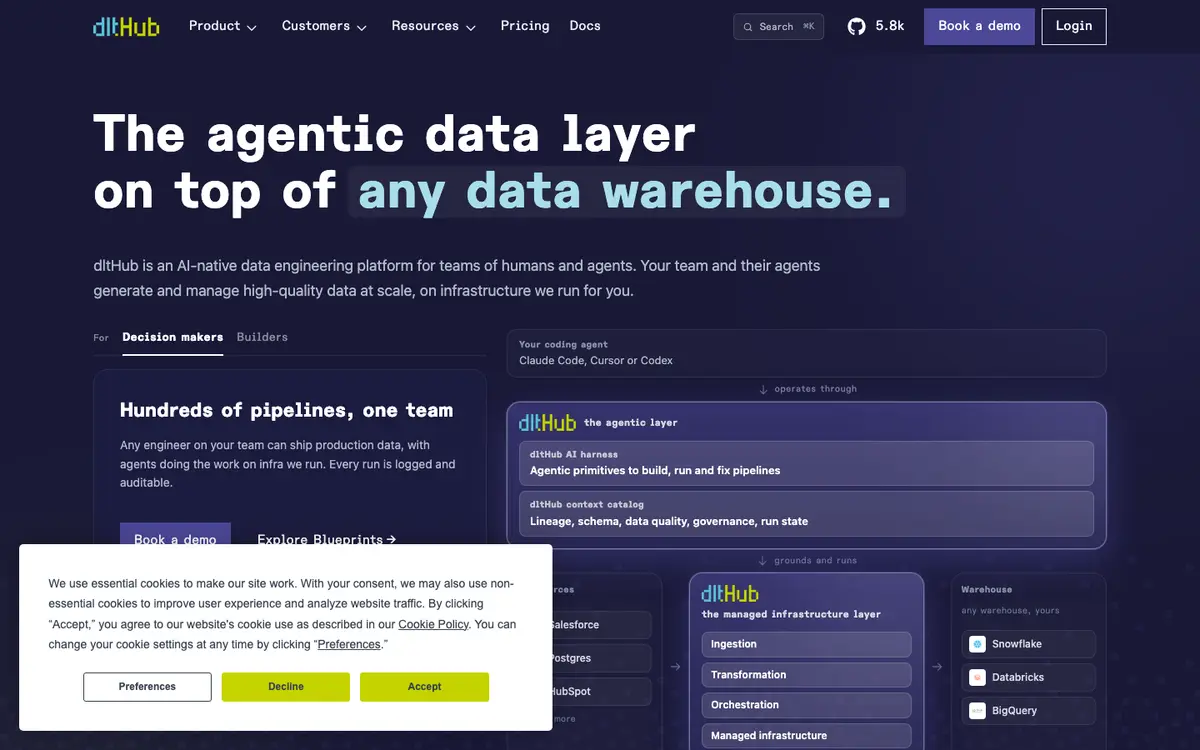
The dlt Python library is Apache-2.0 open source and free; dltHub (managed platform, AI Harness, Playground workspace) is commercially licensed with usage-based plans and custom enterprise terms.
pricing ↗Score trend
How this product’s scores have moved as evidence and verdicts are re-derived — a point per change, not per day.
Try Experimental
Run it in the microterminal →Recorded agent sessions — and a live MCP handshake where the vendor ships one.
Flag
⚑ Flag a verdictThink a verdict is wrong? Opens a prefilled GitHub issue — or use the ⚑ next to any verdict above.
For agents
Agent surface uptime llms.txt up (tracking since Sep 10 '26)