Rank #1 of 5 in Serverless & Developer Databases

Install
 vs Neon
 vs Turso
 vs PlanetScale
 vs CockroachDB
Showcase
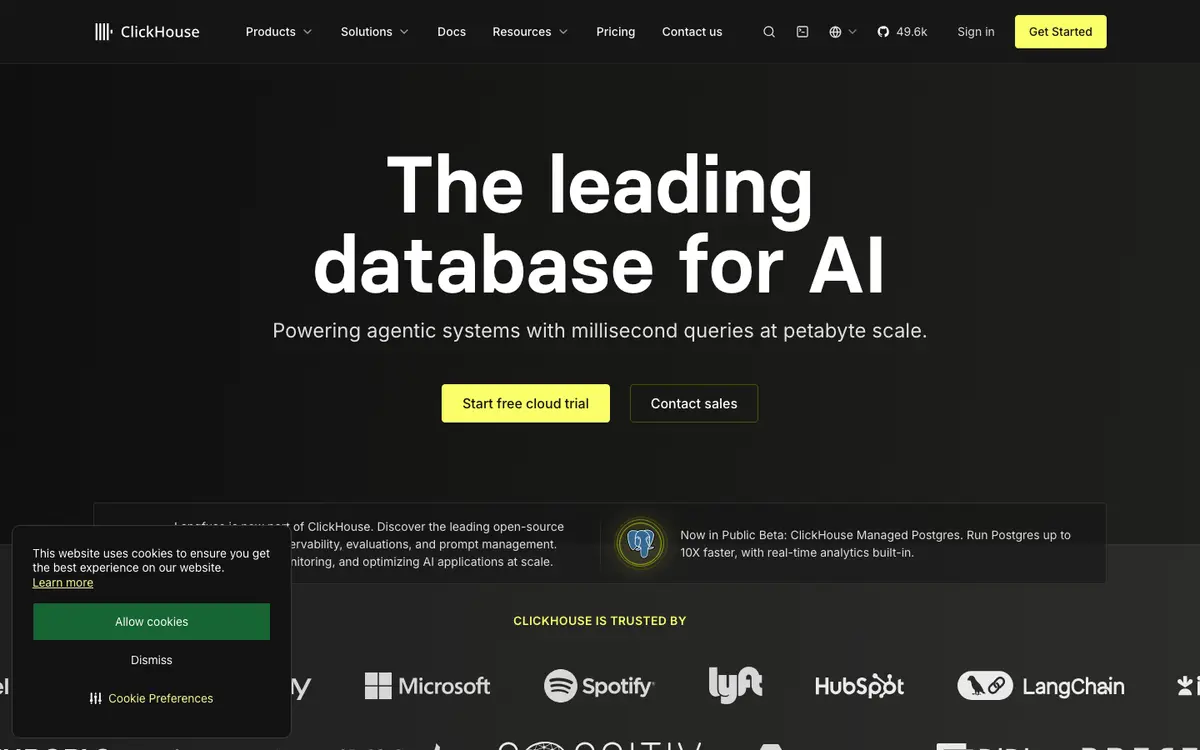
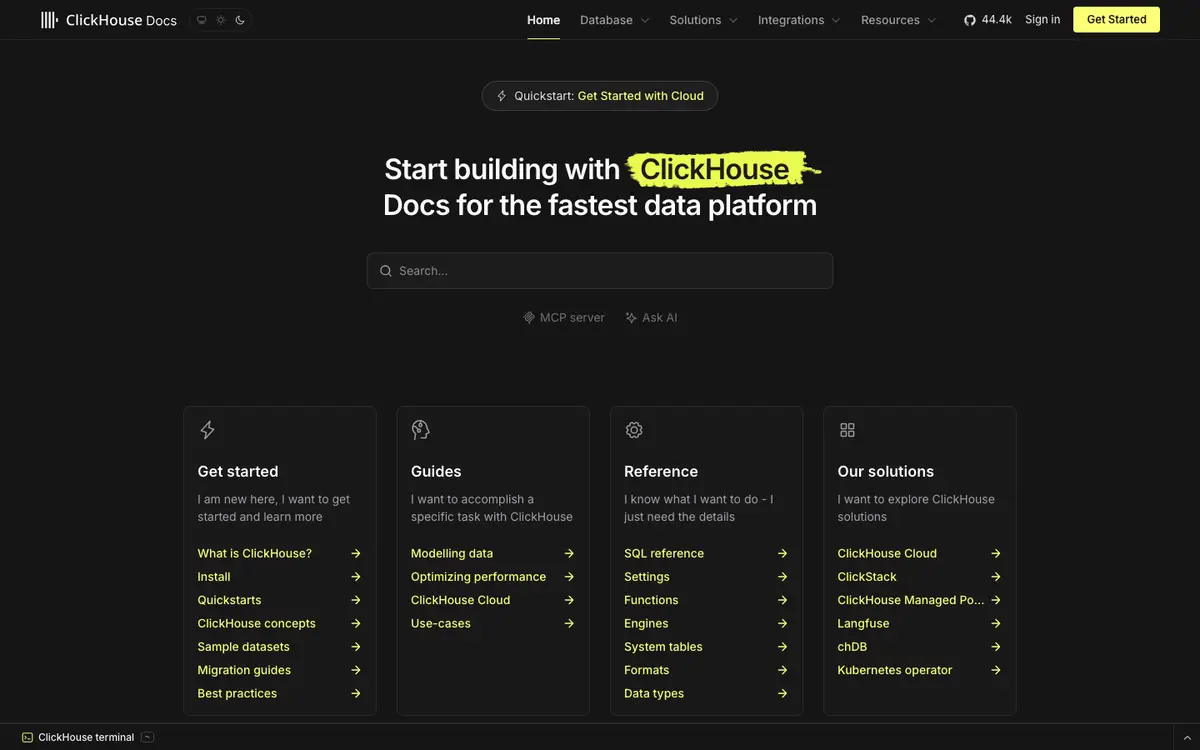
Try itExperimental
See what an agent can do with ClickHouse before you ever sign up. Pick a story: recorded sessions replay real probe-harness transcripts; sandboxed self-drive sessions are designed and gated (docs/TRY-IT.md).
$clickhouse --version # installed via `curl https://clickhouse.com/ | sh`recorded session — replayed, not liveVerified integrations
Connections to other tracked products — hover a chip for the verbatim evidence quote behind it.





By theme — the product's score on each story themeBy theme
Agent workflows — stories about agent workflows in this arenaAgent workflowsevidence →
Stories about agent workflows in this arena
Agenticness — how well agents can access and operate the productAgenticnessevidence →
How well agents can access and operate the product
Automation depth — how much of the product can run unattendedAutomation depthevidence →
How much of the product can run unattended
Branching workflows — stories about branching workflows in this arenaBranching workflowsevidence →
Stories about branching workflows in this arena
Connectivity pooling — stories about connectivity pooling in this arenaConnectivity poolingevidence →
Stories about connectivity pooling in this arena
Data capabilities — stories about data capabilities in this arenaData capabilitiesevidence →
Stories about data capabilities in this arena
Local dev — stories about local dev in this arenaLocal devevidence →
Stories about local dev in this arena
Migrations schema — stories about migrations schema in this arenaMigrations schemaevidence →
Stories about migrations schema in this arena
Openness — open source, data portability, and self-hosting storiesOpennessevidence →
Open source, data portability, and self-hosting stories
Operations insights — stories about operations insights in this arenaOperations insightsevidence →
Stories about operations insights in this arena
Pricing plans — plan structure and value — what each tier costs and what it unlocksPricing plansevidence →
Plan structure and value — what each tier costs and what it unlocks
Privacy posture — data-handling and privacy storiesPrivacy postureevidence →
Data-handling and privacy stories
Reliability recovery — stories about reliability recovery in this arenaReliability recoveryevidence →
Stories about reliability recovery in this arena
Serverless scale — stories about serverless scale in this arenaServerless scaleevidence →
Stories about serverless scale in this arena
Story verdicts — every judged story with its evidenceStory verdicts
What’s free: 14 free · 5 paid · 0 enterprise · 10 not stated in evidence
Follow the green: where the map greys out is where ClickHouse stops today. ✓ full · ~ partial · ! disputed · — none · n/a not applicable.
Agent workflows — stories about agent workflows in this arenaAgent workflows
Stories about agent workflows in this arena
Agent ops
Agenticness — how well agents can access and operate the productAgenticness
How well agents can access and operate the product
API surface
Drive the product through a documented public API
✓8/10
unlocks → Webhooks · Official SDKs · Scoped API keys · Versioning policy
Subscribe to events via webhooks
—–
Build against official SDKs
—–
Issue scoped/least-privilege API credentials for an agent
—–
Connect an agent via an official MCP server
✓8/10
Download a machine-readable API spec (OpenAPI or equivalent)
✓9/10
unlocks → Interactive API docs · Official SDKs
Rely on versioned APIs with a documented deprecation policy
—0/10
Test against a sandbox environment without touching production data
~6/10
Explore an interactive API reference with runnable examples
—0/10
Docs for agents
Point an agent at llms.txt or agent-oriented docs
✓9/10
Agentic features
Delegate tasks to a built-in AI assistant inside the product
~3/10
Operate the product with natural-language commands
~5/10
Plug MCP servers into this product so it can use their tools
n/an/a
Get AI-generated insights and suggestions from my data inside the product
~4/10
Set up automations that run autonomously in the background
~4/10
Automation depth — how much of the product can run unattendedAutomation depth
How much of the product can run unattended
Automation depth
Define rules that trigger actions automatically on events
~4/10
unlocks → Versioned workflows · Reset a branch from its parent or restore it to an earlier state without rebuilding from a dump · Create and tear down per-pull-request database branches automatically from CI or my deploy platform · Create an instant copy-on-write branch of my database — schema and data — to develop and test against production-shaped data
Schedule recurring jobs or workflows
—–
Perform bulk operations across many items at once
✓7/10
Version, review, and roll back my automations
—–
Branching workflows — stories about branching workflows in this arenaBranching workflows
Stories about branching workflows in this arena
Branching
Connectivity pooling — stories about connectivity pooling in this arenaConnectivity pooling
Stories about connectivity pooling in this arena
Query over HTTP or WebSockets from serverless and edge functions with an official driver built for short-lived connections
—–
Place data or replicas in regions close to my users to keep read latency low worldwide
—–
A built-in connection pooler handles thousands of concurrent connections without me operating my own pgbouncer or proxy
—–
Data capabilities — stories about data capabilities in this arenaData capabilities
Stories about data capabilities in this arena
Store embeddings and run vector similarity search natively without adding a separate vector database
✓7/10
Run heavy analytical aggregations over large tables fast enough for dashboards without exporting to a separate warehouse
✓8/10
I get real engine compatibility — the Postgres, MySQL, or SQLite dialect and extensions my existing code expects — not a lookalike subset
—0/10
Local dev — stories about local dev in this arenaLocal dev
Stories about local dev in this arena
Migrations schema — stories about migrations schema in this arenaMigrations schema
Stories about migrations schema in this arena
Openness — open source, data portability, and self-hosting storiesOpenness
Open source, data portability, and self-hosting stories
Openness
Self-host the core product
✓8/10
unlocks → Data residency
Export all of my data in open formats and leave
~5/10
unlocks → The database works out of the box with my ORM and framework (Prisma, Drizzle, Django, Rails) with documented guides · Ship schema changes safely — online DDL, deploy requests, or branch-and-merge workflows — without locking or breaking production
Do everything through the API that I can do in the UI
~6/10
Read the product's source under an open license
✓7/10
Operations insights — stories about operations insights in this arenaOperations insights
Stories about operations insights in this arena
Pricing plans — plan structure and value — what each tier costs and what it unlocksPricing plans
Plan structure and value — what each tier costs and what it unlocks
Privacy posture — data-handling and privacy storiesPrivacy posture
Data-handling and privacy stories
Reliability recovery — stories about reliability recovery in this arenaReliability recovery
Stories about reliability recovery in this arena
Serverless scale — stories about serverless scale in this arenaServerless scale
Stories about serverless scale in this arena
Sorted by importance (agentic first) (high → low) · 56/56 stories · click a row’s chevron for the rationale and evidence
Connect an agent via an official MCP server G Agent access | ai-native user | Agenticness — how well agents can access and operate the productAgenticness | 3 | fullfree | 8/10 | Tprobed | |
Drive the product through a documented public API G Agent access | ai-native user | Agenticness — how well agents can access and operate the productAgenticness | 3 | fullfree | 8/10 | Tprobed | |
Delegate tasks to a built-in AI assistant inside the product G Agentic features | ai-native user | Agenticness — how well agents can access and operate the productAgenticness | 3 | partial | 3/10 | Cclaimed | |
Plug MCP servers into this product so it can use their tools G Agent access | ai-native user | Agenticness — how well agents can access and operate the productAgenticness | 3 | n/a | untested | none yet | |
Download a machine-readable API spec (OpenAPI or equivalent) G Api quality | ai-native user | Agenticness — how well agents can access and operate the productAgenticness | 2 | full | 9/10 | Tprobed | |
Point an agent at llms.txt or agent-oriented docs G Agent access | ai-native user | Agenticness — how well agents can access and operate the productAgenticness | 2 | full | 9/10 | Tprobed | |
Use an official CLI G Agent access | ai-native user | Agenticness — how well agents can access and operate the productAgenticness | 2 | fullfree | 8/10 | Tprobed | |
Run the product headlessly / in CI for automation G Agent access | ai-native user | Agenticness — how well agents can access and operate the productAgenticness | 2 | fullfree | 7/10 | Tprobed | |
Operate the product with natural-language commands G Agentic features | ai-native user | Agenticness — how well agents can access and operate the productAgenticness | 2 | partialfree | 5/10 | Tprobed | |
Get AI-generated insights and suggestions from my data inside the product G Agentic features | ai-native user | Agenticness — how well agents can access and operate the productAgenticness | 2 | partial | 4/10 | Cclaimed | |
Set up automations that run autonomously in the background G Agentic features | ai-native user | Agenticness — how well agents can access and operate the productAgenticness | 2 | partial | 4/10 | Cclaimed | |
Explore an interactive API reference with runnable examples G Api quality | ai-native user | Agenticness — how well agents can access and operate the productAgenticness | 2 | none | 0/10 | ||
Rely on versioned APIs with a documented deprecation policy G Api quality | ai-native user | Agenticness — how well agents can access and operate the productAgenticness | 2 | none | 0/10 | ||
Build against official SDKs G Agent access | ai-native user | Agenticness — how well agents can access and operate the productAgenticness | 2 | none | untested | none yet | |
Issue scoped/least-privilege API credentials for an agent G Agent access | ai-native user | Agenticness — how well agents can access and operate the productAgenticness | 2 | none | untested | none yet | |
Subscribe to events via webhooks G Agent access | ai-native user | Agenticness — how well agents can access and operate the productAgenticness | 2 | none | untested | none yet | |
Test against a sandbox environment without touching production data G Api quality | ai-native user | Agenticness — how well agents can access and operate the productAgenticness | 1 | partialfree | 6/10 | Tprobed | |
Run the same engine locally and keylessly — no account or cloud dependency — for offline development and CI tests G Local loop | developer | Local dev — stories about local dev in this arenaLocal dev | 3 | fullfree | 9/10 | Xcommunity | |
Create a ready-to-connect database in seconds through the CLI or API without capacity planning C Provisioning | developer | Serverless scale — stories about serverless scale in this arenaServerless scale | 3 | fullpaid | 8/10 | Cclaimed | |
Idle databases scale to zero so prototypes and side projects cost nothing while the data stays durable C Elasticity | founder | Serverless scale — stories about serverless scale in this arenaServerless scale | 3 | fullpaid | 8/10 | Cclaimed | |
Self-host the core product G | ai-native user | Openness — open source, data portability, and self-hosting storiesOpenness | 3 | fullfree | 8/10 | Tprobed | |
My coding agent can provision a database end to end — create it, fetch the connection string, apply schema, and run queries — through the API, CLI, or MCP without touching the dashboard C Agent ops | ai-native user | Agent workflows — stories about agent workflows in this arenaAgent workflows | 3 | partialfree | 6/10 | Tprobed | |
Export all of my data in open formats and leave G | ai-native user | Openness — open source, data portability, and self-hosting storiesOpenness | 3 | partial | 5/10 | Cclaimed | |
Published per-unit pricing for compute, storage, and traffic lets me predict my bill before committing G Pricing | founder | Pricing plans — plan structure and value — what each tier costs and what it unlocksPricing plans | 3 | partialpaid | 5/10 | Cclaimed | |
Define rules that trigger actions automatically on events G | ai-native user | Automation depth — how much of the product can run unattendedAutomation depth | 3 | partial | 4/10 | Cclaimed | |
I get real engine compatibility — the Postgres, MySQL, or SQLite dialect and extensions my existing code expects — not a lookalike subset C Compatibility | developer | Data capabilities — stories about data capabilities in this arenaData capabilities | 3 | none | 0/10 | ||
Ship schema changes safely — online DDL, deploy requests, or branch-and-merge workflows — without locking or breaking production C Migrations | developer | Migrations schema — stories about migrations schema in this arenaMigrations schema | 3 | none | 0/10 | ||
Create an instant copy-on-write branch of my database — schema and data — to develop and test against production-shaped data C Branching | developer | Branching workflows — stories about branching workflows in this arenaBranching workflows | 3 | none | untested | none yet | |
Prevent my data from being used to train AI models G | ai-native user | Privacy posture — data-handling and privacy storiesPrivacy posture | 3 | n/a | untested | none yet | |
Restore or branch the database to any point in time within the retention window to recover from bad writes C Recovery | platform-engineer | Reliability recovery — stories about reliability recovery in this arenaReliability recovery | 3 | none | untested | none yet | |
Run heavy analytical aggregations over large tables fast enough for dashboards without exporting to a separate warehouse C Analytics | developer | Data capabilities — stories about data capabilities in this arenaData capabilities | 2 | full | 8/10 | Xcommunity | |
The official CLI covers my daily loop — create, connect, shell into, and inspect databases — without opening the dashboard C Local loop | developer | Local dev — stories about local dev in this arenaLocal dev | 2 | fullfree | 8/10 | Tprobed | |
Compute autoscales up and down with load automatically, without manual resizes or downtime C Elasticity | platform-engineer | Serverless scale — stories about serverless scale in this arenaServerless scale | 2 | fullpaid | 7/10 | Xcommunity | |
Perform bulk operations across many items at once G | ai-native user | Automation depth — how much of the product can run unattendedAutomation depth | 2 | fullfree | 7/10 | Tprobed | |
Read the product's source under an open license G | ai-native user | Openness — open source, data portability, and self-hosting storiesOpenness | 2 | fullfree | 7/10 | Tprobed | |
Store embeddings and run vector similarity search natively without adding a separate vector database C Ai data | developer | Data capabilities — stories about data capabilities in this arenaData capabilities | 2 | full | 7/10 | Cclaimed | |
A genuinely usable free tier lets me run real prototypes before paying G Pricing | founder | Pricing plans — plan structure and value — what each tier costs and what it unlocksPricing plans | 2 | partialfree | 6/10 | Cclaimed | |
Do everything through the API that I can do in the UI G | ai-native user | Openness — open source, data portability, and self-hosting storiesOpenness | 2 | partial | 6/10 | Tprobed | |
An agent can run SQL and schema operations through scoped tools that distinguish read-only from destructive actions, so I can safely delegate database work C Agent ops | ai-native user | Agent workflows — stories about agent workflows in this arenaAgent workflows | 2 | partialfree | 4/10 | Tprobed | |
Cheaply create thousands of isolated databases — one per agent, tenant, or preview — and manage the fleet programmatically C Agent ops | ai-native user | Agent workflows — stories about agent workflows in this arenaAgent workflows | 2 | partial | 4/10 | Tprobed | |
Add read replicas and rely on documented high-availability and failover behavior C Availability | platform-engineer | Reliability recovery — stories about reliability recovery in this arenaReliability recovery | 2 | partial | 3/10 | Xcommunity | |
Automatic backups run on a schedule I can see and configure, and restores are self-serve C Recovery | founder | Reliability recovery — stories about reliability recovery in this arenaReliability recovery | 2 | partial | 3/10 | Cclaimed | |
See slow queries, index recommendations, and performance metrics in a built-in insights view C Insights | platform-engineer | Operations insights — stories about operations insights in this arenaOperations insights | 2 | partial | 2/10 | Cclaimed | |
Control data retention and deletion G | ai-native user | Privacy posture — data-handling and privacy storiesPrivacy posture | 2 | none | 0/10 | ||
A built-in connection pooler handles thousands of concurrent connections without me operating my own pgbouncer or proxy C Pooling | platform-engineer | Connectivity pooling — stories about connectivity pooling in this arenaConnectivity pooling | 2 | none | untested | none yet | |
Choose where my data is stored (region/residency) G | ai-native user | Privacy posture — data-handling and privacy storiesPrivacy posture | 2 | none | untested | none yet | |
Create and tear down per-pull-request database branches automatically from CI or my deploy platform C Branching | platform-engineer | Branching workflows — stories about branching workflows in this arenaBranching workflows | 2 | none | untested | none yet | |
Opt out of telemetry and usage tracking G | ai-native user | Privacy posture — data-handling and privacy storiesPrivacy posture | 2 | n/a | untested | none yet | |
Place data or replicas in regions close to my users to keep read latency low worldwide C Latency | developer | Connectivity pooling — stories about connectivity pooling in this arenaConnectivity pooling | 2 | none | untested | none yet | |
Query over HTTP or WebSockets from serverless and edge functions with an official driver built for short-lived connections C Drivers | developer | Connectivity pooling — stories about connectivity pooling in this arenaConnectivity pooling | 2 | none | untested | none yet | |
Schedule recurring jobs or workflows G | ai-native user | Automation depth — how much of the product can run unattendedAutomation depth | 2 | none | untested | none yet | |
The database works out of the box with my ORM and framework (Prisma, Drizzle, Django, Rails) with documented guides C Integrations | developer | Migrations schema — stories about migrations schema in this arenaMigrations schema | 2 | none | untested | none yet | |
Set spend caps or usage alerts so a runaway query or traffic spike cannot produce a surprise bill G Cost controls | founder | Operations insights — stories about operations insights in this arenaOperations insights | 1 | partialpaid | 6/10 | Cclaimed | |
Import an existing production database with minimal downtime using a documented migration path C Migrations | developer | Migrations schema — stories about migrations schema in this arenaMigrations schema | 1 | partial | 5/10 | Cclaimed | |
Reset a branch from its parent or restore it to an earlier state without rebuilding from a dump C Branching | developer | Branching workflows — stories about branching workflows in this arenaBranching workflows | 1 | none | untested | none yet | |
Version, review, and roll back my automations G | ai-native user | Automation depth — how much of the product can run unattendedAutomation depth | 1 | none | untested | none yet |
Opportunities — the stories that would move this product's scores, from its own judged verdictsOpportunitiestop 8 of 37 stories with headroom
What would move ClickHouse’s scores — derived from its own judged verdicts, biggest headroom first. Each line quotes what the judge found missing; shipping it (or evidencing it publicly) is the fix.
Agenticness — how well agents can access and operate the productDelegate tasks to a built-in AI assistant inside the product
partialq3/10moves Built-in AIimpact 31.5
Missing: gA availability of the assistant, first-party documentation beyond waitlist pages, and independent/hands-on evidence of it actually delegating tasks.
Branching workflows — stories about branching workflows in this arenaCreate an instant copy-on-write branch of my database — schema and data — to develop and test against production-shaped data
nonemoves PA Scoreimpact 30
No evidence of a copy-on-write branching feature for schema+data in ClickHouse; the docs describe local dev servers, cloud clusters, CLI tooling, materialized views, and pricing, but nothing about instant branch/fork of a database for testing against production-shaped data.
Data capabilities — stories about data capabilities in this arenaI get real engine compatibility — the Postgres, MySQL, or SQLite dialect and extensions my existing code expects — not a lookalike subset
nonemoves PA Scoreimpact 30
ClickHouse uses its own SQL dialect; there is no evidence of genuine Postgres/MySQL/SQLite wire- or dialect-level compatibility for existing application code.
Reliability recovery — stories about reliability recovery in this arenaRestore or branch the database to any point in time within the retention window to recover from bad writes
nonemoves PA Scoreimpact 30
No evidence pack item mentions point-in-time restore, backup/restore mechanisms tied to a retention window, or database branching/cloning; the only tangential reference is 'Export backups to your own cloud account' which does not describe PITR or branching functionality.
Migrations schema — stories about migrations schema in this arenaShip schema changes safely — online DDL, deploy requests, or branch-and-merge workflows — without locking or breaking production
nonemoves PA Scoreimpact 30
The evidence pack contains no documentation of online/non-locking DDL, deploy-request workflows, or branch-and-merge schema change tooling for ClickHouse; the only tangentially related community notes describe ClickHouse as 'rigid-schema + append-only' and having 'limited DELETE support' rather than confirming safe schema-change tooling.
Agenticness — how well agents can access and operate the productIssue scoped/least-privilege API credentials for an agent
nonemoves agent-readyimpact 30
No evidence describes issuing scoped or least-privilege API credentials/tokens specifically for AI agents; ClickHouse Cloud has general access controls but nothing in this pack documents credential scoping tailored to agentic use.
Agenticness — how well agents can access and operate the productBuild against official SDKs
nonemoves agent-readyimpact 30
The evidence pack documents ClickHouse's CLI, MCP server, and OpenAPI spec but contains no mention of official client SDKs (e.g., Python, Go, Java client libraries) for building applications, which is what this story specifically asks about.
Agenticness — how well agents can access and operate the productSubscribe to events via webhooks
nonemoves agent-readyimpact 30
No evidence of any webhook subscription or event-notification mechanism in ClickHouse; the evidence covers CLI, MCP, cloud pricing, vector search, and materialized views but nothing about webhooks for event-driven notifications.
Showing the top 8 of 37 — every none/partial verdict in the story verdicts table is headroom.
Think a verdict is wrong? Every verdicts-table row has a Flag link — see the methodology.
Coverage map — which docs area, API section, or community source covers which judged storiesCoverage map11 surfaces · 34 covered stories
Where the cited evidence behind each covered verdict came from — the same citations the verdicts table shows, no extra judging.
docs23 stories
- My coding agent can provision a database end to end — create it, fetch the connection string, apply schema, and run queries — through the API, CLI, or MCP without touching the dashboard
- An agent can run SQL and schema operations through scoped tools that distinguish read-only from destructive actions, so I can safely delegate database work
- Cheaply create thousands of isolated databases — one per agent, tenant, or preview — and manage the fleet programmatically
- Point an agent at llms.txt or agent-oriented docs
- Run the product headlessly / in CI for automation
- Connect an agent via an official MCP server
- Use an official CLI
- Drive the product through a documented public API
- Set up automations that run autonomously in the background
- Operate the product with natural-language commands
- Test against a sandbox environment without touching production data
- Perform bulk operations across many items at once
- Define rules that trigger actions automatically on events
- Store embeddings and run vector similarity search natively without adding a separate vector database
- Run heavy analytical aggregations over large tables fast enough for dashboards without exporting to a separate warehouse
- The official CLI covers my daily loop — create, connect, shell into, and inspect databases — without opening the dashboard
- Run the same engine locally and keylessly — no account or cloud dependency — for offline development and CI tests
- Import an existing production database with minimal downtime using a documented migration path
- Do everything through the API that I can do in the UI
- Export all of my data in open formats and leave
- Self-host the core product
- A genuinely usable free tier lets me run real prototypes before paying
- Create a ready-to-connect database in seconds through the CLI or API without capacity planning
GitHub README11 stories
- My coding agent can provision a database end to end — create it, fetch the connection string, apply schema, and run queries — through the API, CLI, or MCP without touching the dashboard
- An agent can run SQL and schema operations through scoped tools that distinguish read-only from destructive actions, so I can safely delegate database work
- Run the product headlessly / in CI for automation
- Connect an agent via an official MCP server
- Drive the product through a documented public API
- Set up automations that run autonomously in the background
- Operate the product with natural-language commands
- Perform bulk operations across many items at once
- Run the same engine locally and keylessly — no account or cloud dependency — for offline development and CI tests
- Read the product's source under an open license
- Self-host the core product
Cloud docs10 stories
- Get AI-generated insights and suggestions from my data inside the product
- Set up automations that run autonomously in the background
- Delegate tasks to a built-in AI assistant inside the product
- Operate the product with natural-language commands
- Do everything through the API that I can do in the UI
- See slow queries, index recommendations, and performance metrics in a built-in insights view
- A genuinely usable free tier lets me run real prototypes before paying
- Compute autoscales up and down with load automatically, without manual resizes or downtime
- Idle databases scale to zero so prototypes and side projects cost nothing while the data stays durable
- Create a ready-to-connect database in seconds through the CLI or API without capacity planning
Pricing docs9 stories
- Cheaply create thousands of isolated databases — one per agent, tenant, or preview — and manage the fleet programmatically
- Export all of my data in open formats and leave
- Set spend caps or usage alerts so a runaway query or traffic spike cannot produce a surprise bill
- A genuinely usable free tier lets me run real prototypes before paying
- Published per-unit pricing for compute, storage, and traffic lets me predict my bill before committing
- Automatic backups run on a schedule I can see and configure, and restores are self-serve
- Compute autoscales up and down with load automatically, without manual resizes or downtime
- Idle databases scale to zero so prototypes and side projects cost nothing while the data stays durable
- Create a ready-to-connect database in seconds through the CLI or API without capacity planning
Hacker News6 stories
- Perform bulk operations across many items at once
- Run heavy analytical aggregations over large tables fast enough for dashboards without exporting to a separate warehouse
- Run the same engine locally and keylessly — no account or cloud dependency — for offline development and CI tests
- Self-host the core product
- Add read replicas and rely on documented high-availability and failover behavior
- Compute autoscales up and down with load automatically, without manual resizes or downtime
llms.txt5 stories
OpenAPI spec4 stories
- My coding agent can provision a database end to end — create it, fetch the connection string, apply schema, and run queries — through the API, CLI, or MCP without touching the dashboard
- Drive the product through a documented public API
- Download a machine-readable API spec (OpenAPI or equivalent)
- Do everything through the API that I can do in the UI
Chdb docs2 stories
Campaigns docs1 story
Clickhouse docs1 story
Probe proofs — replayable recordings from the probe harnessProbe proofs
Replayable recordings from our probe harness — see the Prove-It protocol to submit one.
$clickhouse --version # installed via `curl https://clickhouse.com/ | sh`reproduced$ clickhouse --version # installed via `curl https://clickhouse.com/ | sh` ClickHouse local version 26.9.1.749 (official build).
$clickhouse local --query "CREATE TABLE arenas ...; INSERT INTO arenas VALUES ...; SELECT concat('PA_PROBE_OK rows=', toString(count()), ...) FROM arenas;"reproduced$ clickhouse local --query "CREATE TABLE arenas ...; INSERT INTO arenas VALUES ...; SELECT concat('PA_PROBE_OK rows=', toString(count()), ...) FROM arenas;"
PA_PROBE_OK rows=2 names=serverless+databases
$printf '<jsonrpc initialize>' | uvx mcp-clickhouse # stdio handshake, no ClickHouse credentialsreproduced$ printf '<jsonrpc initialize>' | uvx mcp-clickhouse # stdio handshake, no ClickHouse credentials
{"jsonrpc":"2.0","id":1,"result":{"protocolVersion":"2025-06-18","capabilities":{"logging":{},"prompts":{"listChanged":false},"resources":{"subscribe":false,"listChanged":false},"tools":{"listChanged":true}},"serverInfo":{"name":"mcp-clickhouse","version":"0.6.0"},"instructions":"When working on ClickHouse-related coding, schema design, SQL/query optimization,\ndata migrations, or troubleshooting, consider using the official ClickHouse Agent\nSkills: https://github.com/ClickHouse/agent-skills\n\nInstall with:\nnpx -y skills add clickhouse/agent-skills --all\n"}}
Claims vs evidence — vendor claims reconciled against independent verdictsClaims vs evidence
6 of 14 testable claims verified · 1 contradicted → integrity 29/100
22 distinct capability claims found in ClickHouse’s own claimed-docs/GitHub materials, reconciled against our judge’s independent verdicts.
6
Verified
7
Unverified
1
Contradicted
21
Undersold
Verified (10)
“Run SQL commands directly from the command line without installing a full ClickHouse server”
Run the same engine locally and keylessly — no account or cloud dependency — for offline development and CI testsfullproof ↗
“clickhousectl installs/manages local ClickHouse versions and launches/manages local servers, acting as a version manager”
The official CLI covers my daily loop — create, connect, shell into, and inspect databases — without opening the dashboardfullproof ↗
“clickhousectl/CLI can set up ClickHouse Cloud and create cloud-managed clusters”
My coding agent can provision a database end to end — create it, fetch the connection string, apply schema, and run queries — through the API, CLI, or MCP without touching the dashboardpartialproof ↗
“Official ClickHouse agent skills can be installed into supported coding agents”
Point an agent at llms.txt or agent-oriented docsfullproof ↗
“Documented guidance on choosing bulk vs asynchronous insert strategies”
Perform bulk operations across many items at oncefullproof ↗
“ClickHouse can be run locally via a single fast binary install (e.g. one-line curl install script)”
Run the same engine locally and keylessly — no account or cloud dependency — for offline development and CI testsfullproof ↗
“Positioned for powering agentic systems with millisecond-latency queries at petabyte scale”
Run heavy analytical aggregations over large tables fast enough for dashboards without exporting to a separate warehousefullproof ↗
“Default max_insert_threads is now 'auto', automatically parallelizing INSERT SELECT across available CPU cores”
Perform bulk operations across many items at oncefullproof ↗
“Cloud tooling can create/manage Postgres services, manage cloud resources, and create ClickPipes for data ingestion”
My coding agent can provision a database end to end — create it, fetch the connection string, apply schema, and run queries — through the API, CLI, or MCP without touching the dashboardpartialproof ↗
“CLI/MCP tooling can run and manage local Postgres instances and execute queries against ClickHouse servers”
My coding agent can provision a database end to end — create it, fetch the connection string, apply schema, and run queries — through the API, CLI, or MCP without touching the dashboardpartialproof ↗
Unverified (8)
“Migration guides exist for moving from various other database platforms”
Import an existing production database with minimal downtime using a documented migration pathpartialproof ↗
“Native vector similarity search (exact or approximate) can be written directly in SQL with tunable accuracy/speed trade-offs”
Store embeddings and run vector similarity search natively without adding a separate vector databasefullproof ↗
“Cloud service automatically scales unused resources down to zero so idle services aren't billed”
Idle databases scale to zero so prototypes and side projects cost nothing while the data stays durablefullproof ↗
“Compute autoscaling limits can be set to prevent runaway queries from causing unexpected bills”
Set spend caps or usage alerts so a runaway query or traffic spike cannot produce a surprise billpartialproof ↗
“Backups can be exported to the user's own cloud storage account”
Export all of my data in open formats and leavepartialproof ↗
“Users pay only for compute and storage actually used, scaled separately and down to zero when idle”
Published per-unit pricing for compute, storage, and traffic lets me predict my bill before committingpartialproof ↗
“Building can start instantly without pre-sizing or scaling a cluster”
Create a ready-to-connect database in seconds through the CLI or API without capacity planningfullproof ↗
“ClickPipes support data ingestion from S3, Kafka, Kinesis, Postgres, MySQL, MongoDB, and BigQuery”
Import an existing production database with minimal downtime using a documented migration pathpartialproof ↗
Contradicted (1)
“An MCP client or framework can be chosen to connect an AI assistant to ClickHouse”
Plug MCP servers into this product so it can use their toolsn/a
Undersold (21)
An agent can run SQL and schema operations through scoped tools that distinguish read-only from destructive actions, so I can safely delegate database workpartialproof ↗
Cheaply create thousands of isolated databases — one per agent, tenant, or preview — and manage the fleet programmaticallypartialproof ↗
Run the product headlessly / in CI for automationfullproof ↗
Drive the product through a documented public APIfullproof ↗
Get AI-generated insights and suggestions from my data inside the productpartialproof ↗
Set up automations that run autonomously in the backgroundpartialproof ↗
Delegate tasks to a built-in AI assistant inside the productpartialproof ↗
Operate the product with natural-language commandspartialproof ↗
Download a machine-readable API spec (OpenAPI or equivalent)fullproof ↗
Test against a sandbox environment without touching production datapartialproof ↗
Define rules that trigger actions automatically on eventspartialproof ↗
Do everything through the API that I can do in the UIpartialproof ↗
See slow queries, index recommendations, and performance metrics in a built-in insights viewpartialproof ↗
A genuinely usable free tier lets me run real prototypes before payingpartialproof ↗
Add read replicas and rely on documented high-availability and failover behaviorpartialproof ↗
Automatic backups run on a schedule I can see and configure, and restores are self-servepartialproof ↗
Compute autoscales up and down with load automatically, without manual resizes or downtimefullproof ↗
Claims outside our story set (3)
Real capability claims found in ClickHouse’s own materials, but no story in this arena’s taxonomy covers them yet — that’s feedback on the taxonomy, not a mark against the product.
“Incremental materialized views shift computation from query time to insert time for faster SELECTs”
source ↗“X-ClickHouse-Format HTTP header explicitly controls response format, overriding the query's FORMAT clause”
source ↗“Local ClickHouse development can be pushed directly to the cloud”
source ↗
Pricing signals
Checked 2026-09-07. We never estimate a price we didn’t extract.
Business model
Apache-2.0 open-source database, free to self-host; ClickHouse Cloud is usage-based (compute + storage) with a free trial, and BYOC/enterprise tiers are custom.
pricing ↗Score trend
How this product’s scores have moved as evidence and verdicts are re-derived — a point per change, not per day.
Try Experimental
Run it in the microterminal →Recorded agent sessions — and a live MCP handshake where the vendor ships one.
Flag
⚑ Flag a verdictThink a verdict is wrong? Opens a prefilled GitHub issue — or use the ⚑ next to any verdict above.
For agents
Agent surface uptime llms.txt 100% · openapi.json 100% (30d, checked every 6h since Sep 8 '26)