Rank #9 of 9 in Agent Frameworks & SDKs

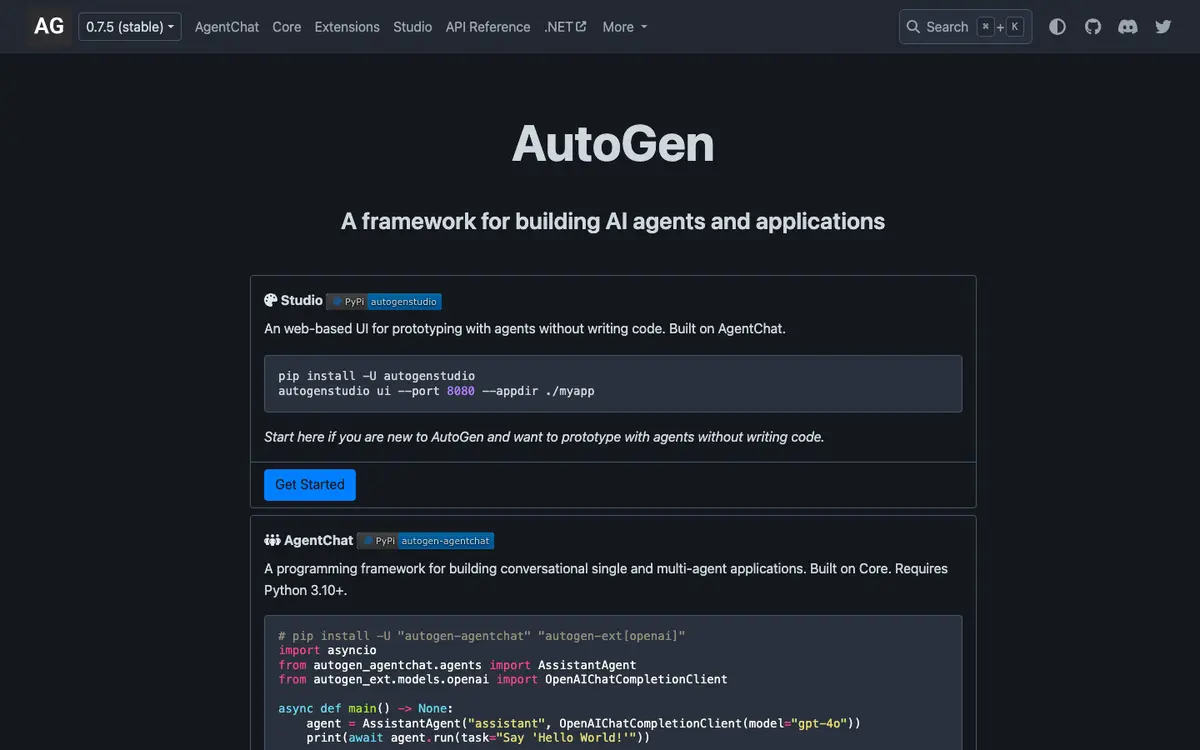
Install
pip install -U "autogen-agentchat" "autogen-ext[openai]" vs LangGraph
 vs OpenAI Agents SDK
 vs Claude Agent SDK
 vs CrewAI
 vs Pydantic AI
 vs Mastra
 vs Google ADK
 vs smolagents
Showcase
Products
Microsoft, product by product →Microsoft ships more than one product — each judged line competes in its own arena on the same stories as everyone else.
| Line | Arena | Rank | PA Score | Agent-ready |
|---|---|---|---|---|
| Microsoft Copilot | AI Assistants | #9/9 | 4/100 | 0/100 |
| Windows | Desktop OS | #3/5 | 9/100 | 15/100 |
| Microsoft Teams | Team Chat | #5/5 | 21/100 | 32/100 |
| AutoGenthis page | Agent Frameworks & SDKs | #9/9 | 26/100 | 31/100 |
Not yet judged (1 — no arena where they compete): Visual Studio Code
Verified integrations
No integration evidence found in our corpus for this product yet — that means none was found, never that it doesn’t integrate.
By theme — the product's score on each story themeBy theme
Agenticness — how well agents can access and operate the productAgenticnessevidence →
How well agents can access and operate the product
Agents tools — stories about agents tools in this arenaAgents toolsevidence →
Stories about agents tools in this arena
Automation depth — how much of the product can run unattendedAutomation depthevidence →
How much of the product can run unattended
Deployment portability — stories about deployment portability in this arenaDeployment portabilityevidence →
Stories about deployment portability in this arena
Evals observability — stories about evals observability in this arenaEvals observabilityevidence →
Stories about evals observability in this arena
Guardrails safety — stories about guardrails safety in this arenaGuardrails safetyevidence →
Stories about guardrails safety in this arena
Human in the loop — stories about human in the loop in this arenaHuman in the loopevidence →
Stories about human in the loop in this arena
Memory context — stories about memory context in this arenaMemory contextevidence →
Stories about memory context in this arena
Openness — open source, data portability, and self-hosting storiesOpennessevidence →
Open source, data portability, and self-hosting stories
Orchestration multi agent — stories about orchestration multi agent in this arenaOrchestration multi agentevidence →
Stories about orchestration multi agent in this arena
Privacy posture — data-handling and privacy storiesPrivacy postureevidence →
Data-handling and privacy stories
State durability — stories about state durability in this arenaState durabilityevidence →
Stories about state durability in this arena
Streaming output — stories about streaming output in this arenaStreaming outputevidence →
Stories about streaming output in this arena
Story verdicts — every judged story with its evidenceStory verdicts
What’s free: 2 free · 0 paid · 0 enterprise · 22 not stated in evidence
Follow the green: where the map greys out is where AutoGen stops today. ✓ full · ~ partial · ! disputed · — none · n/a not applicable.
Agenticness — how well agents can access and operate the productAgenticness
How well agents can access and operate the product
API surface
Drive the product through a documented public API
✓7/10
unlocks → Webhooks · Scoped API keys · Machine-readable spec · Official CLI · Have a coding agent scaffold a new agent project from an official CLI or template in one command · Rely on strict typing and schema validation so a coding agent catches its own mistakes at build time
Subscribe to events via webhooks
—–
Build against official SDKs
✓8/10
Issue scoped/least-privilege API credentials for an agent
—–
Connect an agent via an official MCP server
n/an/a
Download a machine-readable API spec (OpenAPI or equivalent)
—0/10
Rely on versioned APIs with a documented deprecation policy
~3/10
Test against a sandbox environment without touching production data
~4/10
Explore an interactive API reference with runnable examples
—0/10
Docs for agents
Point an agent at llms.txt or agent-oriented docs
—0/10
Agentic features
Delegate tasks to a built-in AI assistant inside the product
~6/10
Operate the product with natural-language commands
~6/10
Plug MCP servers into this product so it can use their tools
~6/10
Get AI-generated insights and suggestions from my data inside the product
~4/10
Set up automations that run autonomously in the background
~6/10
Agents tools — stories about agents tools in this arenaAgents tools
Stories about agents tools in this arena
Automation depth — how much of the product can run unattendedAutomation depth
How much of the product can run unattended
Deployment portability — stories about deployment portability in this arenaDeployment portability
Stories about deployment portability in this arena
Evals observability — stories about evals observability in this arenaEvals observability
Stories about evals observability in this arena
Guardrails safety — stories about guardrails safety in this arenaGuardrails safety
Stories about guardrails safety in this arena
Human in the loop — stories about human in the loop in this arenaHuman in the loop
Stories about human in the loop in this arena
Memory context — stories about memory context in this arenaMemory context
Stories about memory context in this arena
Openness — open source, data portability, and self-hosting storiesOpenness
Open source, data portability, and self-hosting stories
Orchestration multi agent — stories about orchestration multi agent in this arenaOrchestration multi agent
Stories about orchestration multi agent in this arena
Privacy posture — data-handling and privacy storiesPrivacy posture
Data-handling and privacy stories
State durability — stories about state durability in this arenaState durability
Stories about state durability in this arena
Streaming output — stories about streaming output in this arenaStreaming output
Stories about streaming output in this arena
Sorted by importance (agentic first) (high → low) · 51/51 stories · click a row’s chevron for the rationale and evidence
Drive the product through a documented public API G Agent access | ai-native user | Agenticness — how well agents can access and operate the productAgenticness | 3 | full | 7/10 | Tprobed | |
Delegate tasks to a built-in AI assistant inside the product G Agentic features | ai-native user | Agenticness — how well agents can access and operate the productAgenticness | 3 | partial | 6/10 | Cclaimed | |
Plug MCP servers into this product so it can use their tools G Agent access | ai-native user | Agenticness — how well agents can access and operate the productAgenticness | 3 | partial | 6/10 | Cclaimed | |
Connect an agent via an official MCP server G Agent access | ai-native user | Agenticness — how well agents can access and operate the productAgenticness | 3 | n/a | 0/10 | ||
Build against official SDKs G Agent access | ai-native user | Agenticness — how well agents can access and operate the productAgenticness | 2 | full | 8/10 | Tprobed | |
Operate the product with natural-language commands G Agentic features | ai-native user | Agenticness — how well agents can access and operate the productAgenticness | 2 | partial | 6/10 | Cclaimed | |
Run the product headlessly / in CI for automation G Agent access | ai-native user | Agenticness — how well agents can access and operate the productAgenticness | 2 | partial | 6/10 | Cclaimed | |
Set up automations that run autonomously in the background G Agentic features | ai-native user | Agenticness — how well agents can access and operate the productAgenticness | 2 | partial | 6/10 | Xcommunity | |
Get AI-generated insights and suggestions from my data inside the product G Agentic features | ai-native user | Agenticness — how well agents can access and operate the productAgenticness | 2 | partial | 4/10 | Cclaimed | |
Rely on versioned APIs with a documented deprecation policy G Api quality | ai-native user | Agenticness — how well agents can access and operate the productAgenticness | 2 | partial | 3/10 | Cclaimed | |
Download a machine-readable API spec (OpenAPI or equivalent) G Api quality | ai-native user | Agenticness — how well agents can access and operate the productAgenticness | 2 | none | 0/10 | ||
Explore an interactive API reference with runnable examples G Api quality | ai-native user | Agenticness — how well agents can access and operate the productAgenticness | 2 | none | 0/10 | ||
Point an agent at llms.txt or agent-oriented docs G Agent access | ai-native user | Agenticness — how well agents can access and operate the productAgenticness | 2 | none | 0/10 | ||
Issue scoped/least-privilege API credentials for an agent G Agent access | ai-native user | Agenticness — how well agents can access and operate the productAgenticness | 2 | none | untested | none yet | |
Subscribe to events via webhooks G Agent access | ai-native user | Agenticness — how well agents can access and operate the productAgenticness | 2 | none | untested | none yet | |
Use an official CLI G Agent access | ai-native user | Agenticness — how well agents can access and operate the productAgenticness | 2 | none | untested | none yet | |
Test against a sandbox environment without touching production data G Api quality | ai-native user | Agenticness — how well agents can access and operate the productAgenticness | 1 | partial | 4/10 | Xcommunity | |
Orchestrate multiple agents — handoffs, subagents, or crews — inside one workflow C Multi agent | developer | Orchestration multi agent — stories about orchestration multi agent in this arenaOrchestration multi agent | 3 | full | 9/10 | Xcommunity | |
Self-host the core product G | ai-native user | Openness — open source, data portability, and self-hosting storiesOpenness | 3 | fullfree | 8/10 | Xcommunity | |
Define an agent with typed custom tools in a few lines of code C Agent authoring | developer | Agents tools — stories about agents tools in this arenaAgents tools | 3 | partial | 6/10 | Cclaimed | |
Pause an agent mid-run for human input or approval and resume with the human's decision C Approval flows | developer | Human in the loop — stories about human in the loop in this arenaHuman in the loop | 3 | partial | 6/10 | Cclaimed | |
Swap the underlying LLM provider or model without rewriting my agent C Portability | developer | Deployment portability — stories about deployment portability in this arenaDeployment portability | 3 | partial | 6/10 | Xcommunity | |
Define rules that trigger actions automatically on events G | ai-native user | Automation depth — how much of the product can run unattendedAutomation depth | 3 | partial | 4/10 | Cclaimed | |
Export all of my data in open formats and leave G | ai-native user | Openness — open source, data portability, and self-hosting storiesOpenness | 3 | partial | 4/10 | Cclaimed | |
Trace every LLM call and tool invocation of an agent run in an observability UI C Tracing | developer | Evals observability — stories about evals observability in this arenaEvals observability | 3 | partial | 4/10 | Cclaimed | |
Checkpoint agent state so a run can resume exactly where it left off after a crash or restart C Durable state | developer | State durability — stories about state durability in this arenaState durability | 3 | partial | 3/10 | Cclaimed | |
Attach input/output guardrails that validate, transform, or block unsafe content C Guardrails | developer | Guardrails safety — stories about guardrails safety in this arenaGuardrails safety | 3 | none | 0/10 | ||
Stream tokens and intermediate agent events (tool calls, steps) to my UI in real time C Streaming | developer | Streaming output — stories about streaming output in this arenaStreaming output | 3 | none | 0/10 | ||
Get schema-validated structured output from an agent, with automatic retries when validation fails C Structured output | developer | Streaming output — stories about streaming output in this arenaStreaming output | 3 | none | untested | none yet | |
Prevent my data from being used to train AI models G | ai-native user | Privacy posture — data-handling and privacy storiesPrivacy posture | 3 | n/a | untested | none yet | |
Run my agents entirely on my own infrastructure with no dependence on the vendor's platform C Deployment | engineering-lead | Deployment portability — stories about deployment portability in this arenaDeployment portability | 2 | fullfree | 8/10 | Xcommunity | |
Compose agents into an explicit graph or workflow with branching, loops, and parallel steps C Workflow control | developer | Orchestration multi agent — stories about orchestration multi agent in this arenaOrchestration multi agent | 2 | partial | 6/10 | Cclaimed | |
Do everything through the API that I can do in the UI G | ai-native user | Openness — open source, data portability, and self-hosting storiesOpenness | 2 | partial | 6/10 | Cclaimed | |
Read the product's source under an open license G | ai-native user | Openness — open source, data portability, and self-hosting storiesOpenness | 2 | partial | 6/10 | Cclaimed | |
Give agents long-term memory that persists across sessions and threads C Memory | developer | Memory context — stories about memory context in this arenaMemory context | 2 | partial | 5/10 | Cclaimed | |
Require human approval before specific sensitive tool calls execute C Approval flows | engineering-lead | Human in the loop — stories about human in the loop in this arenaHuman in the loop | 2 | partial | 5/10 | Cclaimed | |
Restrict what an agent may do with fine-grained tool permissions and sandboxed execution C Guardrails | engineering-lead | Guardrails safety — stories about guardrails safety in this arenaGuardrails safety | 2 | partial | 5/10 | Xcommunity | |
Deploy an agent to a managed runtime and call it as an API endpoint C Deployment | engineering-lead | Deployment portability — stories about deployment portability in this arenaDeployment portability | 2 | partial | 4/10 | Cclaimed | |
Run the framework's example agents headlessly from a terminal so an agent can verify what it just built C Ai buildability | ai-native user | Agents tools — stories about agents tools in this arenaAgents tools | 2 | partial | 4/10 | Xcommunity | |
Run long-lived agents durably across process restarts and deploys, natively or via durable-execution integrations C Durable state | engineering-lead | State durability — stories about state durability in this arenaState durability | 2 | none | 0/10 | ||
Trim, summarize, or filter conversation history to keep an agent inside its context window C Memory | developer | Memory context — stories about memory context in this arenaMemory context | 2 | none | 0/10 | ||
Choose where my data is stored (region/residency) G | ai-native user | Privacy posture — data-handling and privacy storiesPrivacy posture | 2 | n/a | untested | none yet | |
Control data retention and deletion G | ai-native user | Privacy posture — data-handling and privacy storiesPrivacy posture | 2 | none | untested | none yet | |
Have a coding agent scaffold a new agent project from an official CLI or template in one command C Ai buildability | ai-native user | Agents tools — stories about agents tools in this arenaAgents tools | 2 | none | untested | none yet | |
Opt out of telemetry and usage tracking G | ai-native user | Privacy posture — data-handling and privacy storiesPrivacy posture | 2 | none | untested | none yet | |
Perform bulk operations across many items at once G | ai-native user | Automation depth — how much of the product can run unattendedAutomation depth | 2 | none | untested | none yet | |
Rely on strict typing and schema validation so a coding agent catches its own mistakes at build time C Ai buildability | ai-native user | Agents tools — stories about agents tools in this arenaAgents tools | 2 | none | untested | none yet | |
Schedule recurring jobs or workflows G | ai-native user | Automation depth — how much of the product can run unattendedAutomation depth | 2 | none | untested | none yet | |
Score agent quality with built-in evals and run them as part of CI C Evals | engineering-lead | Evals observability — stories about evals observability in this arenaEvals observability | 2 | none | untested | none yet | |
Unit-test agents with mocked models and tools C Testing | developer | Evals observability — stories about evals observability in this arenaEvals observability | 2 | none | untested | none yet | |
Version, review, and roll back my automations G | ai-native user | Automation depth — how much of the product can run unattendedAutomation depth | 1 | none | 0/10 |
Opportunities — the stories that would move this product's scores, from its own judged verdictsOpportunitiestop 8 of 43 stories with headroom
What would move AutoGen’s scores — derived from its own judged verdicts, biggest headroom first. Each line quotes what the judge found missing; shipping it (or evidencing it publicly) is the fix.
Guardrails safety — stories about guardrails safety in this arenaAttach input/output guardrails that validate, transform, or block unsafe content
nonemoves PA Scoreimpact 30
Missing: any documentation of guardrail/validation hooks, content moderation APIs, or examples of blocking/transforming unsafe outputs.
Streaming output — stories about streaming output in this arenaStream tokens and intermediate agent events (tool calls, steps) to my UI in real time
nonemoves PA Scoreimpact 30
Missing: any mention of a streaming API (e.g., token/event streaming methods), UI integration examples, or independent confirmation of real-time event delivery.
Streaming output — stories about streaming output in this arenaGet schema-validated structured output from an agent, with automatic retries when validation fails
nonemoves PA Scoreimpact 30
Missing: any mention of structured output schemas (e.g., Pydantic models), validation error handling, or retry logic tied to output parsing.
Agenticness — how well agents can access and operate the productPoint an agent at llms.txt or agent-oriented docs
nonemoves agent-readyimpact 30
Probes explicitly show no llms.txt (404) and no markdown-formatted docs endpoint (404) or OpenAPI spec, so there is no evidence AutoGen exposes agent-oriented docs formats; all other evidence is standard human-readable documentation.
Agenticness — how well agents can access and operate the productUse an official CLI
nonemoves agent-readyimpact 30
AutoGen ships a Python package (pip install), a Studio GUI, and library APIs, but no evidence of an official standalone CLI tool for AI-native workflows.
Agenticness — how well agents can access and operate the productIssue scoped/least-privilege API credentials for an agent
nonemoves agent-readyimpact 30
No evidence in the pack mentions scoped/least-privilege API credential issuance or any credential-management/permissioning system for agents; AutoGen's docs focus on agent orchestration, teams, and tools, not credential scoping.
Agenticness — how well agents can access and operate the productSubscribe to events via webhooks
nonemoves agent-readyimpact 30
No evidence in the pack mentions webhooks or event subscription mechanisms; AutoGen's docs focus on agent orchestration, teams, and Studio UI with no webhook API or subscription feature described.
Agenticness — how well agents can access and operate the productExplore an interactive API reference with runnable examples
nonemoves API qualityimpact 30
AutoGen ships conventional static docs and tutorials (autogen-docs-1..22) but no evidence of an interactive, runnable API reference (e.g., embedded live code execution, Jupyter-style sandbox tied to reference pages); probes confirm no llms.txt, no markdown-served docs, and no OpenAPI spec (autogen-probe-1,2,3), indicating the docs are not AI-native/interactive in the way the story describes.
Showing the top 8 of 43 — every none/partial verdict in the story verdicts table is headroom.
Think a verdict is wrong? Every verdicts-table row has a Flag link — see the methodology.
Coverage map — which docs area, API section, or community source covers which judged storiesCoverage map4 surfaces · 28 covered stories
Where the cited evidence behind each covered verdict came from — the same citations the verdicts table shows, no extra judging.
Autogen docs26 stories
- Run the product headlessly / in CI for automation
- Drive the product through a documented public API
- Build against official SDKs
- Get AI-generated insights and suggestions from my data inside the product
- Set up automations that run autonomously in the background
- Delegate tasks to a built-in AI assistant inside the product
- Operate the product with natural-language commands
- Test against a sandbox environment without touching production data
- Rely on versioned APIs with a documented deprecation policy
- Define an agent with typed custom tools in a few lines of code
- Run the framework's example agents headlessly from a terminal so an agent can verify what it just built
- Define rules that trigger actions automatically on events
- Deploy an agent to a managed runtime and call it as an API endpoint
- Run my agents entirely on my own infrastructure with no dependence on the vendor's platform
- Swap the underlying LLM provider or model without rewriting my agent
- Trace every LLM call and tool invocation of an agent run in an observability UI
- Restrict what an agent may do with fine-grained tool permissions and sandboxed execution
- Pause an agent mid-run for human input or approval and resume with the human's decision
- Require human approval before specific sensitive tool calls execute
- Give agents long-term memory that persists across sessions and threads
- Do everything through the API that I can do in the UI
- Export all of my data in open formats and leave
- Self-host the core product
- Orchestrate multiple agents — handoffs, subagents, or crews — inside one workflow
- Compose agents into an explicit graph or workflow with branching, loops, and parallel steps
- Checkpoint agent state so a run can resume exactly where it left off after a crash or restart
GitHub README12 stories
- Run the product headlessly / in CI for automation
- Plug MCP servers into this product so it can use their tools
- Drive the product through a documented public API
- Build against official SDKs
- Get AI-generated insights and suggestions from my data inside the product
- Define an agent with typed custom tools in a few lines of code
- Run the framework's example agents headlessly from a terminal so an agent can verify what it just built
- Run my agents entirely on my own infrastructure with no dependence on the vendor's platform
- Swap the underlying LLM provider or model without rewriting my agent
- Read the product's source under an open license
- Self-host the core product
- Orchestrate multiple agents — handoffs, subagents, or crews — inside one workflow
Hacker News8 stories
- Set up automations that run autonomously in the background
- Test against a sandbox environment without touching production data
- Run the framework's example agents headlessly from a terminal so an agent can verify what it just built
- Run my agents entirely on my own infrastructure with no dependence on the vendor's platform
- Swap the underlying LLM provider or model without rewriting my agent
- Restrict what an agent may do with fine-grained tool permissions and sandboxed execution
- Self-host the core product
- Orchestrate multiple agents — handoffs, subagents, or crews — inside one workflow
Claims vs evidence — vendor claims reconciled against independent verdictsClaims vs evidence
3 of 8 testable claims verified · 0 contradicted → integrity 38/100
15 distinct capability claims found in AutoGen’s own claimed-docs/GitHub materials, reconciled against our judge’s independent verdicts.
3
Verified
5
Unverified
0
Contradicted
20
Undersold
Verified (6)
“RoundRobinGroupChat lets multiple agents share context and take turns responding”
Orchestrate multiple agents — handoffs, subagents, or crews — inside one workflowfullproof ↗
“Teams built visually can be exported and run as standalone Python code”
Run my agents entirely on my own infrastructure with no dependence on the vendor's platformfullproof ↗
“AgentTool enables composing basic multi-agent orchestration setups”
Orchestrate multiple agents — handoffs, subagents, or crews — inside one workflowfullproof ↗
“Installable via pip as an official Python package (autogen-agentchat)”
“SelectorGroupChat coordinates multiple agents via a shared context with a centralized, customizable selector”
Orchestrate multiple agents — handoffs, subagents, or crews — inside one workflowfullproof ↗
“Swarm-style coordination lets agents share context with a localized, tool-based selector for handoffs”
Orchestrate multiple agents — handoffs, subagents, or crews — inside one workflowfullproof ↗
Unverified (6)
“Built-in AssistantAgent lets you define an LLM-backed agent that can call tools”
Define an agent with typed custom tools in a few lines of codepartialproof ↗
“UserProxyAgent lets a human provide feedback/input into a running agent team”
Pause an agent mid-run for human input or approval and resume with the human's decisionpartialproof ↗
“Agents can be connected to external tools via MCP servers, e.g. a Playwright MCP server for web browsing”
Plug MCP servers into this product so it can use their toolspartialproof ↗
“Developers can create custom agents with their own custom behaviors”
Define an agent with typed custom tools in a few lines of codepartialproof ↗
“Agents can be composed into a directed graph workflow with branching paths”
Compose agents into an explicit graph or workflow with branching, loops, and parallel stepspartialproof ↗
“Agents can be given memory capabilities to retain information”
Give agents long-term memory that persists across sessions and threadspartialproof ↗
Undersold (20)
Run the product headlessly / in CI for automationpartialproof ↗
Drive the product through a documented public APIfullproof ↗
Get AI-generated insights and suggestions from my data inside the productpartialproof ↗
Set up automations that run autonomously in the backgroundpartialproof ↗
Delegate tasks to a built-in AI assistant inside the productpartialproof ↗
Operate the product with natural-language commandspartialproof ↗
Test against a sandbox environment without touching production datapartialproof ↗
Rely on versioned APIs with a documented deprecation policypartialproof ↗
Run the framework's example agents headlessly from a terminal so an agent can verify what it just builtpartialproof ↗
Define rules that trigger actions automatically on eventspartialproof ↗
Deploy an agent to a managed runtime and call it as an API endpointpartialproof ↗
Swap the underlying LLM provider or model without rewriting my agentpartialproof ↗
Trace every LLM call and tool invocation of an agent run in an observability UIpartialproof ↗
Restrict what an agent may do with fine-grained tool permissions and sandboxed executionpartialproof ↗
Require human approval before specific sensitive tool calls executepartialproof ↗
Do everything through the API that I can do in the UIpartialproof ↗
Export all of my data in open formats and leavepartialproof ↗
Read the product's source under an open licensepartialproof ↗
Checkpoint agent state so a run can resume exactly where it left off after a crash or restartpartialproof ↗
Claims outside our story set (3)
Real capability claims found in AutoGen’s own materials, but no story in this arena’s taxonomy covers them yet — that’s feedback on the taxonomy, not a mark against the product.
“Visual builder lets you create agent teams via JSON or drag-and-drop UI”
source ↗“Interactive environment lets you test and run agent teams directly”
source ↗“Central hub lets users discover and import community-created agent components”
source ↗
Business model
Fully open-source Microsoft framework (MIT-licensed code), free to use; now community-managed in maintenance mode, with Microsoft Agent Framework as its designated successor.
pricing ↗Score trend
How this product’s scores have moved as evidence and verdicts are re-derived — a point per change, not per day.
Flag
⚑ Flag a verdictThink a verdict is wrong? Opens a prefilled GitHub issue — or use the ⚑ next to any verdict above.
For agents